





© ROOT-NATION.com - Use of content is permitted with a backlink.
Smarter, faster, clearer, and with minimal nonsense – that’s how the new language model ChatGPT-5 is being presented. It’s expected to soon replace the current lineup of models. Most importantly, it will be available even in the free version. Reportedly, it won’t just be for geeks and professionals – even casual users who’ve only clicked the “New chat” button once will notice the difference.
It’s been 32 months since the launch of ChatGPT, reminded Sam Altman, co-founder and CEO of OpenAI, during the presentation. “In the first week, a million people tried ChatGPT – and it was insane,” he recalled.
What began as an underestimated experiment has grown into a global fascination with generative AI. According to Sam Altman, around 700 million people now use ChatGPT each week.
This week, all of them will start gaining access to the long-anticipated GPT-5 model. The rollout includes both paid users on the Plus and Pro plans, as well as those using the free version. Altman describes GPT-5 as a significant step forward in AI development, adding that interactions with it should feel more engaging – the model is designed to be more helpful, smarter, faster, and easier to use.
Altman offered a comparison: previous versions of the model were like debating with a smart high school student – occasionally amusing, sometimes frustrating. GPT-5, on the other hand, aims to feel more like a conversation with a subject-matter expert, regardless of the topic.
Whether the model lives up to that bold analogy remains to be seen. We’ll find out soon enough.
Read also: Windows 11 Open Source: Myth or Reality?
TABLE OF CONTENTS:
Finally, the confusion disappears
Rumors about GPT-5 have been circulating since November 2023. In the meantime, OpenAI released a series of updates to its chatbot, including GPT-4.1, GPT-4.5, GPT-4o, and a range of so-called “thinking” models like o3, o3-mini, o4-mini, among others. For many users, this naming system felt inconsistent and confusing.
The “thinking” models were designed to simulate internal monologue and were better suited for handling complex, multi-step tasks. In contrast, the standard models focused more on speed – useful for quick drafting or brainstorming. “Now you don’t need to choose between a list of models – you can just use GPT-5 for whatever you’re working on,” explained Michelle Pokrass, who leads model retraining at OpenAI.
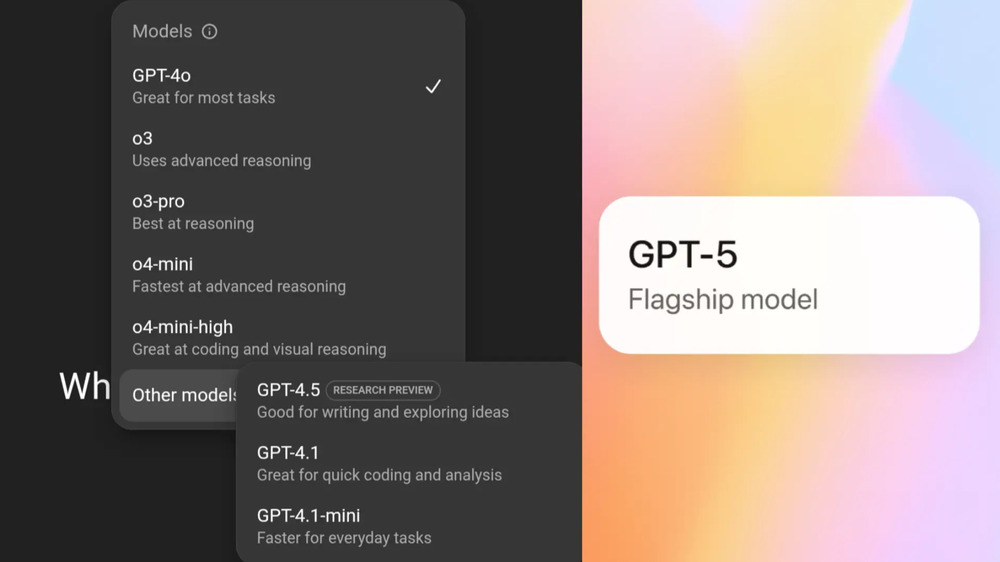
As researcher Mark Chen notes, “In the past, users had to trade off speed for depth. The new model eliminates that compromise – you can now control how long it thinks in order to get the best possible answer.”
For most users, GPT-5 will be the only available option in ChatGPT. However, the distinction between free and paid access remains. Subscribers on paid plans get higher usage limits with the full version of ChatGPT-5, while free users may be switched to a lightweight version after a certain number of requests.
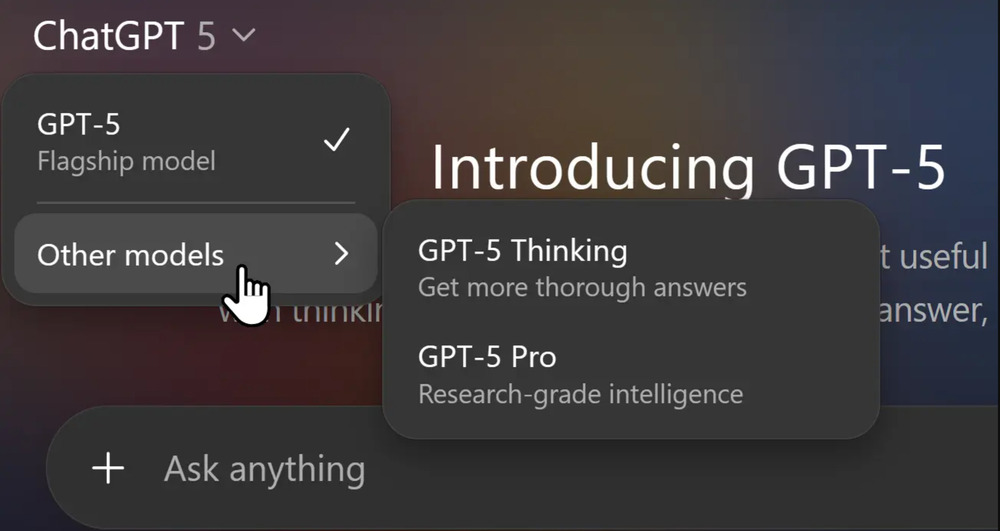
“For the first time, our best model is available to everyone, including users on the free tier,” said Renny Song. “Organizations will get access to the new model next week.”
Read also: Rare Earth Metal Situation: Whoever Controls the Resources, Rules the World
Comparison of ChatGPT-5 with competitors
With rumors swirling for over a month about OpenAI preparing to release its most advanced model yet, we now finally have some context for comparison. Competitors haven’t been idle: just ahead of ChatGPT-5’s debut, Anthropic introduced Claude Opus 4.1, and Google unveiled Gemini 2.5 Pro – complete with what they describe as a “stronger reasoning component” and clear signals of broader ambitions.
Comparing models at this level isn’t straightforward. Various benchmarks exist to measure performance, but even if an AI system performs well in one test, that doesn’t necessarily mean it will handle other types of tasks with the same level of competence.
During its presentation, OpenAI focused primarily on how ChatGPT-5 differs from its own earlier versions. But if we look beyond the internal comparisons and place it alongside competing models, it becomes clear: the race in the large language model space is tighter than ever. Success won’t hinge solely on speed or raw intelligence. The deciding factor may ultimately be how practical, intuitive, and useful these models are in everyday use.
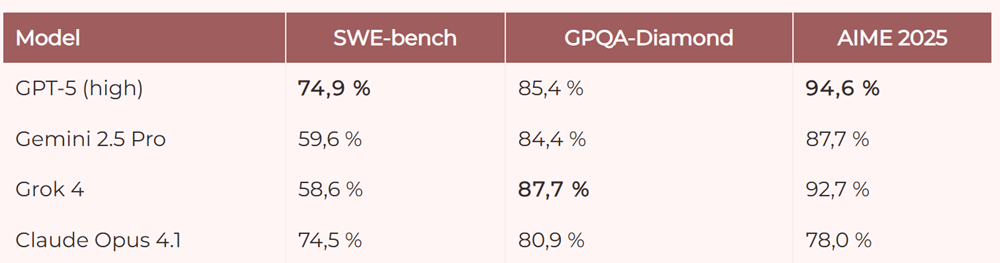
As expected, ChatGPT-5 delivered strong results in benchmark tests, though it didn’t secure first place in every category. The gap between leading models has narrowed to just a few percentage points, and choosing a “favorite” often comes down more to personal preference than raw numbers.
Still, the fact remains: ChatGPT-5 currently tops the rankings on LMArena, a platform where users directly compare and rate models. While these rankings are subjective, that subjectivity is part of what matters most. GPT-5 is already popular with a wide audience and appears poised to become the default choice for many users.
Read also: How to Spot Fake Photos: New Challenges of the Digital Age
Still can’t do without hallucinations
“ChatGPT-5 is unquestionably our most intelligent model,” said Max Schwarzer, a specialist in feedback-driven training, highlighting several key milestones where the new state-of-the-art (SOTA) reached global peak performance.
However, he acknowledged that test scores aren’t the full story – the model’s real-world behavior matters more. “Large language models have always struggled with what we call hallucinations,” Schwarzer explained. This refers to confidently presenting factual errors as truth, which limits their use in high-stakes scenarios. While GPT-5 hasn’t completely eliminated this issue, Schwarzer noted that the frequency of such errors has significantly decreased.
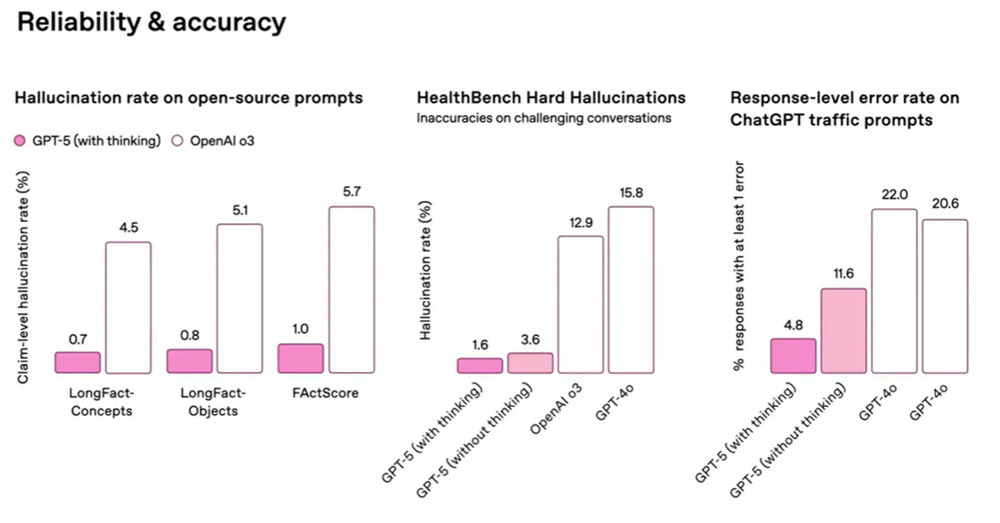
Sam Altman, somewhat unexpectedly, pointed out that ChatGPT has already become a source of health information for many users. Whereas the company previously took a very cautious approach to any responses that might resemble medical advice, the models now respond more openly to such queries – providing warnings but avoiding outright refusals.
ChatGPT-5 also introduces a new level of “awareness of impact.” Rather than shutting down sensitive topics outright, it attempts to consider the context and provide answers that aim to benefit the user while minimizing potential risks.
Read also: Cryptography: What It Is and How It Works
Amazingly competent programming
A significant part of the presentation was dedicated to live demonstrations – a bold move for any tech launch, but especially risky with generative AI. Since the model never produces identical responses twice and the complexity of tasks increases the chance of errors, there’s always a degree of unpredictability.
Still, the presenters didn’t hold back from putting ChatGPT-5 to unconventional tests. One participant asked it to create a game designed to teach his girlfriend French, based on a modified version of “Snake.” Another demonstrated how ChatGPT-5 generated an interactive financial dashboard from scratch, building it modularly like a constructor. The model also handled games and visual explanations of physical phenomena with ease. Greg Brockman, OpenAI’s president, openly expressed his enthusiasm after watching ChatGPT-5 create a complex 3D game in just a few minutes.
Notably, visually complex and unconventional projects often challenged the so-called “vibrational coding” approach – programming strictly through instructions without direct code editing. Despite this, ChatGPT-5 repeatedly demonstrated an ability to handle such tasks. Of course, these are still demonstrations, and the true test will come when users try these capabilities on their own.


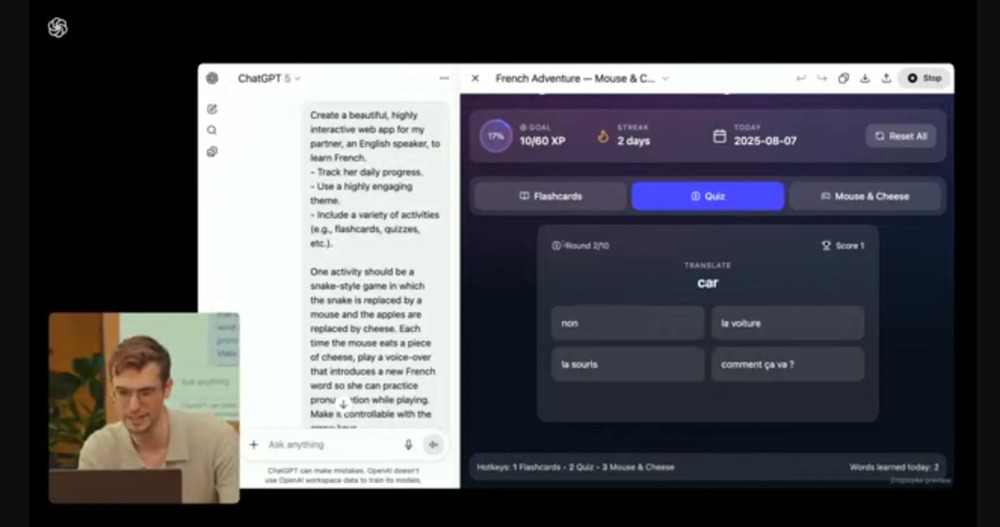

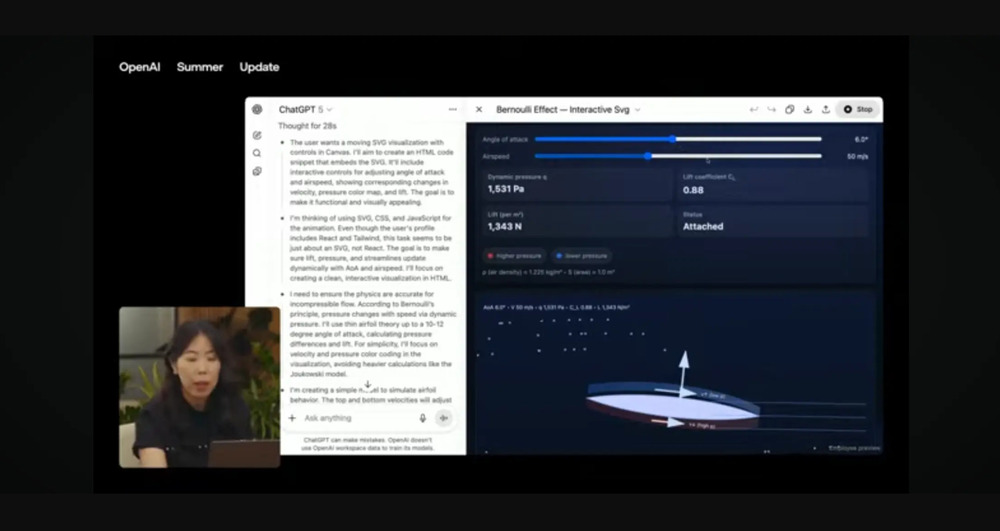
Early tests show that the model writes code quickly but isn’t error-free. Like its predecessors, it makes mistakes and doesn’t recognize them unless explicitly pointed out. For non-programmers, these capabilities may seem impressive, but professional developers tend to be more measured in their response. They understand that in practice, the speed of AI-generated code matters less than a developer’s ability to collaborate, maintain complex systems, read documentation, and test changes.
Michael Truell, head of programming tools at Cursor and one of the few presenters outside of OpenAI’s team, demonstrated that ChatGPT-5 can handle these practical challenges. He gave the model a real, unresolved problem from an open-source library and asked it to find a solution. The outcome impressed him:
“ChatGPT-5 is currently the best model for programming,” Truell said. “It’s fast, interactive, and capable of reasoning, planning, and explaining its steps. You can essentially have a dialogue with it instead of just letting it work blindly.”
Read also: How Chinese Companies Circumvent the US Ban on AI Chips
A personality tailored to each individual
Not everyone is interested in ChatGPT-5’s coding abilities, but the new features introduced with this model clearly target a broad user base. One key improvement is that ChatGPT-5 no longer pretends to know something when it doesn’t. If information is missing, the model can now – better than before – access external tools and search the internet.
Google users are likely to welcome this. Starting next week, ChatGPT will be able to integrate with Gmail and Google Calendar.
“This makes ChatGPT much more personalized and useful in everyday life,” says Christina Kaplan, who uses the chatbot to plan her marathon training.
Memory has also been improved. Previously, it worked somewhat inconsistently: ChatGPT would remember some user details, sometimes applying them appropriately, other times causing confusion. With GPT-5, this process has become smarter and more predictable.
There’s also good news for users communicating in languages other than English. GPT-5 not only supports multiple languages but can switch between them even mid-sentence. That said, a demonstration mixing English and Korean wasn’t flawless – the model seemed a bit confused and didn’t fully grasp the request.
Another update is the ability to customize the chatbot’s “personality” without complicated commands. Want it to be a strict mentor or, on the other hand, a playful friend with jokes and nicknames? A dedicated settings panel will now make this easier.
“You’ll be able to interact with ChatGPT in whatever style suits you best,” explains Mark Chen, head of research at OpenAI.
There is a nuance here. Sometimes what’s needed from a chatbot isn’t a friendly conversation but honest, even uncomfortable truth. It remains to be seen whether ChatGPT-5 can balance politeness with the kind of constructive criticism we value in people.
For those expecting “superintelligence” from the new model, some disappointment is likely. The real advantage of ChatGPT-5 for most users is that it’s now the smartest option readily available. You no longer have to guess if you’ve chosen the right model for your task. However, this still doesn’t answer the bigger question of what exactly users want from a chatbot – and even OpenAI admits they don’t have a clear answer to that yet.
“Our research is focused on understanding the capabilities of this technology and making it safe and useful for everyone,” summarized OpenAI’s chief scientist, Jakub Pachocki. “What you see today is just a glimpse of what’s to come. There’s still a lot of work ahead, but we hope our developments will prove genuinely valuable to users – and that we’ll continue to scale them.”
ChatGPT-5 represents a significant advancement in OpenAI’s product lineup – not just because of its scale or speed, but also due to its agent capabilities and planned integration with external tools.
Whether you’re a developer, founder, researcher, or simply interested in artificial intelligence, ChatGPT-5 is a model to watch in 2025.
Read also:
- OpenAI’s New Superpower: What Is a ChatGPT Agent?
- AI in Medicine: Is the Future Already Here?
- “Superintelligence” – Breakthrough or Marketing Hype? An Analysis
- ChatGPT Destroys the Competition: Era of Super Apps Has Arrived

