





© ROOT-NATION.com - Use of content is permitted with a backlink.
Have you ever wondered what protects your online data and who’s behind it? The answer is cryptography – it’s what keeps your passwords, messages, and banking transactions secure.
Operating silently in the background, cryptography continuously encrypts and decrypts streams of data – something we often take for granted. Though it rarely crosses our minds, it serves as a digital shield, defending against hacking attempts, data breaches, and online surveillance. But what exactly is happening under the hood?

Cryptography isn’t just a collection of complex algorithms and formulas – it’s the science of trust in the digital age. From traditional encryption techniques to cutting-edge protocols involving quantum cryptography, it forms the backbone of our online security.
So the next time you send a message or log in to your bank account, remember: somewhere deep in the system, cryptography is at work – quietly, reliably, and without compromise.
Read also: The Third World War of Browsers: Has It Already Begun?
TABLE OF CONTENTS:
What is cryptography?
Imagine you want to send a secret note to a friend – but not in front of everyone, of course. So you come up with a way to scramble the letters so that only the two of you can read it. That’s the basic idea behind cryptography: the art of hiding the meaning of messages from unintended eyes. It’s not magic, but a mathematical and linguistic puzzle built around codes and keys – one that has followed humanity for thousands of years.
Today, those notes aren’t written on paper – they travel through the internet. Whether you’re messaging someone, making an online purchase, or logging into your bank account, you’re relying on cryptography. It’s the invisible shield that protects your data as it moves from your device to a server and back again – all happening instantly and quietly in the background.
But cryptography didn’t start with the iPhone era – its roots go back to ancient times. The Greeks, for example, used a device called a scytale: a wooden cylinder wrapped in parchment containing encrypted text. Julius Caesar had his own method – a simple substitution cipher that shifted letters by a fixed number of positions in the alphabet. It’s now known as the Caesar cipher and considered a classic.
The real leap came in the 20th century with the introduction of the Enigma machine. For those unfamiliar, it was a German encryption device used during World War II. British mathematician Alan Turing and his team at Bletchley Park managed to break parts of its code – a breakthrough that historians believe shortened the war by several years. Once again, cryptography found itself at the center of world-changing events.

Modern cryptography has long moved beyond the idea of hiding secret notes. Its goal today is much broader: to provide comprehensive digital security. At its core, it relies on four key principles:
- Confidentiality – only the recipient can see the content.
- Integrity – the message is not altered en route.
- Authentication – you know that you are writing to someone you trust.
- Non-repudiation – the sender cannot say, ‘It wasn’t me.’
In the end, cryptography is the foundation of digital trust. It ensures that our conversations remain private, our data stays intact, and the person on the other end is who they claim to be.
But there’s another side to the story. Wherever cryptography exists, so does cryptanalysis – the study of breaking codes. If you think of the cryptographer as someone building a lock, the cryptanalyst is the one trying to open it without a key. Both fields are part of a broader discipline known as cryptology. And it’s in the constant push and pull between the two that real progress takes shape.
Read also: OpenAI’s New Superpower: What Is a ChatGPT Agent?
Types of cryptography
Cryptography comes in several forms, each responsible for a different aspect of digital security. At the core of it all are keys – the “secret codes” that control who can access the actual content of a message. Depending on how these keys are used, cryptography is generally divided into three main types: symmetric, asymmetric, and hash functions. Each serves a distinct purpose and acts as a specialized tool in the broader digital security toolkit.
Symmetric cryptography: one key for two
Imagine a simple diary with a lock, where both you and your friend have identical keys. That key is the only way to lock or unlock it. This is essentially how symmetric encryption works – the same key is used to both encrypt and decrypt the data.

For example, let’s say Alina wants to send a secret message to Viktor. They both share a common key – like a password. Alina encrypts the message using that key, and Viktor decrypts it using the same one.
Some well-known symmetric encryption algorithms include DES, Triple DES (3DES), and AES. Of these, AES is the current standard and is widely used in secure systems today.
One advantage of this type of cryptography is that it offers fast and efficient encryption, especially when dealing with large amounts of data. However, it also has drawbacks – most notably, the key must be securely shared in advance. This is a critical challenge, since losing the key or password can lead to permanent data loss.
Asymmetric cryptography: a pair of keys – public and private
In this case, the analogy is different. Imagine a mailbox that only the owner can open with their unique key, but anyone can drop a letter inside. This is how asymmetric encryption, or public-key cryptography, works.
Each user has two keys:
- a public key (which can be shared with anyone)
- and a private key (which is kept secret).
If Alina wants to send a message to Viktor, she encrypts it using Viktor’s public key. Only Viktor can decrypt it, as he alone holds the corresponding private key.

When you visit a website with a lock icon in the address bar (HTTPS), your browser and the server use asymmetric cryptography for the initial key exchange. After that, they switch to symmetric encryption to speed up data transfer.
This approach is often more convenient because there’s no need to share secret keys in advance. Asymmetric cryptography is also used for authentication and digital signatures. However, it tends to be slower and requires more computing resources compared to symmetric methods.
Hash functions: digital signatures of data
This one is straightforward. You have some data – like a password, document, or transaction – and you create a unique “fingerprint” of it. This process is called hashing, and the result is known as a hash.
The key characteristics of a hash are:
- It always has a fixed length, regardless of the size of the original data.
- Even a tiny change in the input data completely changes the hash.
- Most importantly, it’s a one-way process – you can’t reverse a hash to retrieve the original data. In other words, there’s no decryption.
For example, when you enter a password on a website, the system doesn’t store the password itself. Instead, it stores only the hash. When you log in, the system generates a new hash from the entered password and compares it to the stored one. If they match, you’re granted access.
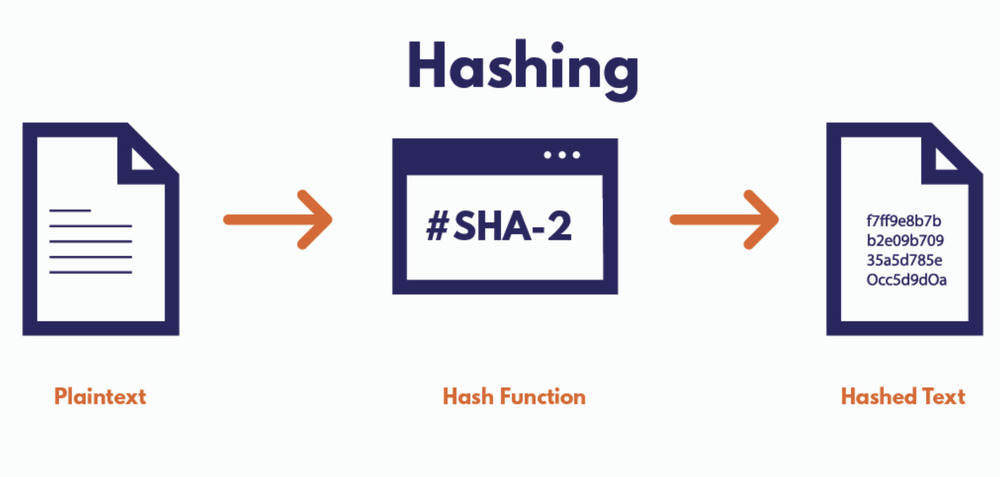
The most well-known hashing algorithms include SHA-256, which is widely used in blockchain technology, and MD5, an older and less secure option that is still sometimes used for file verification.
Hash functions play a key role in secure password storage, file integrity checks, digital signatures, and blockchain applications.
Ultimately, cryptography isn’t just about secrecy – it’s about building trust in the digital world. If you opt for symmetric encryption, the process is fast, but it requires careful management of the keys.
In contrast, with asymmetric cryptography, the exchange process is slower but offers greater reliability and security, especially over open networks.
Hash functions, meanwhile, provide integrity and protection where it’s important to verify the essence of data without revealing its content.
Three approaches, three pillars – one shield. Together, they form the foundation that keeps our digital world secure every day.
Read also: AI in Medicine: Is the Future Already Here?
How encryption works
Encryption is essentially the process of converting readable data, known as plaintext, into an unreadable format called ciphertext. Only someone with the correct key can reverse this process and make sense of the data again. This reverse process is called decryption.
Think of encryption like locking a message inside a safe. You need a key to lock it – and a key to unlock it. The key aspect is that depending on the type of encryption, it can be the same key (as in symmetric encryption) or two different keys – one to lock (public key) and another to unlock (private key), as seen in asymmetric encryption.
Imagine you’re shopping online. As soon as you visit a secure website, your browser and the server quickly “shake hands” – using asymmetric encryption to exchange a secret key. To keep things efficient, they then switch to symmetric encryption, which is much faster. This way, everything you enter – your card number, delivery address, passwords – is encrypted from end to end, preventing anyone from reading it along the way.
At first glance, it might seem like magic. But it’s really just precise math, tested algorithms, and protocols refined over years. The best part is, you don’t need to configure or understand any of it. It simply works – and that’s exactly how it should.
Cryptography protects us online every day – quietly, invisibly, but reliably. While it has become a part of everyday life, there’s still a lot ahead: post-quantum algorithms, new encryption methods, and the challenge of future supercomputers. For now, though, it remains the foundation of digital trust.
Read also: “Superintelligence” – Breakthrough or Marketing Hype? An Analysis
Where cryptography is used
Cryptography is everywhere in today’s information-driven world, operating quietly in the background.
Whenever your data is transmitted over the internet, you can be sure cryptography is at work. It doesn’t make headlines or demand your attention, but it provides the foundation for digital security – from simple logins to international bank transfers.
Secure connection: HTTPS, SSL, and TLS
When you see “https://” and a small lock icon in the address bar, it’s more than just a detail. Behind the scenes, cryptography is at work. SSL/TLS protocols encrypt the data you send and receive, preventing any network eavesdropper from seeing your information. Passwords, banking details, private messages – all of it passes through an encrypted tunnel.

End-to-end encryption in messengers
You’ve probably seen the phrase: “This chat is protected with end-to-end encryption.” But what does that mean in practice?
Only you and the person you’re messaging can read the messages. Even the app itself – whether it’s WhatsApp, Signal, or iMessage – doesn’t have access to the content, because the encryption keys are stored solely on your devices.

This means that even if someone gains access to the servers, it will be impossible to hack the correspondence.
Digital signatures and certificates
In a world where anyone can impersonate someone else with just a few clicks, it’s essential to verify that a message or file really comes from the claimed sender. That’s where digital signatures come in.
They allow recipients to confirm the authenticity of data and ensure it hasn’t been altered during transmission. Similarly, SSL certificates on websites guarantee that you’re not dealing with a fake or copy, but the genuine site.
Cryptocurrencies and blockchain – they wouldn’t exist without cryptography
Cryptography is more than just part of the word “cryptocurrency” – it’s fundamental to how they work. Public-key encryption is commonly used to sign transactions.
Hash functions, meanwhile, play a key role in creating each new block in the chain, ensuring that any attempt to alter data retroactively would require breaking the entire system.
Each transaction in Bitcoin, Ethereum, or any other cryptocurrency is a mathematically encrypted transfer with a clear and traceable history.
Cloud storage: Google Drive, Dropbox, OneDrive
When you upload a file to the cloud, it’s encrypted either on the client side or the server side. This means that even if an attacker gains access to the servers, all they’ll see is a set of encrypted characters. Without the key, the data remains inaccessible.
Some services, like MEGA, also offer end-to-end encryption, ensuring that even the service provider cannot read your files.
Secure authentication and 2FA
Your password is an example of cryptography in action. The system doesn’t store the password directly; instead, it stores a hash that’s checked when you log in. If you use two-factor authentication (2FA), each one-time code you receive is a cryptographically generated token – unique and valid for only a few seconds.
Banking operations, online payments, fintech
Cryptography is also widely used in banking. Every payment involves more than just pressing a button. Multiple layers of cryptography work behind the scenes, including:
- Encryption of transmitted data
- Digital signatures to verify transactions
- Card tokenization in systems like Apple Pay and Google Pay.
All of this is designed to prevent intermediaries or hackers from stealing your financial information or personal data.
Read also: Network-Centric Warfare: How Warfare Is Evolving in the 21st Century
Why do we need cryptography at all?
Primarily because we live online today. Shopping, banking, chatting with friends, medical records, smart locks, security cameras, electronic signatures – everything passes through the internet. Without cryptography, all this personal information would be as exposed as a postcard without an envelope.
Cryptography acts like a digital envelope, lock, and guard all in one. It protects passwords, card numbers, photos, messages, and business data – anything that shouldn’t fall into the hands of hackers, malicious actors, or unintended observers.

In short, cryptography builds the trust we need to operate in the digital world, quietly running in the background to ensure security, privacy, and reliability.
Cryptography isn’t just confined to government labs – it protects your messages, photos, passwords, files, and money every day. It’s like the air of the digital world: invisible but essential. Most users barely notice it, but without cryptography, no online service would be secure.
Read also:
- Online Safety: How to Protect Your Data – Even When You Let Your Guard Down
- Everything You Need to Know About NVIDIA DLSS 4.0 and Reflex 2: What They Offer and Why They Matter

