





© ROOT-NATION.com - Use of content is permitted with a backlink.
OpenAI has introduced the ChatGPT Agent – a tool that’s far more capable than a typical virtual assistant. It doesn’t just give smart answers or suggest a movie for the evening. This is a next-generation digital assistant that behaves as if it has access to its own computer, complete with a browser, installed apps, and endless patience.
At its core, the ChatGPT Agent combines the functionality of two earlier OpenAI experiments – Operator and Deep Research. But instead of just offering intelligent suggestions, it can now actually perform tasks online on your behalf. You no longer need to do the work manually – just give the command, and it handles the rest.

The new feature is built around a virtual computer equipped with a real web browser. It can perform typical user actions like clicking, scrolling pages, pressing buttons, filling out forms, and filtering results – without hesitation or interruption. In practical terms, this means you can give it instructions like, “Check my calendar, summarize everything into a briefing, and add the latest updates on clients,” or “Create a Japanese breakfast menu for four and order everything needed.” It handles these tasks directly, without back-and-forth or complications.
Read also:
TABLE OF CONTENTS:
What is ChatGPT Agent?
ChatGPT Agent brings together the strengths of three separate OpenAI systems – and not just for the sake of integration.
Operator gives it “hands” – the ability to click, browse websites, and fill out forms. But as an analyst, it’s limited. It tends to stay on the surface and quickly loses track when the task requires deeper understanding or goes beyond simple instructions.
Deep Research, on the other hand, was all brain and no hands. It could compare sources, read reports, write analytical summaries, and spot inconsistencies in lengthy documents. But interacting with the internet was like facing a door without a handle – it could see what was needed, but had no way to act on it.
ChatGPT provided natural language fluency and overall reasoning – a universal communication interface that understands both what you say and what you mean.
Agent isn’t just a combination of existing tools. It’s a system that can switch modes on the fly, deciding when to think, when to act, when to analyze, and when to simply stop and say: “Task complete.”
This marks a fundamental shift. It’s no longer about issuing single-use prompts and getting one-off answers. Instead, you initiate a process. The Agent determines the route, the pace, and the tools to use. Your role is to define the goal.
Read also: Network-Centric Warfare: How Warfare Is Evolving in the 21st Century
Technological heart of the new agent
At the core of ChatGPT Agent is a specialized AI model called the Computer-Using Agent (CUA). It combines the visual capabilities of GPT-4o with enhanced decision-making skills powered by reinforcement learning. In simple terms, this assistant doesn’t just “see” the screen – it understands what’s happening on it. Buttons, menus, text fields – these aren’t just images, but an interactive environment where it can take meaningful action.
The Agent analyzes screen captures and behaves much like a real user sitting at the computer – clicking with the mouse, typing on the keyboard, filling out forms, and scrolling through pages. If something goes wrong – say, a site freezes or a “Skip” button disappears – it doesn’t crash or freeze up. Instead, it tries to reassess the situation and adjust its behavior accordingly. And if the issue turns out to be unsolvable, it simply hands control back to you – no fuss, no errors.
Read also: ChatGPT Destroys the Competition: Era of Super Apps Has Arrived
Deep Research – when AI becomes an analyst
In-depth research is the second key pillar supporting this digital workhorse. This comes from Deep Research – a more advanced tool that allows ChatGPT not just to run web searches, but to independently dig through online sources, analyze large volumes of information, and produce detailed analytical reports. The results can be thorough enough to give even human experts a moment of pause.
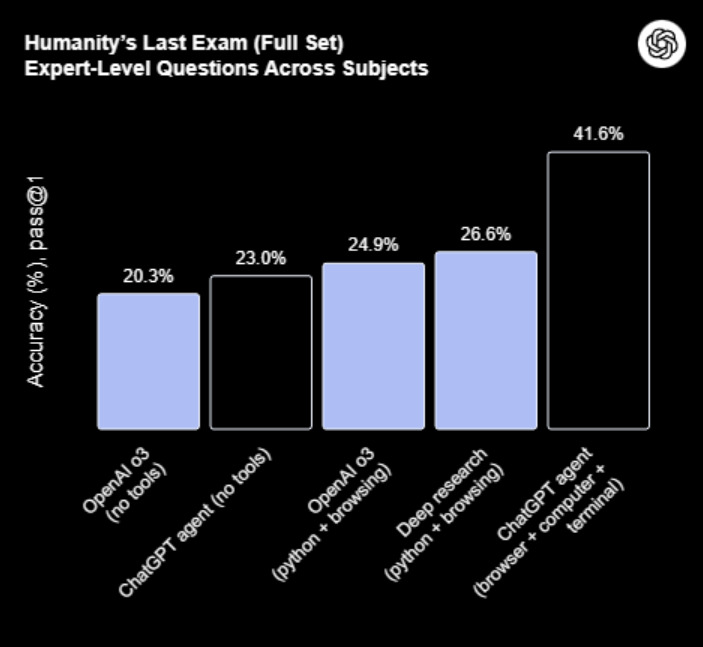
At its core is a specialized version of the o3 model, designed for browsing websites, processing complex information, and performing a kind of digital deduction across diverse data. Deep Research can interpret text, images, and PDF files – and, importantly, it works without constant input. It operates independently, typically completing tasks within 5 to 30 minutes, logging its progress along the way, and pulling in external citations where needed – just as you’d expect from a proper research assistant.
According to OpenAI, the agent can complete tasks in a matter of minutes that would typically take an average user half a day, along with a coffee break and some frustration. In benchmark tests called Humanity’s Last Exam, it scored 26.6% – almost three times higher than its competitor DeepSeek, which managed only 9.4%. These numbers indicate that artificial intelligence is no longer just catching up to humans; it’s surpassing them decisively.
Read also: Gabe Newell’s Starfish Neuroscience Сhallenges Neuralink
Safety comes first
OpenAI has acknowledged that highly capable agents can be both useful and potentially risky. To address this, ChatGPT Agent includes safeguards designed to prevent it from causing unintended issues – like accidentally initiating a loan application or triggering unwanted actions. The system features control mechanisms that block potentially sensitive or inappropriate tasks. If a request involves confidential information, the agent politely pauses and asks for confirmation. When it comes to financial matters, it generally refuses to proceed, recognizing that money-related actions require caution and discretion beyond AI’s scope.
The user remains firmly in control throughout. At any time, they can hit “stop,” take over the browser manually, or halt the agent’s actions. This is especially useful during authentication processes, where the system politely prompts the user to enter login credentials themselves rather than attempting to solve captchas or impersonate a banking client.
Read also: Online Safety: How to Protect Your Data – Even When You Let Your Guard Down
Availability and restrictions
Currently, ChatGPT Agent is not available to all users. The feature is limited to subscribers of the Pro, Plus, and Team plans. Pro users receive up to 400 agent interactions per month, while Plus and Team subscribers get 40 interactions, with the option to purchase additional credits through a flexible credit system. In other words, AI now comes with its own pricing tiers and credits – raising the possibility that more complex services, like mortgages, might follow in the future.
To activate the agent, simply select the corresponding mode in the ChatGPT tools menu. It’s straightforward – just make sure you have available credits. For other users, OpenAI has announced that Agent will soon be accessible to enterprise customers under the Enterprise plan, as well as to educational institutions through the Education plan. So, either pay up or wait it out like most students do.
Read also: When AI Nudges Toward Death: The Illusion of a Safe ChatGPT
Practical application in the real world
ChatGPT Agent introduces a new level of automation for everyday tasks. It goes beyond being a simple assistant to act as a digital worker that can handle booking restaurant tables, planning trips, comparing competitor prices, selecting ingredients for specific recipes, or even assisting with major life projects like organizing a wedding.
In a demonstration video, OpenAI showed how the Agent assists users by searching for outfits that fit a dress code, suggesting five hotels with options for early check-in, managing logistics, and reminding users of details people typically only think about on the wedding day itself. All of this happens without stress or the need for complex spreadsheets. Companies like Instacart have already integrated with the Agent, allowing users to order groceries by voice instead of clicks – convenient when you’re hungry and only have energy left to say “dumplings.”
Kevin Weil, OpenAI’s Chief Product Officer, has called 2025 a “turning point” for the company – and with good reason. ChatGPT is evolving from a simple source of answers into a practical tool that actually gets work done. This shift isn’t experimental; it’s a strategic direction. Sam Altman frequently emphasizes that agents are key to OpenAI’s future. To make this vision widely accessible, the company is developing the OpenAI Agents SDK – a toolkit that will enable third-party developers to build their own agents for a wide range of tasks, from ordering pizza to managing smart cities.
Read also: Everything You Need to Know About Dolby Atmos FlexConnect Wireless Technology
Limitations of the current version
Despite its advanced capabilities, ChatGPT Agent is still far from being an infallible digital assistant. OpenAI openly acknowledges that the agent can sometimes “hallucinate” facts or draw incorrect conclusions during Deep Research. In other words, you might request an analysis and receive a convincing but fabricated story sourced from the internet. These instances occur less frequently than with earlier models, but the issue hasn’t been fully resolved.

The agent also sometimes struggles to distinguish authoritative sources from forums where expertise is measured by the number of exclamation marks. Its confidence levels don’t always translate accurately – what should be a “maybe” can come across as “definitely,” and vice versa. There are also some current limitations: the “Tasks” feature allows no more than 10 active processes running at the same time. It doesn’t yet support file handling or voice input – interaction is limited to text and keyboard, so no voice conversations in the kitchen just yet.
Despite these limitations, ChatGPT Agent represents a clear step toward the future. AI is moving beyond being a passive advisor to becoming an active executor capable of handling real tasks. The key question now is whether we’re ready to delegate part of the control over our digital lives. Early reactions suggest that people are gradually loosening their grip on the wheel and beginning to enjoy the ride. And, as it often goes, this is just the beginning.
Read also:
- ERNIE Bot: What’s Behind China’s AI Success
- Everything You Need to Know About NVIDIA DLSS 4.0 and Reflex 2: What They Offer and Why They Matter
- AI Hallucinations: What They Are and Why They Matter

