




© ROOT-NATION.com - Use of content is permitted with a backlink.
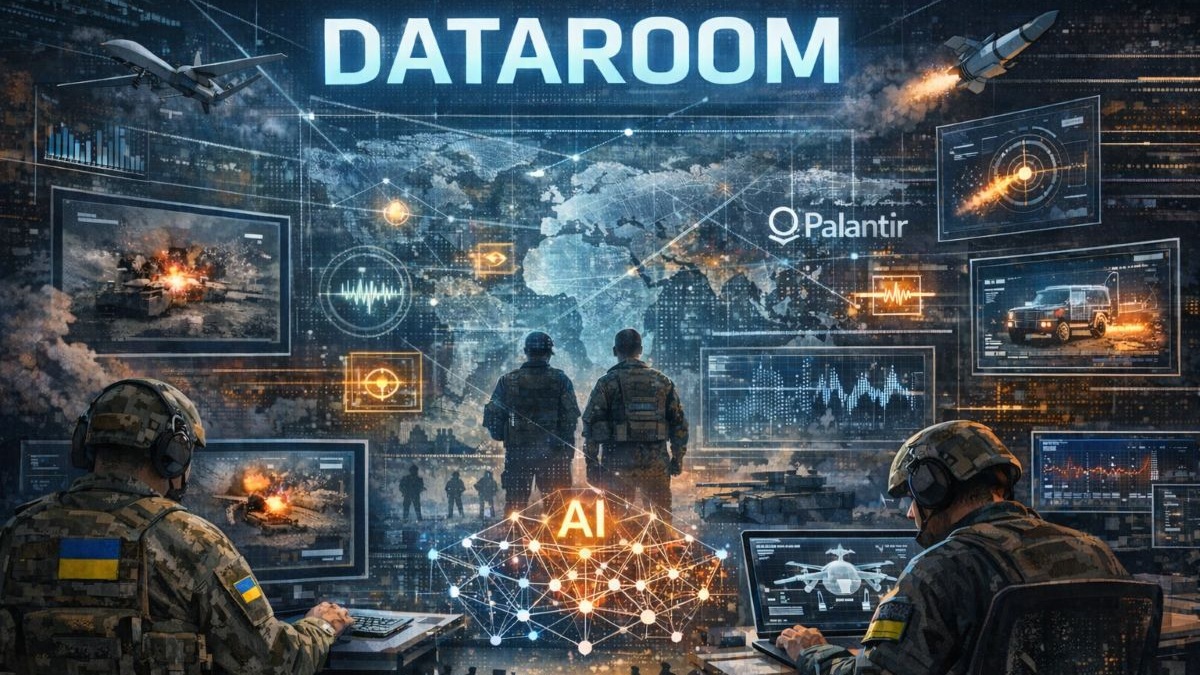
Modern warfare increasingly resembles a competition of algorithms, sensors, and data-processing speed rather than a traditional clash of armies. In this context, the decisive resources are not only missiles or drones but also high-quality combat data and the ability to turn it into actionable solutions. It is at this intersection that the Dataroom project has emerged, developed in collaboration between Ukraine and the U.S. company Palantir Technologies.
Dataroom is not just another database or an abstract “cloud.” It is a secure digital environment where defense developers gain access to real wartime data and tools for training, testing, and validating artificial intelligence models. Essentially, it provides the infrastructure to transform chaotic combat experience into a systematic technological advantage.
TABLE OF CONTENTS:
From Chaos to System
Over the course of the full-scale war, Ukraine has accumulated an unprecedented volume of data, both in scale and operational value, with few parallels in modern military history. This is not merely large amounts of information – it consists of data collected in a real, intense, high-tech conflict, where the adversary constantly changes tactics, employs electronic warfare, camouflage, and asymmetric approaches.
Read also: Weapons of Ukraine’s Victory: Tempest Air Defense System with AGM-114L Longbow Hellfire Missiles
This dataset includes thousands of hours of video from reconnaissance and strike drones, recorded under a wide range of conditions – day and night, fog, rain, snow, as well as under signal interference and loss. It also contains thermal and infrared imagery that captures targets not by shape but by heat signature, enabling the detection of vehicles, personnel, and drones even in complete darkness. Of particular value are radar datasets, which record air target flight trajectories, signal reflection characteristics, and the response of surveillance systems to low-observable objects.

This picture is further complemented by acoustic signatures – distinct sound “fingerprints” of drone engines, missiles, and artillery fire, which can be used for passive threat detection. Another important component is flight telemetry, including speed, altitude, maneuvers, and engine and navigation system operating modes, allowing real-world behavior of aerial platforms to be reconstructed. A separate and significant layer consists of data on air defense and electronic warfare systems, covering detection events, system responses, successful and failed intercepts, and the effects of jamming and coverage gaps.
Under normal conditions, however, even such a valuable resource has a critical limitation: it remains fragmented. The data is scattered across different units, agencies, storage media, and formats. Some of it exists as raw files, some as reports, while another portion survives only as a byproduct of combat operations. Much of it is not standardized, not synchronized in time or space, and largely unsuitable for systematic use without extensive preprocessing. As a result, a vast body of combat experience risks remaining isolated within individual units rather than serving as a foundation for broader technological advancement.

This is the core problem that Dataroom is designed to address. The platform takes on the task of organizing, standardizing, and securely integrating combat data into a single, controlled environment. It turns fragmented information into a structured resource suitable for analysis, modeling, and AI training. Crucially, this is not just about storage, but about contextualization – linking data to specific scenarios, conditions, threat types, and the outcomes of combat episodes.
At the same time, Dataroom is built around a strict access-control model. Sensitive military information does not leave the secure environment, is not copied in an uncontrolled manner, and is not exposed to unnecessary risk of compromise. At the same time, the data is not locked away or inert – it is actively used. Developers can work with it to train computer vision algorithms, improve target recognition, analyze trajectories, predict adversary behavior, and optimize the performance of defensive systems.
Dataroom performs a critically important function. It converts the chaos of combat into a structured digital framework and turns accumulated wartime experience into a foundation for developing effective AI solutions. This is the point at which data stops being merely an archive of past events and becomes a practical tool for shaping future military capabilities.
Read also: All About Proteus: Self-Contained Helicopter with Potential Implications for Future of Aviation
Who Created Dataroom and Why
The Dataroom project is being implemented as a complex, multi-layered initiative that brings together the interests of the state, the military, and the private technology sector. A central coordinating role in this process is played by Ukraine’s defense cluster Brave1, an organization specifically established to connect frontline needs with the capabilities of engineers, startups, and industrial manufacturers. Brave1 defines the framework for cooperation, sets priority areas, and manages developer access to sensitive technologies and data.

Alongside the cluster, the project involves relevant government bodies responsible for security policy, digital transformation, and information protection. They provide the regulatory framework, oversee access control, and ensure the platform complies with military secrecy requirements. Within this architecture, the Armed Forces of Ukraine are not an abstract “end user,” but the direct source of combat experience, operational scenarios, and data that give Dataroom its practical value. It is the frontline that determines which data is critical and which algorithms have the greatest real-world impact.
Palantir Technologies plays a role in this system that differs fundamentally from the traditional model of defense contracting. The company does not own Ukrainian combat data and does not control how it is used. Instead, Palantir acts as a provider of the technological platform, data-processing tools, and expertise in working with large, complex, and highly sensitive datasets. This reflects the company’s long-standing experience in building systems that can integrate disparate data sources, operate in near real time, and enforce strict access controls.
This distinction is critical. Dataroom is not an “outsourcing of war” or a transfer of key functions to an external contractor. Rather, it illustrates how a state can use Western technologies to develop its own defense ecosystem while retaining sovereignty over data, decisions, and priorities. In this model, Ukraine is not a passive customer but the system’s primary architect, shaping a platform designed to serve its own security interests.
Read also: Weapons of Ukraine’s Victory: Tempest Air Defense System with AGM-114L Longbow Hellfire Missiles
What Happens Inside the Platform
The internal logic of Dataroom is built around aggregating and integrating different types of combat data into a single, controlled environment. The platform consolidates visual inputs from unmanned aerial vehicles and ground-based sensors, including video and imagery captured from varying altitudes, angles, and visibility conditions. These datasets reflect the real dynamics of the battlefield rather than idealized training scenarios.

Thermal and infrared imagery play a significant role, enabling the detection of objects based on their heat signatures. These data are particularly relevant for identifying vehicles, personnel, and drones at night or under conditions of concealment. A separate category includes information on aerial targets, such as various types of strike drones, their trajectories, characteristic behaviors, and responses of detection systems.
In addition to raw sensor data, the Dataroom contains segments of real operational scenarios. These are structured episodes that can be reproduced in a simulated environment, with adjustable parameters to analyze alternative developments. This approach allows not only the examination of past events but also the modeling of potential future threats, evaluating how algorithms might perform under different conditions.
Data serve as the foundation for military AI systems
These datasets are used as a training environment for modern AI solutions. Based on them, computer vision models are trained to automatically identify targets in videos and images, distinguishing actual threats from background noise or false positives. Algorithms are developed to recognize both aerial and ground objects, taking into account not only their shapes but also behavioral patterns.

In parallel, the Dataroom serves as a basis for decision support systems that assist operators and commanders in assessing situations more quickly and selecting appropriate courses of action. In more advanced applications, the same data are used to develop elements of autonomous weapons systems, where artificial intelligence assumes part of the functions related to detection, tracking, and response.
Overall, the Dataroom functions as an infrastructural hub that brings together operational experience, state oversight, and advanced Western technologies. It is not a standalone product or a temporary solution, but rather a foundation for the long-term development of Ukrainian defense AI systems designed to adapt to a continuously evolving conflict.
Read also: Weapons of Ukraine’s Victory: 1KR1 “Sapsan” Operational-Tactical Missile System
Not an experiment, but an applied system
The key difference between the Dataroom and academic or commercial AI platforms lies in the absence of controlled laboratory conditions in which algorithms achieve optimal results only on carefully curated datasets. The Dataroom operates under a different set of assumptions shaped by wartime conditions, where data are often incomplete, inconsistent, noisy, and collected under continuous pressure on sensors, communication channels, and human operators. As a result, the platform functions not as a testbed, but as a reality filter that systematically eliminates solutions that perform well in theory but fail under real-world constraints.

AI models in the Dataroom are tested on “dirty” operational data: video with missing frames, low-resolution images, thermal streams with high noise levels, fragmented telemetry, and radar signals distorted by interference. The algorithm receives no allowances – it either performs or fails. These conditions reveal whether a model can reliably identify targets in fog, rain, or smoke, maintain functionality under unstable communications, resist disruptions from electronic warfare, and adapt to constantly changing tactical scenarios.
Unlike training datasets where objects are clearly labeled and repetitive, the Dataroom exposes algorithms to the inherent uncertainty of real combat environments. Targets may be partially obscured, camouflaged, moving along non-standard trajectories, or deliberately mimicking other objects. Under such conditions, it becomes evident whether a model functions merely as a statistical classifier or whether it can reason in terms of context, behavior, and threat probability.
Equally important is that the Dataroom does not impose predefined solutions on developers. Engineers can upload their own AI models and evaluate them directly on real operational data. This makes it possible to assess not abstract metrics presented in reports, but practical indicators such as detection accuracy, false positive rates, response time under constraints of limited time and computational resources, and the algorithm’s robustness to errors and atypical situations.
Testing within the Dataroom takes the form of a continuous refinement cycle. Models that fail under load are returned for additional training or architectural changes. Algorithms that demonstrate acceptable performance proceed to further validation under more demanding scenarios. As a result, deployment favors not models that are theoretically optimal, but those that have demonstrated effectiveness under real-world conditions.
For this reason, the Dataroom becomes a critical tool: it shifts the development of military AI from a theoretical exercise to an engineering discipline, where each line of code is evaluated against the realities of war. Only algorithms that withstand this process have the potential to be integrated into operational systems.
Read also: Weapons of Ukraine’s Victory: Terrahawk Paladin Anti-Aircraft Artillery System
Security as a foundation
A distinct and fundamentally important aspect of the Dataroom is data access, which determines whether the platform can be simultaneously useful for developers and secure for the state. In military contexts, this is always a delicate balance: excessive restrictions can stifle innovation, while excessive openness creates the risk of leaking critical information. The Dataroom is designed to avoid both extremes.
The platform implements a multi-layered security approach, where access to data is granted not “in general,” but strictly according to the specific task, role, and usage context. Each developer or team receives only the information necessary to work on a particular algorithm or functionality. This may include specific types of sensor data, limited time segments, or specially prepared scenarios without extraneous details irrelevant to the task.


This approach minimizes the risk of compromise: no participant sees the “full picture” of operations unless their role justifies it. At the same time, developers are not confined to an artificially restricted environment – they work with real operational data, but within clearly defined boundaries. This preserves the practical value of their work without compromising security.
Equally important, control in the Dataroom is not purely administrative. It does not rely on manual approvals or endless authorizations, but on technologically integrated mechanisms for access control, action logging, and data usage tracking. Every interaction with the information – viewing, processing, or model testing – occurs within a controlled environment and leaves a digital trace. This establishes a fundamentally different level of accountability and transparency.
The Dataroom establishes a new model of interaction between the state and private developers in the defense sector. In this model, trust is not based solely on declarations or formal obligations but is reinforced by technology for control and risk management. The state retains oversight of critical data, while developers are provided with an environment in which they can create and test operational solutions rather than simulations of innovation.
The Dataroom demonstrates that security and development speed are not mutually exclusive. With a properly designed architecture, they become mutually reinforcing elements, enabling the advancement of defense technologies without compromising control over the most valuable resource in a conflict: data.
Read also: Hermione – France’s hydrogen fuel-cell robotic complex explained
Strategic significance
The Dataroom is more than a tool for addressing immediate wartime needs or a digital data processing service. It represents a long-term investment in the future defense architecture, where the decisive factors are not the number of platforms or munitions, but the speed of decision-making and the ability of systems to adapt faster than the adversary.
Within this architecture, decisions are made proactively, before a threat becomes apparent to human operators. Algorithms analyze data streams in near real-time, identifying anomalies, patterns, and weak signals that would be impossible for a person to detect amid informational noise. This shifts the logic of defense from reactive to proactive, enabling the system not only to respond to an attack but also to anticipate its parameters.

Equally important is the ability of such systems to rapidly adapt to new types of enemy weapons and tactics. In environments where offensive capabilities evolve faster than conventional military doctrines are updated, AI solutions become a critical instrument of operational flexibility. The Dataroom supports this adaptability by enabling models to be updated, algorithms retrained, and performance tested on new scenarios almost in real time, without multi-year development cycles.
In this context, Ukraine is undergoing a fundamental transformation. It is shifting from being a passive consumer of foreign military technologies to becoming an active producer of operational AI solutions, tailored to its own needs and validated under the most demanding conditions of modern conflict. These are not experimental prototypes or “future concepts,” but tools shaped directly by frontline experience.
Read also: Weapons of Ukrainian Victory: The Robotic KRAMPUS System
War as a technology catalyst
The Dataroom project clearly illustrates a fundamental shift in the logic of modern warfare. Victory no longer depends solely on the quantity of equipment or munitions, but on who can most quickly and accurately translate combat experience into algorithms, models, and operational systems. Warfare is no longer just a contest between armies; it becomes a competition of engineering approaches and the pace of digital evolution.

In this new reality, data become a fully fledged instrument of warfare. They determine how early a threat is detected, how accurately a target is identified, and how effective the response will be. Platforms such as the Dataroom effectively function as production environments for this capability – places where raw combat experience is processed, structured, and transformed into practical AI solutions.
Ukraine, having been forced to the forefront of a global conflict, has also found itself at the forefront of military AI development. This is a difficult and costly position, but one that creates a distinct technological advantage. The Dataroom is one of the clearest examples of how this advantage is built not through statements or strategies on paper, but through real digital wartime infrastructure, where every algorithm is tested against reality and every byte of data contributes to operational outcomes.
Read also:
- Top 10 Smart TVs
- How and Why Brands Collaborate with Film
- Nine of the Strangest and Most Mysterious Weapons

