





© ROOT-NATION.com - Use of content is permitted with a backlink.
On September 4, 2026, Microsoft unveiled Project Zenith – and judging by the initial reactions, it is one of the company’s most controversial initiatives in recent years. On the one hand, there is a promise to put an end to the long-standing ritual of “cleaning up” a new Windows PC. On the other, there are strict hardware requirements, no pricing or shipping timeline, and early critics arguing that Microsoft is once again “not reading the room.”
TABLE OF CONTENTS:
The Problem Everyone Knows but Nobody Likes
The story is so old that it has become a meme among developers: you buy a new Windows laptop, turn it on – and spend the next few hours uninstalling preinstalled apps, disabling unnecessary services, installing a terminal, setting up development environments, and fighting with Search, which occasionally manages to lose track of Windows’ own system files.
The reason is not any malicious intent on Microsoft’s part, but rather the very nature of Windows – an operating system that simultaneously tries to serve gamers, office workers, schools, older users, and corporations. When a product has to satisfy everyone, it rarely ends up being truly great for any one group.
Read also: AI Has the Right to Steal – and the U.S. Government Supports It
What Zenith Offers
Project Zenith is not a new version of Windows, but a specialized, preconfigured system setup for “developer” devices. Windows Platform Vice President Logan Ayer described the project’s goal as creating an environment that is ready to work out of the box, without requiring developers to go through the familiar setup ritual.

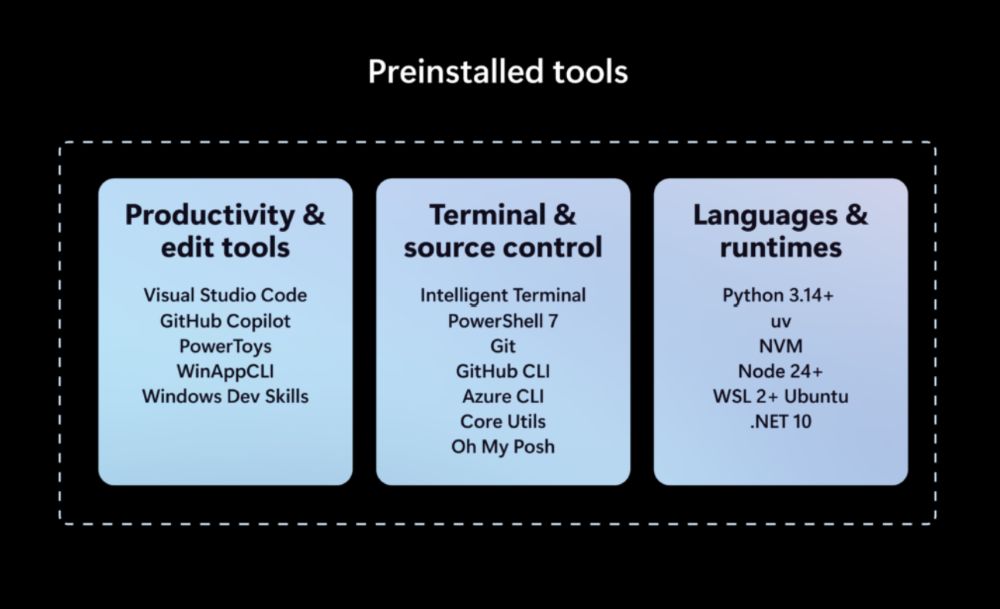
In practice, this means that File Explorer immediately shows file extensions and hidden items, long path support is enabled, and sync prompts and “recent files” are disabled. The Command Palette in Search and Start is enabled by default, while promotional suggestions and account notifications are turned off. The package includes Windows Terminal, Visual Studio Code, GitHub Copilot, PowerToys, and other tools that developers would normally install themselves – the Terminal and VS Code are even pinned to the taskbar.
Read also: OpenAI’s Astra: When an Algorithm Reaches What Took Mathematicians Decades to Achieve
The Price of Being “Code-Ready” Is Hardware, Not Money
The most revealing detail about the project is its hardware requirements. A minimum of 64 GB of unified memory and more than 250 GB/s of memory bandwidth are specifications that, just a few years ago, were associated more with servers than personal computers. According to Microsoft, these capabilities make it possible to run language models with more than 30 billion parameters locally – without the cloud, external data transfers, or latency. In effect, a developer’s workstation becomes a compact AI server capable of handling tasks that until recently required dedicated graphics accelerators costing thousands of dollars.
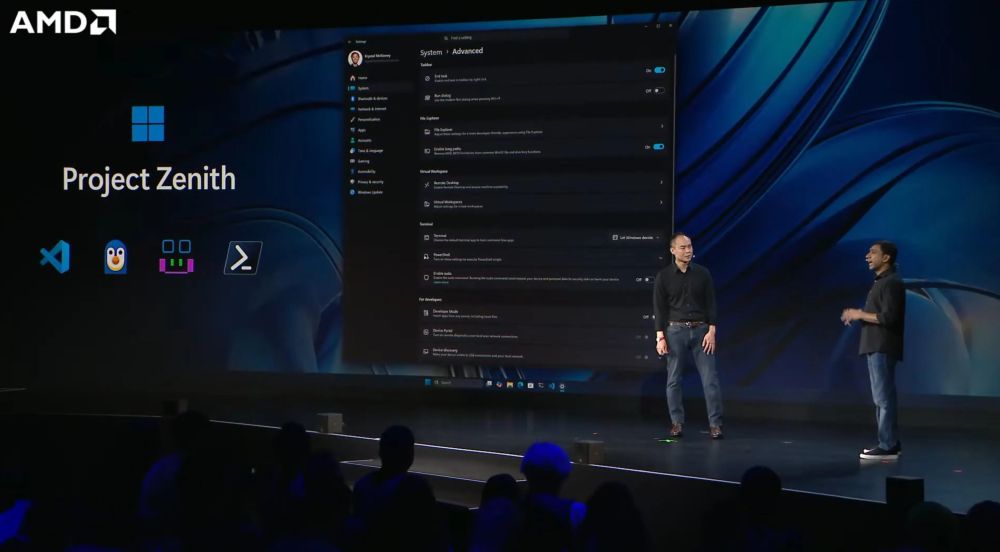
The first Zenith devices will be based on the AMD Ryzen AI Halo platform – a new class of mini-desktops designed for local AI computing. AMD has already showcased the first such device at IFA. In terms of specifications, AMD’s platform actually exceeds Microsoft’s minimum requirements, offering up to 128 GB of unified LPDDR5x memory and 256 GB/s of memory bandwidth. Other manufacturers are expected to join the initiative in the coming months, with devices based on Nvidia RTX Spark chips reportedly likely to be the next step, although Microsoft has yet to officially name its partners.
However, it is important to understand the limits of the announcement: on September 4, Microsoft did not announce pricing, a specific sales launch date, or a complete list of devices. Zenith is better understood as a specification and user experience concept than as a commercial product that can be ordered today.
Read also: Mysterious Update Without Icon in Google Play: What Is Android Pulse?
WSL and Agent Security – The Foundation, Not an App
Microsoft emphasizes that WSL (Windows Subsystem for Linux) has become the foundation of development work on Windows: last year, it became fully open source, and at the 2026 Build conference, the company introduced WSL containers – a native way to run Linux containers directly on Windows. Zenith makes full use of these capabilities.
Particular attention is paid to AI agent security – a topic that is becoming increasingly relevant as agentic applications gain wider adoption. Zenith will rely on Microsoft Execution Containers (MXC), an agent isolation mechanism designed to control their access to resources, along with OS-provided identity and enterprise-grade management. However, according to some reports, MXC is still in the early preview stage, and Microsoft itself warns that generated policies may be overly permissive and that current MXC profiles should not be treated as a complete security perimeter.
Read also: Next-Generation Flying Radar: Everything You Need to Know About GlobalEye
Not Everyone Is Impressed
The announcement has not been met with universal enthusiasm. Reviewers at Thurrott called the situation yet another example of Microsoft “not reading the room.” In their view, developers do not need a preconfigured version of Windows, because everyone has their own preferences when it comes to system configuration, and the owner of such a PC would still spend several hours “rolling back” some of Zenith’s default settings to suit their needs. It is a fair criticism: the “smart defaults” that work for one developer may feel like “unnecessary interference” to another.
What It Really Means
If we set the marketing rhetoric aside, Project Zenith is Microsoft’s attempt to solve two problems at once. The first is reputational: to show that the company listens to developers rather than simply monetizing their attention through Bing, Copilot, or MSN. The second is entirely pragmatic: to lay the hardware and software groundwork for a new token economy, in which some AI workloads move from the expensive cloud to the local device.
Whether the idea will work will be up to the market to decide – once the first devices go on sale at a specific price and developers can test in practice whether the system is really as stable, predictable, and fast as Microsoft promises. But the direction itself – less marketing noise, more technical substance, and more control in the user’s hands – is exactly where Windows should have been heading for a long time if it wants to regain the trust of an audience that is increasingly looking toward macOS and Linux.
Read also: How to Keep Your Child Safe Online: A Parent’s Guide

