





© ROOT-NATION.com - Use of content is permitted with a backlink.
The stable version of Windows ML from Microsoft is ready to support local AI development. Here’s a closer look at what it offers.
Read also: Instructions, Guides, How To for Windows
TABLE OF CONTENTS:
Windows ML is back
After months of testing, Microsoft has taken a significant step forward. The release of Windows App SDK 1.8.1 marks not just another update, but the launch of a stable version of Windows ML with a full API for working with local AI models. For the average user, this may seem like a technical detail, but for developers, it signals a new era – one in which AI is no longer confined to the cloud and can run directly on personal computers.

This move is no accident. Microsoft has been steadily building an ecosystem around the Copilot+ PC concept, and it’s now clear why the company has been pushing it so strongly. Integrating local AI capabilities means lower latency, greater data privacy, and more room for custom solutions. Essentially, developers now have the “keys” to local AI, which could significantly shift the balance between cloud services and on-device computing in the Windows ecosystem.
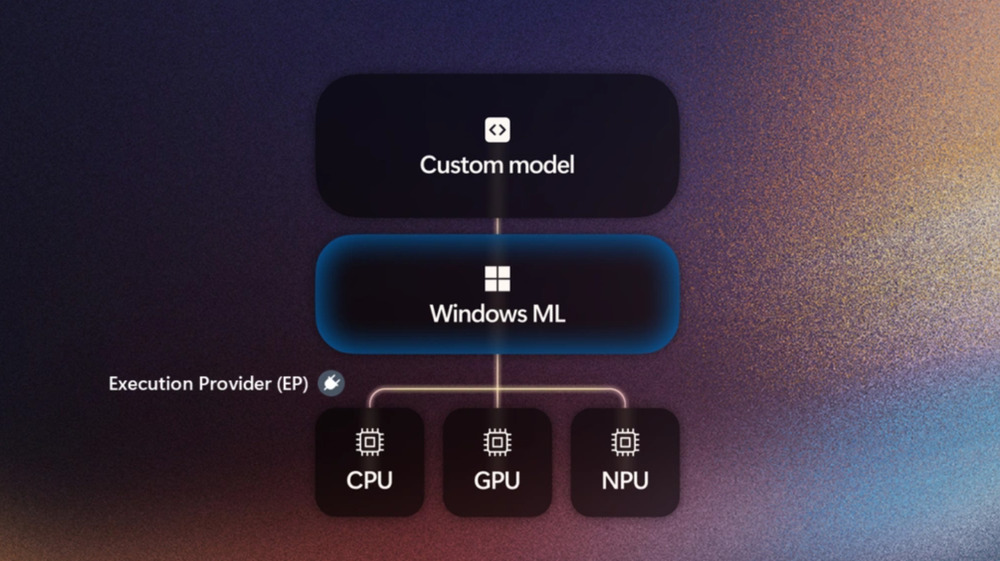
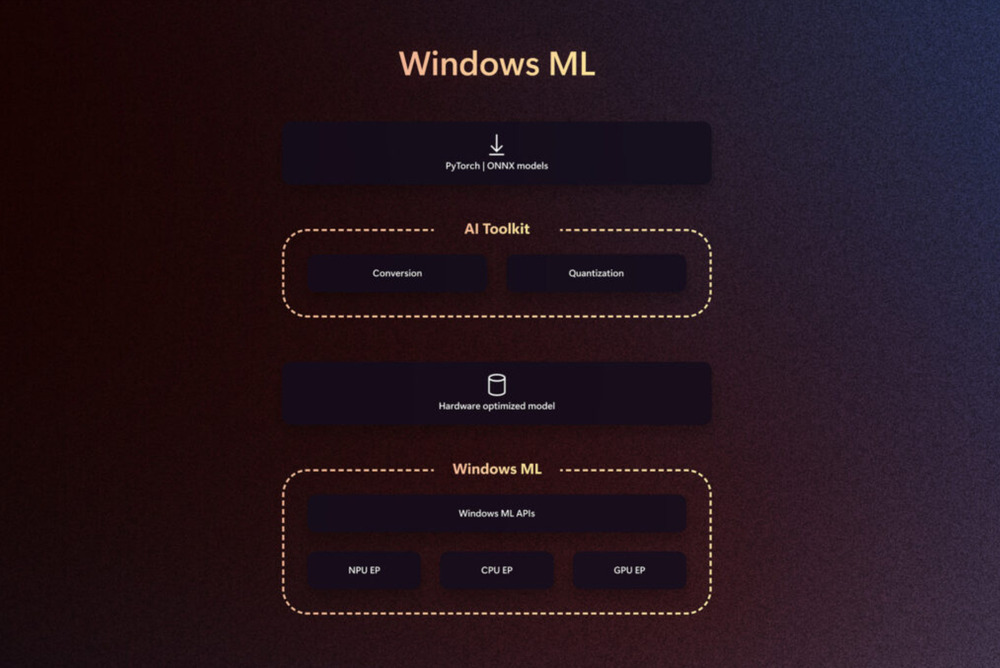
Windows ML is a high-performance runtime for local AI, integrated directly into the operating system. Its main advantage lies in its versatility and transparency for developers. The system automatically detects available hardware – whether CPU, GPU, or neural processing unit (NPU) – and selects the optimal path for each task. This eliminates the need for developers to manually optimize applications for specific hardware architectures, as the workload distribution mechanism automatically balances performance and energy efficiency.
Another key component is the use of the ONNX Runtime, which has become the de facto standard for model interoperability in machine learning. This means applications no longer need to bundle their own runtime copies, reducing installation package sizes and eliminating version conflicts. For the Windows ecosystem, this translates to greater stability, easier updates, and faster scaling of new solutions.
In essence, Windows ML lays the groundwork for widespread adoption of local AI. Whereas AI on PCs was once limited to specialized software or niche solutions, Microsoft now provides a standardized layer that allows intelligent features to be integrated into any application – from office tools to games and professional software. This encourages developers not only to experiment but also to embed local AI as a fundamental part of their products’ architecture.
Read also: Strangest Deal of Year: TikTok to Lease Out Its Algorithm
Phi Silica – a small giant in NPU
The second pillar of this shift is Phi Silica – a language model from Microsoft designed specifically to run locally on the NPU in Copilot+ PCs. This full-featured LLM has 3.3 billion parameters and can generate text at around 650 tokens per second while consuming just 1.5 W of power.
Phi Silica’s main advantage is its remarkable energy efficiency. It can run in the background with minimal impact on laptop battery life or CPU load. Microsoft notes that computations on the NPU are roughly 56% more efficient than performing the same tasks on a CPU, making local AI less of a “luxury” and more of a standard tool for everyday use.
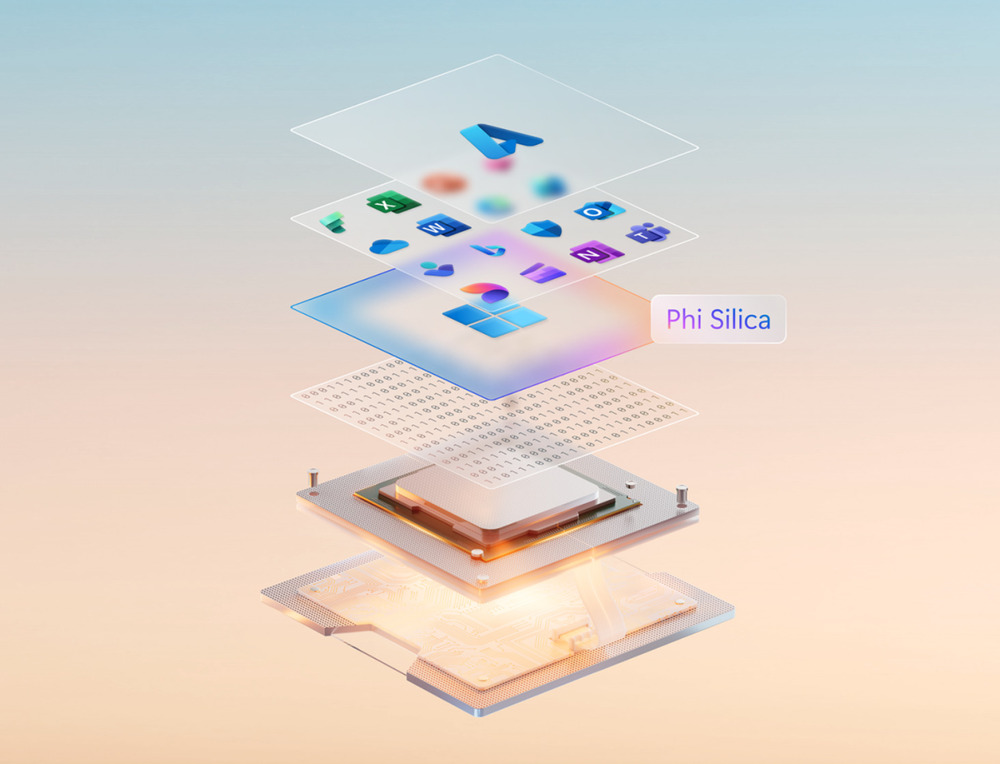
Phi Silica isn’t just about fast text generation. The model can summarize conversations, transcribe recordings in various styles – from formal to casual – and analyze prompts to tailor responses based on size or context constraints. All of this runs locally, without sending data to the cloud, improving both speed and security.
As a result, Phi Silica is more than a technological showcase; it forms the foundation for a new generation of Windows user experiences, where intelligent features are consistently available, fast, and privacy-conscious.
Read also: All About the New Windows 11 25H2: Not a Revolution, but Stability?
New API for developers
Windows App SDK 1.8.1 opens up a wide range of new possibilities for developers working with AI, providing a set of APIs that effectively create a unified ecosystem for local AI on Windows. This includes Microsoft.Windows.AI.Text for text processing, Microsoft.Windows.AI.Imaging for graphics, and Microsoft.Windows.AI.Foundation, which serves as the backbone of the entire infrastructure.
One feature worth highlighting is the Object Erase API, which allows objects to be removed from images. Developers provide an image and a grayscale mask marking the unwanted object, and the system automatically reconstructs the background as if the object was never there. This capability, once only available in complex graphic editors, is now a native part of Windows.
The APIs are designed not just as a set of tools, but as a straightforward and easy-to-integrate foundation for developers. For instance, initializing a text generator based on Phi Silica can be done in just a few lines of code, and the entire process relies on asynchronous calls, ensuring the user interface remains responsive. This lowers the entry barrier, making local AI a standard tool for any application rather than a feature reserved for specialists.
In practice, Windows App SDK 1.8.1 marks a shift where AI on Windows moves from experimental integrations to a system-level feature, setting new development standards and opening opportunities for next-generation applications.
Read also: Microsoft Ends Windows 10 Support: Is There Life After the End?
Foundry Local – openness to models for active recreation
Microsoft does not restrict the ecosystem to its own models. Foundry Local is a versatile platform that automatically assesses a user’s hardware and suggests compatible open-source models. The catalog includes options from Ollama, Nvidia NIM, and other sources, allowing developers to test them locally and integrate them directly into their applications.
The system handles all the routine tasks, from downloading the necessary runtime environments and optimization tools to installing the SDK for specific hardware. When new hardware enters the market, Microsoft updates the components promptly, addressing compatibility issues before they become critical. This allows developers to focus on building functional features rather than dealing with drivers or library conflicts.
Importantly, Foundry Local works not only on Windows but also on macOS, effectively creating a bridge between different operating systems. This approach lowers the barrier for developers looking to experiment with local AI models and encourages the development of cross-platform AI applications.
In this sense, Foundry Local is more than just a tool for working with models; it represents a strategic move by Microsoft to standardize and simplify local AI, providing developers with consistent access to innovations regardless of hardware or operating system.
Read also: Windows 11 Open Source: Myth or Reality?
Fundamental change in NuGet
Microsoft has significantly updated the Windows App SDK architecture, making it more flexible and scalable. The main NuGet package is now a meta-package that references each component as a separate module. This allows developers to include only the features their applications actually need, reducing unnecessary code and dependencies.
This modular approach offers several clear benefits. First, applications become more lightweight, which is particularly important for mobile or low-power devices. Second, updates are faster: developers no longer need to download the entire SDK, only the specific component that requires updating. This not only saves development time but also reduces the risk of compatibility-related issues.
It’s also worth noting that MSIX publishing support has been moved into a separate NuGet package. This creates a new use case: developers can now integrate MSIX functionality into projects outside the Windows App SDK, allowing this tool to evolve independently of the main SDK update cycle.
Microsoft is shaping an ecosystem focused on adaptability, providing developers not with a monolithic toolkit but with a set of flexible building blocks. This approach lowers the entry barrier and aligns the Windows App SDK with modern development trends, where modularity and component independence are key factors for scalability.
Read also: How Chinese Companies Circumvent the US Ban on AI Chips
Safety and responsibility. Revolution or evolution?
Phi Silica underwent a five-stage security alignment process using a “gap fixing” methodology. The model includes a built-in content moderation system, and the entire API has been audited according to responsible AI standards. In other words, what Windows App SDK 1.8.1 presents is not just a technical update, but a deliberately designed foundation for the safe and scalable use of local AI models.

Microsoft is achieving something that seemed nearly impossible just a few years ago: making local AI accessible to virtually any developer. Basic knowledge of .NET or C++ is enough to integrate capabilities that previously required deep expertise in machine learning. Local AI is moving beyond a niche tool and becoming a new standard in Windows development.
The real shift lies in the change of paradigm. Whereas AI used to be almost synonymous with the cloud – bringing latency, paid APIs, and privacy risks – it is now associated with local execution: instant response, no operational costs, and full control over data. This fundamentally alters the playing field for both small indie studios and large multinational corporations.

Microsoft is taking a long-term approach. Windows ML is integrated directly into the operating system and will evolve as a core component, ensuring stability, backward compatibility, and support for years to come. Most importantly, it signals that this is not a short-term experiment or trend, but a strategic foundation for the future of Windows.
Read also:
- Secret Behind Microsoft’s Profits: What the Company Hid for 15 Years
- How Chinese Companies Circumvent the US Ban on AI Chips
- How to Spot Fake Photos: New Challenges of the Digital Age

