© ROOT-NATION.com - Use of content is permitted with a backlink.
To be honest, when I was asked to review an electric scooter, my first thought was something along the lines of: “well, it’s basically a bicycle with ambitions, I’ll manage.” However, the SUNRA K6 quickly made me reconsider that assumption – and I’m glad it did.
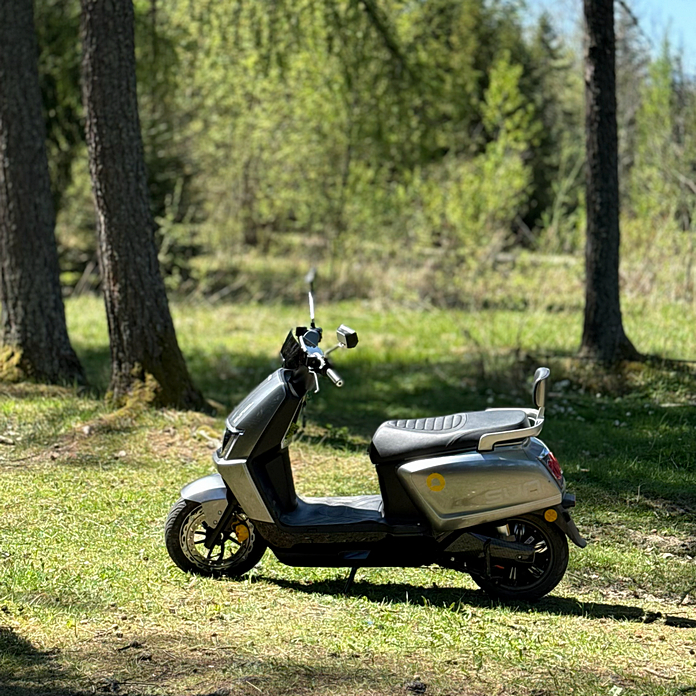
The K6 is not just another electric scooter on the market. It is a crossover-style model with a distinct character: a mech-inspired design, intelligent features, a TCS traction control system, and up to 110 km of range – all without requiring a driver’s license. It comes as a package that has already been tested in global markets. With that in mind, let’s get comfortable and move on to a detailed and straightforward review.
Read also: All car reviews
TABLE OF CONTENTS:
SUNRA K6 video review
SUNRA K6 Technical Specifications
- Motor: brushless (BLDC), built into the rear wheel
- Power: rated – 1500 W, maximum – 2300 W, maximum speed: up to 55 km/h
- Battery: 72 V graphene battery, 38 Ah (consisting of 6 cells of 12 V each)
- Energy capacity: 2736 Wh, range: up to 110 km on a single charge (depending on conditions and load), charging time: approximately 6–8 hours from a standard mains supply
- Braking system: front and rear hydraulic disc brakes (disc diameter 298 mm)
- Safety: TCS (traction control system)
- Suspension: hydraulic suspension with 5 levels of stiffness adjustment
- Tyres: semi-slick, front – 90/90-12, rear – 90/80-12
- Lighting: full LED system; headlight brightness 30,000 cd, beam range over 50 m
- Load capacity: standard – 75 kg, maximum – up to 200 kg
- Dimensions: 1846×753×1145 mm
- Wheelbase: 1319 mm, seat height: 620 mm, seat length: 620 mm, footboard length: 370 mm
- Boot capacity: 32 l
- Weight: approx. 140 kg
- Extras: LED display, alarm, rear-view mirrors, footrest.
Read also: User Experience of the KOVI ADT 300 Motorcycle After 10,000 km of Use
Positioning and price
On the Ukrainian market, the SUNRA K6 occupies the niche of a reliable everyday scooter with a focus on increased comfort. It sits in the middle ground for users looking to balance affordability with modern technology. The model is not overloaded with unnecessary features, but it includes essential elements such as a traction control system (TCS) and a long-lasting graphene battery. This type of scooter is a practical option for urban users who want to avoid traffic congestion, as well as for those whose work involves frequent movement around the city, for example in delivery services.
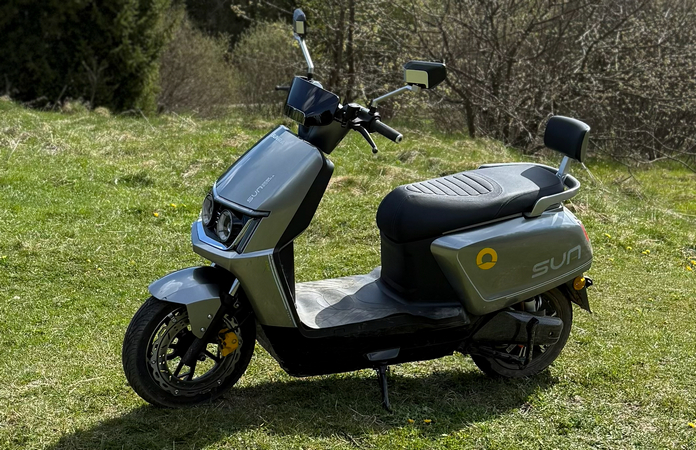
The SUNRA K6 sits in the “solid mid-range” segment with a relatively clear pricing position. As of now, its cost is approximately $1500–1600 / €1400–1500, placing it between basic urban electric scooters and more expensive premium models. Thanks to a reinforced frame, a durable suspension system with five-level adjustment, and semi-slick tires, it is designed to handle uneven road surfaces – something that, in practice, remains a common characteristic of many urban environments.
Read also: First Impressions of the Volvo EX30 EV Electric Car: Safety and Space
Design and ergonomics
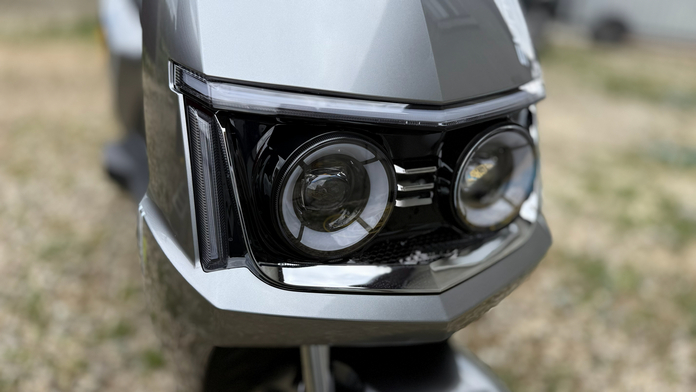
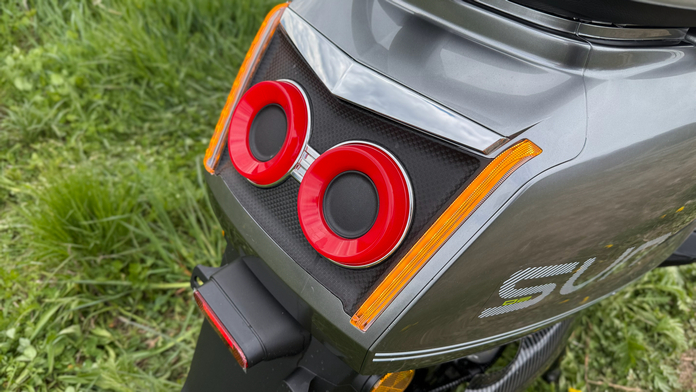
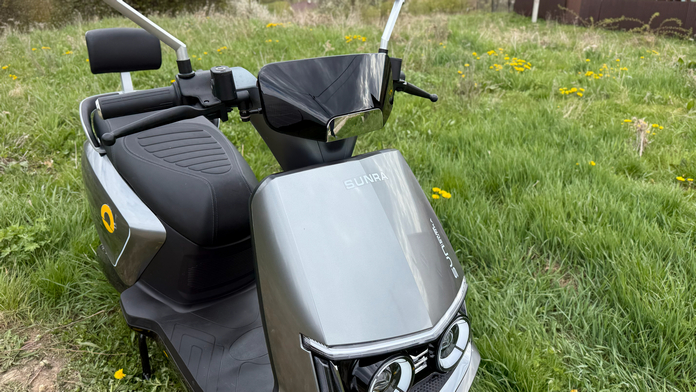
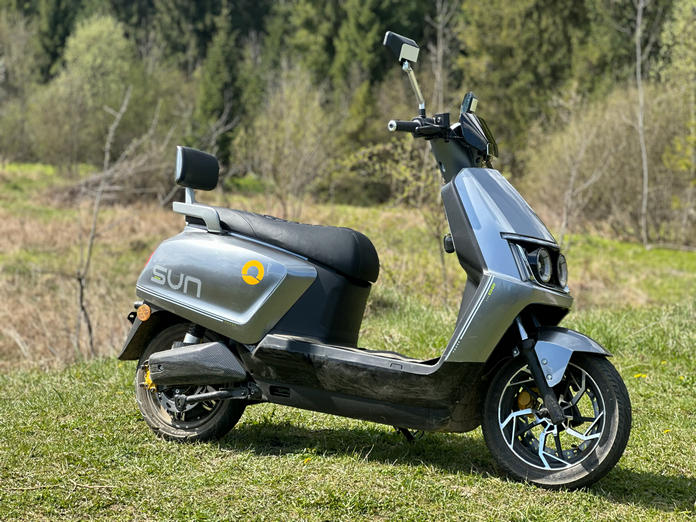
The design of the SUNRA K6 presents a fairly cohesive impression at first glance. It avoids overly aggressive styling choices that are often used to stand out in this segment. On closer inspection, small details become more noticeable – elements that are typically absent from specification sheets. The dual front headlights with circular daytime running lights provide adequate illumination for road visibility while also contributing to the scooter’s overall design identity. The rear lighting uses circular elements that resemble a more futuristic, almost aerospace-inspired aesthetic. From the front, the K6 can be seen as combining sporty and modern design cues, while the rear design draws more on traditional motorcycle styling references.
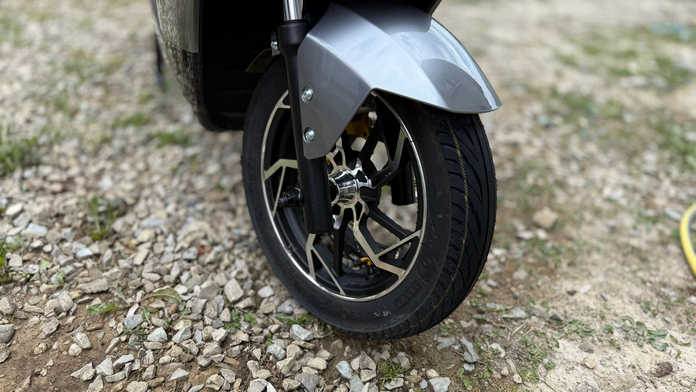
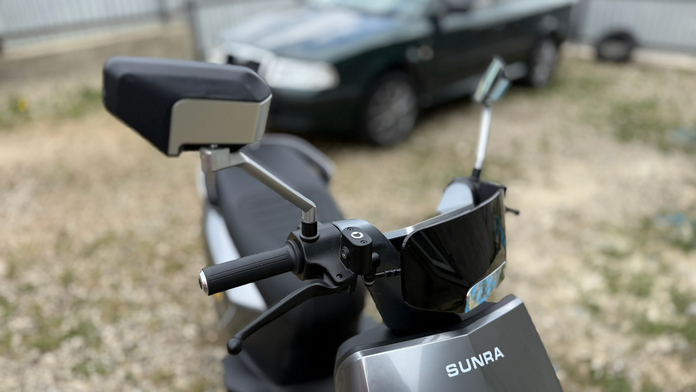
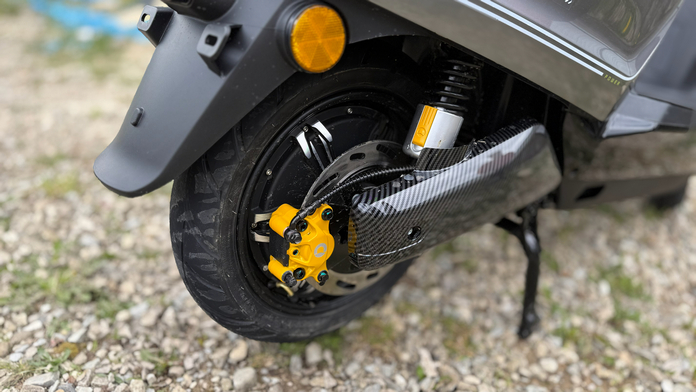
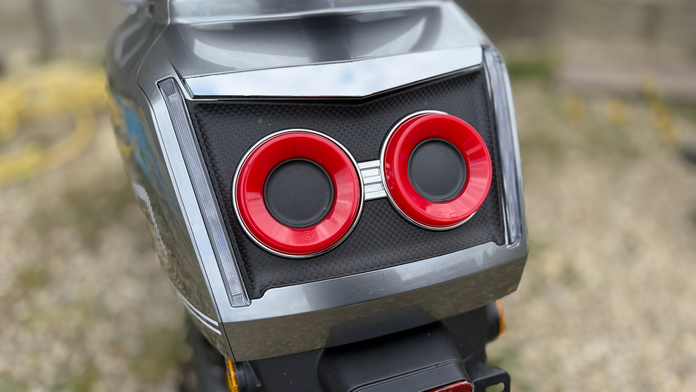
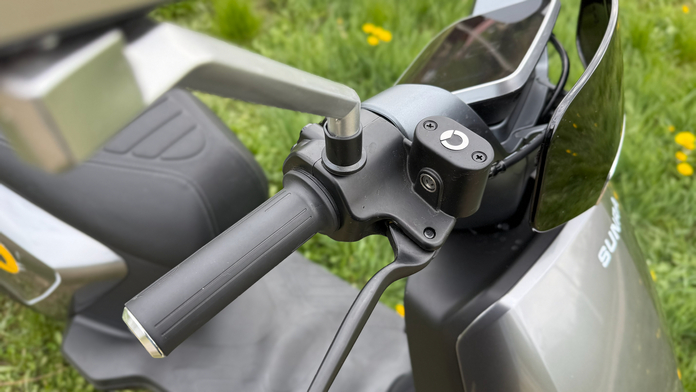
What stands out most is the attention to technical aesthetics. The bright yellow brake calipers create a strong contrast against the more restrained grey bodywork. Combined with carbon-style trim elements and large hydraulic shock absorbers with adjustable stiffness, the scooter presents a visual impression that exceeds what one might expect at its price point. Even the mirrors are not purely functional round elements; they feature a more defined geometric shape and an anti-glare coating, which fits the overall design language. Their relatively wide mounting position on the handlebars provides a notably good rearward field of view.
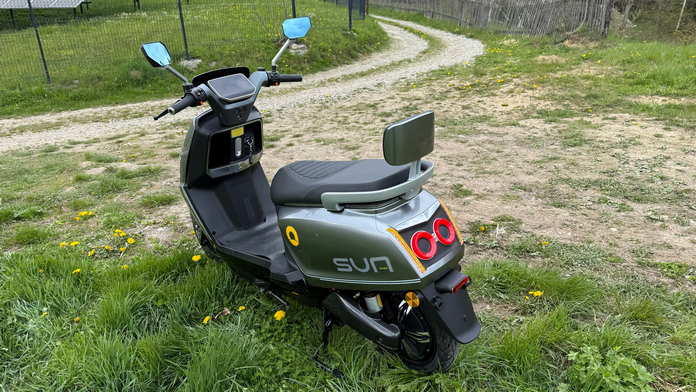
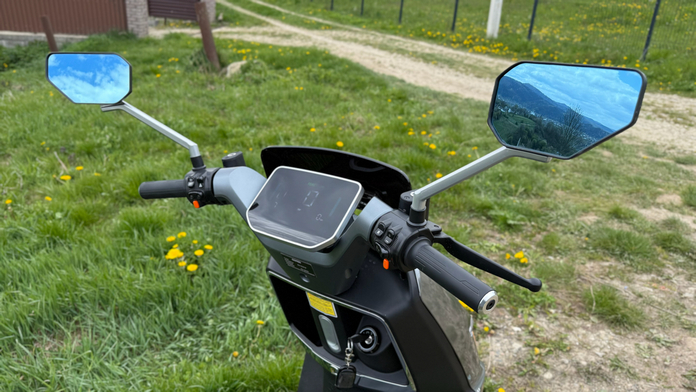
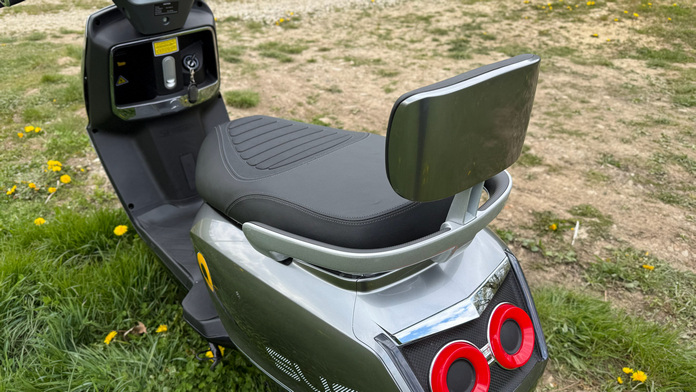
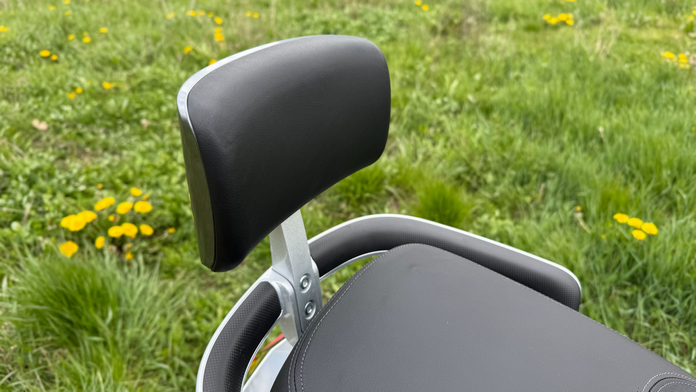
From an ergonomics perspective, the design clearly prioritizes everyday comfort. The riding position feels natural, without requiring the rider to adapt to the vehicle. The long seat supports two-person riding without major limitations. The wide, soft seat – approximately 620 mm in length – is comfortable for both rider and passenger. Passenger comfort is further supported by a rear backrest and a dedicated grab handle. The footboard area is sufficiently spacious, allowing a relaxed seating position for both occupants.
The 32-liter storage compartment covers most basic use cases. In practical terms, it can accommodate a helmet, a bottle of water, a bouquet of flowers, and additional personal items such as shoes, depending on how it is packed.
Read also: Škoda Kodiaq Sportline (2025) Review: Balanced Family SUV with Sporty Character
Dynamics and handling of the SUNRA K6
In motion, the K6 behaves as if it has a built-in “sport plus comfort” mode that shifts depending on how the throttle is applied. A practical note: when riding it for the first time, it is not advisable to aggressively twist the throttle. Acceleration is immediate, strong, and lacks gradual buildup – something that can catch an inexperienced rider off guard. With a 2300 W motor, the response is noticeable right away. Once the initial adaptation phase is over, the scooter becomes significantly easier to control, and its behaviour feels more predictable and manageable in everyday riding conditions.
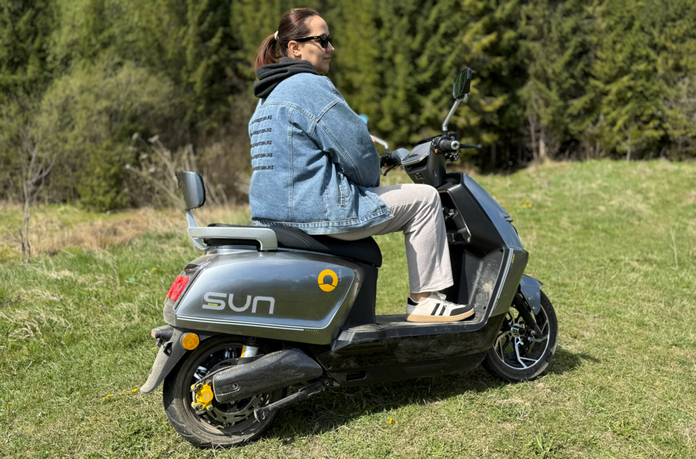
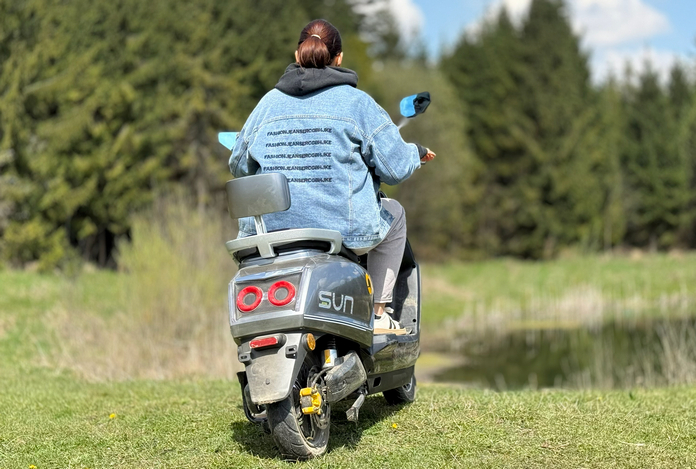
On asphalt, the K6 performs very smoothly. The ride is quiet, stable, and comfortable, to the point where it can feel unusually calm in typical urban traffic conditions. The suspension handles road imperfections in a controlled and consistent manner, while the wide, soft seat contributes to comfort even on longer trips. The riding position is natural: feet can reach the ground easily, the footboard is positioned appropriately, and the body does not require adjustment to maintain a relaxed posture. At times, the absence of engine noise may feel slightly unusual, as the rider is left primarily with tyre noise and road feedback instead of mechanical sound.
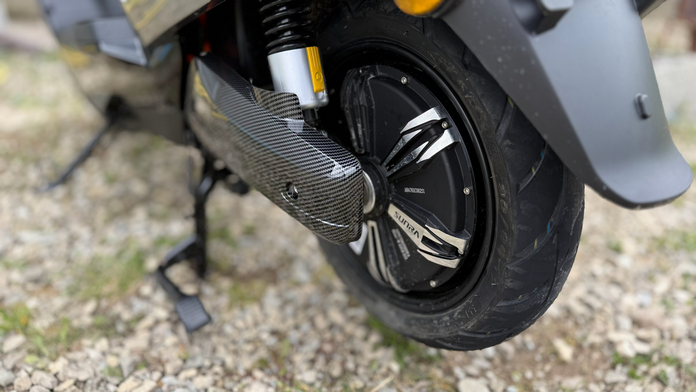
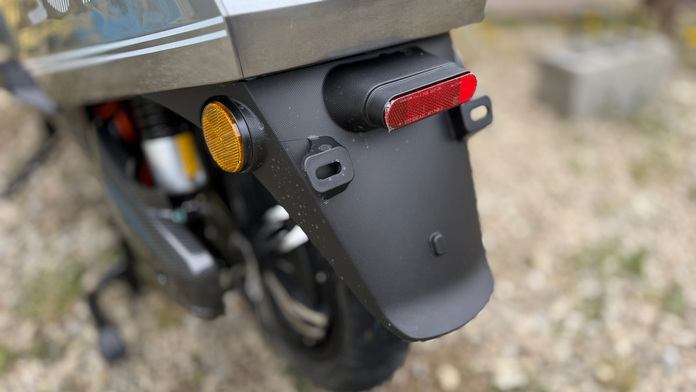
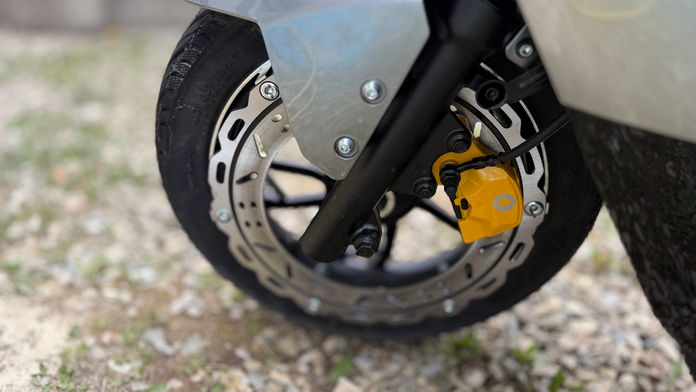
On a gravel road with loose stones, the scooter does transmit some vibration, as expected. However, the combination of a soft seat and hydraulic suspension helps reduce the perceived discomfort, making the ride feel more controlled than harsh. When cornering, it is important to account for the scooter’s weight and initiate turns slightly in advance. The K6 is not particularly heavy for its class, but it is also not extremely light, so it responds better to deliberate and measured steering inputs rather than abrupt manoeuvres.
Overall, the handling leaves a positive impression: the scooter feels predictable, stable, and provides a sense of confidence on the road. The most noticeable aspect is the acoustic profile – or rather, the near absence of sound. The ride is so quiet that the only noticeable noise is typically limited to tyre contact with the road surface.
Read also: Škoda Karoq Sportline Test Drive: Just a Visual Refresh?
Technology and safety
When examining the technical equipment of the SUNRA K6 in more detail, it becomes clear that the design goes beyond its visual appearance and is based on substantial engineering work. The structural foundation is a frame made of high-strength carbon steel, tested under long-term vibration cycles. This is intended to ensure durability under demanding road conditions. Braking performance is handled by hydraulic disc brakes with 298 mm rotors. Compared to typical solutions in this segment, this configuration provides more effective and controlled deceleration, contributing to overall riding stability and safety.


There is also a practical bonus: the K6 is equipped with a regenerative braking system. During braking, the electric motor automatically switches into generator mode, and part of the kinetic energy is fed back into the battery. In simple terms, braking also contributes to charging. In urban riding conditions with frequent stops, this can have a measurable effect and may slightly extend the overall range. The scooter also includes a reverse gear, which is useful for parking manoeuvres and tight turns.
The energy system is based on a 72 V, 38 Ah graphene battery with an estimated cycle life of up to 1,000 charge cycles. With a total capacity of 2,736 Wh and a motor rated at 1,500 W (with peak output up to 2,300 W), the scooter demonstrates solid endurance for its class. Particular attention is given to the traction control system (TCS), which monitors wheel rotation in real time and helps prevent wheel slip on low-traction surfaces. This improves stability on tiles, cobblestones, wet roads, and even in snowy conditions. In practice, it is more than a specification entry – it provides functional support in everyday riding scenarios.
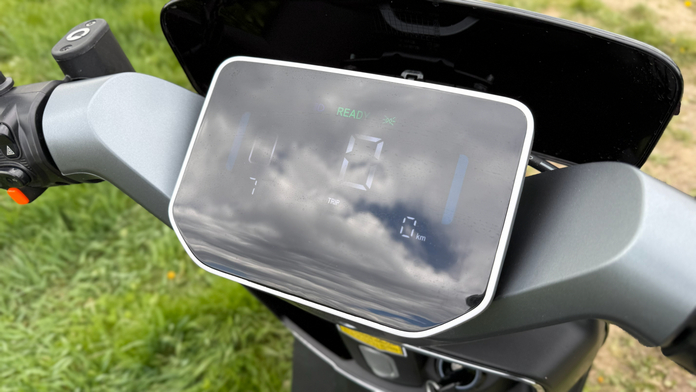
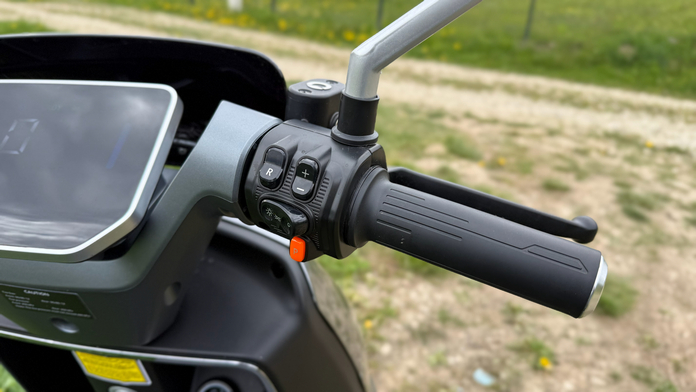
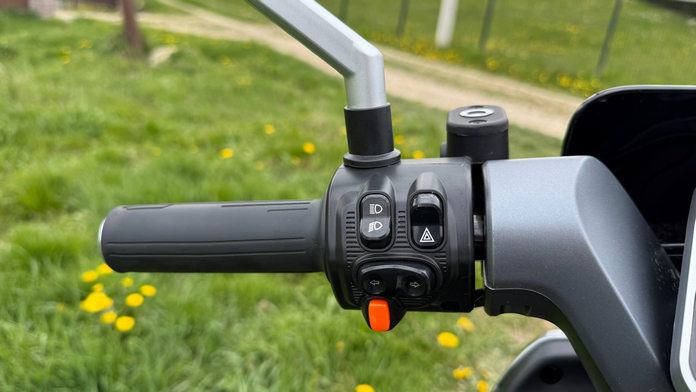
The K6 is equipped with 12-inch wheels and semi-slick tyres: front 90/90-12R and rear 90/80-12. Compared to conventional tyres, semi-slicks are designed to increase grip as they heat up during riding, improving road contact at higher speeds under suitable conditions. The suspension system is a five-stage hydraulic setup with adjustable spring preload. This allows tuning based on rider weight or road conditions. In practice, it can be adjusted for smoother highway riding when unloaded, or for improved stability on uneven surfaces when carrying additional load. Adjustments are made manually without the need for additional tools. While these features may appear minor individually, their practical value becomes more noticeable over longer distances and extended daily use.
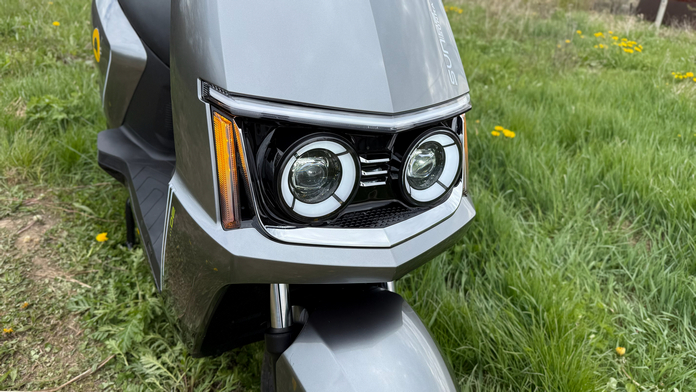
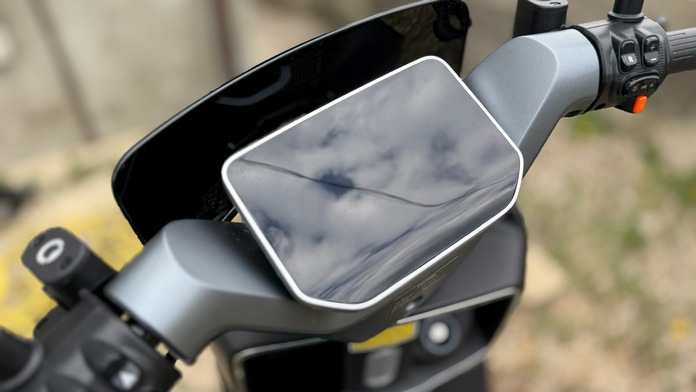
It is also worth noting that the SUNRA K6 includes an anti-theft system with remote control, aimed at improving security while the scooter is parked. In addition to a motion sensor, the system can lock the rear wheel if suspicious activity is detected. The model also features an automatic pause function supported by dedicated sensors. In urban use, this allows the system to switch the motor into a parking mode and disable throttle input, reducing the risk of unintended acceleration when the scooter is stationary.


The body dimensions – 1846×753×1145 mm with a wheelbase of 1319 mm – contribute to a balance between stability and maneuverability in urban environments. The scooter feels stable at speed, while still remaining compact enough for city use. When reviewing the technical specifications – such as the TCS system, multi-level suspension settings, and dual-core controller – the level of equipment may feel unusually extensive for this class. There is no autonomous driving functionality (despite the impression such a feature might be suggested), but the scooter remains fully functional without it.
Read also: Mazda CX-30 SPORT BLACK Review – What Can a Compact SUV Do?
Range and charging
Starting with the specifications, the SUNRA K6 is offered with three battery options: a 72V 26Ah graphene battery, a 72V 30Ah lithium iron phosphate (LFP) battery, and a 72V 38Ah graphene battery. The stated ranges are 80 km, 90 km, and 110 km respectively. These figures are measured under controlled conditions: a constant speed of 40 km/h, flat terrain, and a 70 kg rider.
It is important to note that real-world conditions differ significantly. In typical urban use – frequent stops, variable speeds, additional cargo, or sustained speeds of 50–55 km/h – actual range is generally lower, often around 65–75% of the stated values. In practical terms, the 26Ah version provides approximately 55–65 km in city riding, while the 38Ah battery allows for roughly 80–85 km under similar conditions without requiring frequent recharging.


Riding mode has a significant impact on energy consumption, and this should be taken into account when planning routes. At a steady speed of around 40–45 km/h, the scooter operates efficiently and maintains relatively stable energy use. When accelerating to 55–60 km/h, energy consumption increases noticeably, as aerodynamic drag becomes a more significant factor at these speeds. Inclines, especially those exceeding 8–10 degrees, also temporarily increase motor load and reduce overall range. Rider weight is another variable that affects efficiency. The difference between a 60 kg and a 90 kg rider can result in an estimated 10–15% variation in range under otherwise identical conditions. For this reason, when planning longer trips close to the battery’s limits, it is advisable to include a safety margin rather than relying strictly on the manufacturer’s stated figures.
An unexpected detail about charging – something that typically does not appear in technical specifications – is the sound of the charger during operation. The SUNRA K6 charger produces a noticeable, steady fan-driven cooling noise. It is not loud in absolute terms, but it becomes clearly audible in a quiet environment such as a garage. In practice, it can be more noticeable than the scooter itself during riding, since the vehicle is almost silent in motion. Technically, charging is performed from a standard 220 V power outlet. A full charge takes approximately 6 hours for the 26 Ah version, and up to around 8 hours for the 38 Ah version, depending on the charger output. The most practical usage pattern is to charge the scooter overnight, allowing it to be fully ready for use in the morning.


It is important to remember that the long-term reliability and stable performance of an electric scooter depend directly on proper maintenance of its energy system. Although graphene batteries offer a relatively high energy capacity, it is not recommended to regularly discharge them to zero. Deep discharge cycles place additional stress on the chemical components and may, over time, reduce the overall service life of the battery.
For optimal longevity of both lithium and graphene cells, it is generally recommended to keep the charge level within the range of approximately 20% to 90%. In practice, starting to recharge when the battery drops to around 30–40% helps avoid operating at extreme charge levels. This approach reduces unnecessary stress on the battery and helps maintain consistent performance over time. These guidelines are broadly applicable to most electric scooters, not only this specific model.
Read also: Mazda CX-60 Premium-Sport Review: Not Enough Premium, But Too Much Sport
Advantages and disadvantages of the SUNRA K6
Looking at the scooter without idealization, its strengths are fairly clearly defined and become noticeable from the first rides. The primary advantage is stability and control. Thanks to 12-inch semi-slick tyres and the TCS system, the scooter maintains good traction even on challenging surfaces such as wet asphalt or tiled roads. Front and rear disc brakes also contribute to a greater sense of control, reducing braking distance under typical conditions. The relatively large brake disc diameter and ventilated design help improve heat dissipation, reducing the risk of overheating during normal urban use.

The second key strength is the balance between power and everyday usability. A nominal output of 1,500 W (with peak values of around 2,300 W) provides sufficient performance for urban riding, while the scooter does not feel overly aggressive in its handling. The claimed range is generally adequate for daily use cases, especially when riding is not consistently performed at maximum speed. In addition, the structural design contributes to a solid overall impression. The steel frame, tested for vibration resistance, gives the scooter a more rigid, “monolithic” feel rather than a lightweight or toy-like construction.

However, there are also several aspects worth considering before purchase. First is weight. The K6 is not lightweight, and this is noticeable both when manoeuvring at low speeds and when handling it at a standstill. It remains stable, but it does not feel particularly agile or “light on its feet”. Second is acceleration. The throttle response is immediate and relatively sharp, which can be surprising for riders without prior experience with electric scooters. Third, the real-world range depends significantly on riding style and load. Therefore, it is not advisable to rely strictly on the maximum claimed figures when planning trips.
One additional practical consideration is acoustic awareness. Because the scooter operates almost silently, it may be less noticeable to pedestrians and other road users in traffic, which is an important factor to keep in mind during urban riding. Overall, it is a well-balanced vehicle with realistic capabilities and a fairly predictable behaviour in everyday use.
Read also: Škoda Karoq Review: Compact City SUV Focused on Comfort and Safety
Conclusions and impressions
After the overall experience with the SUNRA K6, the impression it leaves is fairly clear and, importantly, stable. The scooter effectively covers the basic scenarios of everyday mobility. It provides sufficient power for urban use, a comfortable suspension setup, predictable handling, and a practical range for daily commuting. One notable aspect is that the K6 does not require a long adaptation period. In practice, it can be used almost immediately after getting on, without a significant learning curve. It also appears suitable for both urban environments and rural roads, within the limits of its class and intended use.
The SUNRA K6 is a solid option for users looking to switch to electric mobility without unnecessary complexity or loss of everyday comfort. It balances visual appeal with practical functionality, focusing on getting the rider from point A to point B reliably and consistently. Perhaps its most notable quality is this balance between presentation and utility. It does not attempt to be a specialized or experimental device, but rather a practical means of transport within its intended use case. The main thing is not to try and check if it’s quiet by sneaking up on the cats – they’ll suspect something anyway!
Read also:
- How Autonomous Trucks Are Reshaping Global Logistics
- Weapons of Ukraine’s Victory: FP-1 – A Drone Capable of Reaching Moscow
- Interview with founders of Ukrainian Global Drone Academy: How drone warfare culture and operator mindset are shaped
- Xiaomi Watch 5 Review: Wear OS and 6 Days of Battery Life
Where to buy the SUNRA K6