





© ROOT-NATION.com - Use of content is permitted with a backlink.
Today, we will examine whether OLED screens really suffer from burn-in, how relevant this issue remains in 2026, and what has changed in display technology over recent years.
We will look at the actual risks, common misconceptions, and modern display protection mechanisms to determine whether burn-in is still a major concern compared to the early years of OLED technology.
TABLE OF CONTENTS:
OLED Burn-In: A Myth That Outlived the Problem
For decades, pixel burn-in was the shadow hanging over what many considered the most advanced display technology on the market. Yet between the lines of warranty policies, corporate announcements, and product presentations, a broader conclusion has gradually emerged: the industry has, quietly but decisively, brought the problem under control.
Some technologies are born with a stigma. OLED is one of them. From the very beginning of the commercial OLED era in the late 2000s, these displays developed a persistent reputation: visually outstanding, but inherently short-lived. Organic materials degrade, pixels wear unevenly, and static images leave behind ghost-like traces. For many users, no advantage in contrast or color reproduction seemed worth the long-term risk.

That perception was not entirely unfounded. Early generations of OLED panels did indeed suffer from burn-in issues. But here lies the paradox: the belief itself proved far more persistent than the problem. The technology evolved rapidly, while the fear remained.
Today, there is enough data, enough industry decisions, and enough market evidence to draw a clearer conclusion: in 2026, OLED burn-in is largely an artifact of collective memory rather than a serious technical concern.
Read also: Main Differences Between LED, OLED, and QLED in TVs
The Anatomy of Fear: Where It All Began
To understand today’s shift in perception, it is necessary to return to the origins of the technology. OLED is a display system in which every pixel functions simultaneously as both a light source and a color-producing element. Unlike LCD panels, where the backlight is always active, each OLED pixel illuminates only when needed. This is what enables perfect blacks, effectively infinite contrast, and near-instant response times.
The trade-off, however, lies in the nature of organic materials, which gradually degrade over time. Pixels that continuously display the same static element – a TV channel logo, an operating system icon, or a game interface indicator – wear out faster than surrounding pixels. Eventually, this can produce a faint “ghost” image: a semi-transparent remnant of a previously static element that remains visible even after the displayed content changes.
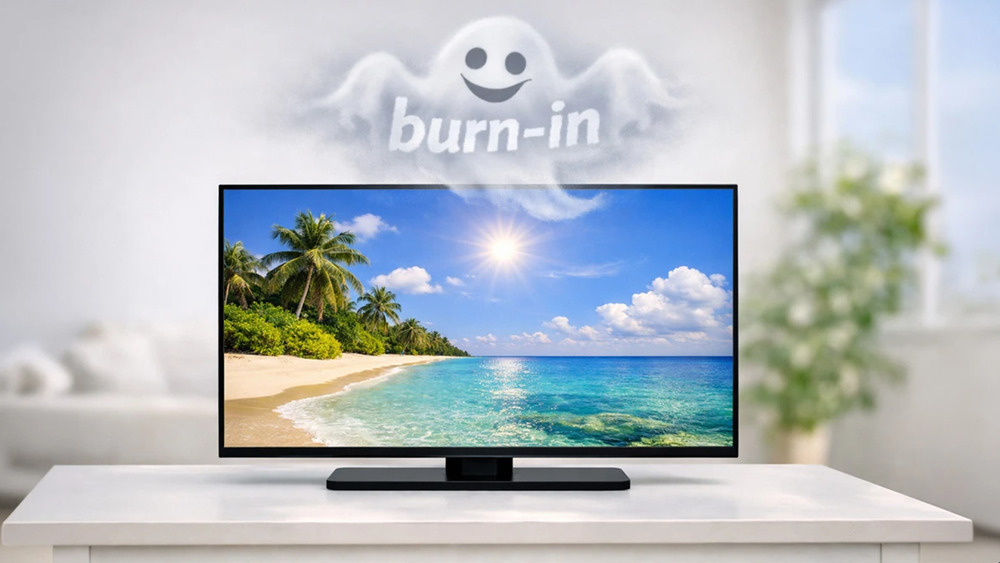

The term “burn-in” is technically imprecise. A pixel is not literally burned by an external force; rather, it gradually wears out internally over time. Yet the word itself became a symbol of nearly every concern associated with OLED technology.
A turning point in public perception came with the RTINGS tests published in 2018. The widely respected review outlet conducted long-term experiments using a rigorous methodology and documented visible burn-in after roughly 4,000 hours of displaying content with persistent static elements. Media coverage amplified the findings quickly, and OLED displays gained a reputation similar to “a Lamborghini without airbags” – visually impressive, but potentially risky in long-term use.
Competing manufacturers quickly capitalized on the moment. Samsung Electronics, which at the time had not yet entered the OLED TV market with its own products, actively referenced these tests in marketing materials, directly highlighting the perceived risks of competing panels produced by LG Electronics. The concern gained corporate validation, and the narrative effectively reinforced itself.
Read also: What is HDR in monitors and how to properly adjust it
A Billion Panels and Almost No Complaints
Eight years have passed since then. And if we move beyond forum debates and look at the broader numbers, the picture has changed dramatically.
Today, roughly one billion OLED panels are manufactured and sold annually. They are used in televisions, monitors, laptops, tablets, smartphones, and smartwatches. If burn-in had remained the same systemic issue it appeared to be in 2018, manufacturers’ support centers and warranty services would likely be overwhelmed with complaints. That is not what happened. Reports of permanent OLED burn-in under normal home usage conditions have become notably rare.

Market trends tell an even more revealing story. Shipments of OLED monitors reached 2.735 million units in 2025, representing annual growth of 92%. Monitors present a fundamentally different usage scenario compared to televisions: static operating system interfaces, software toolbars, and persistent taskbars remain on screen for hours at a time. If burn-in were still a widespread and serious issue, this segment simply could not sustain such rapid growth. Consumers ultimately vote with their wallets – and they continue choosing OLED.
Read also: ASUS ROG Zephyrus Duo GX651 (2026) Review: Two 16-inch OLED displays are no joke anymore
The Technological Revolution We Barely Noticed
Between the RTINGS tests of 2018 and today, a major technological transformation took place. It did not happen overnight. Instead, it accumulated gradually over years, which is precisely why it has been so easy to overlook from the outside.
One of the most important breakthroughs was the emergence of Tandem OLED architecture. The concept is relatively straightforward: instead of relying on a single organic emissive layer, the panel uses two or more stacked vertically. Each layer therefore produces less light to achieve the same final brightness, reducing the rate of material degradation over time.
LG Display, currently the world’s largest OLED panel producer, pushed this approach further with its Tandem WOLED 2.0 technology introduced at CES 2026. The company announced peak brightness levels of up to 4,500 nits, while claiming that panel lifespan at a more typical operating brightness of 1,000 nits can increase by as much as four times compared to conventional OLED designs. This represents more than incremental refinement. It is effectively a shift to a new technological class.
In parallel, manufacturers equipped their panels with a software-based toolkit aimed at mitigating degradation. Pixel Shift subtly moves the image by a few pixels at regular intervals – imperceptible to the human eye, yet sufficient to prevent any single pixel from remaining in a fixed, “sedentary” state for too long. Logo Dimming automatically detects static on-screen logos and reduces their brightness relative to the rest of the image. Pixel Refresh runs a longer calibration cycle, measuring pixel wear and compensating for uneven aging by adjusting drive current across the panel. The result is not restoration, but more uniform aging, without visible “ghost” artifacts.
These hardware and software measures did not eliminate the fundamental nature of organic materials. However, they significantly changed both the rate and pattern of degradation to the point where burn-in is no longer a practical concern for the vast majority of users.
Read also: NVIDIA N1 and N1X: The Moment Windows Has Been Waiting for for Twenty Years
The Warranty Race as a Reflection of Confidence
There is a particular kind of corporate honesty that does not require statements: warranty policy. A manufacturer uncertain about its product is unlikely to take on long-term financial liability. For this reason, the “warranty race” that has unfolded in the OLED monitor market since 2024 is arguably one of the clearest indicators that the technology has fundamentally changed.
2024. ASUS launches the first official two-year burn-in warranty for OLED monitors. This marks a precedent: previously, no manufacturer had formally assumed such obligations in writing.
2024–2025. MSI extends its warranty to three years. ASUS follows immediately. Gigabyte joins with a similar offer. LG Electronics introduces a two-year warranty for the U.S. market, while Sony opts for three years.
June 2026, Computex 2026. Gigabyte announces a four-year burn-in warranty for the Aorus Elite FO27Q28G monitor based on fourth-generation Tandem WOLED panels. This becomes the first move of its kind in the industry.

Four years is not a marketing number. Even premium monitors typically come with a standard three-year warranty. An additional year specifically covering burn-in is a clear statement: the manufacturer is confident the panel will hold up. That confidence is grounded in economic calculation rather than optimism. If mass failure were a real risk, no company’s finance department would approve such an exposure.
Read also: Middle Strike: How Ukraine Is Building a New Class of Medium-Range Strike Systems
Samsung vs. Samsung: A Symbolic Turning Point
If the warranty race is the language of numbers, then Samsung’s decision regarding the S99H television is the language of symbols. And it speaks louder than any warranty extension.
For years, Samsung Electronics offered its Art Store service – a feature that displays artworks in standby mode – exclusively on its LCD-based The Frame series. The logic was straightforward: showing static images for long periods on OLED panels was considered an open invitation to burn-in. As a result, Art Store was firmly excluded from OLED models.

At the launch of the S99H and S95H – Samsung’s flagship QD-OLED televisions for 2026 – Samsung Electronics announced that these models would be the first OLED TVs with full access to the Art Store. Over 5,000 artworks, including The Mona Lisa, can now be displayed for extended periods – without warnings, without warranty concerns, and without implied risk.
The significance of this decision is difficult to overstate. In 2018, Samsung actively used RTINGS burn-in tests as a competitive argument against rival OLED implementations. In 2026, the same company is effectively stating that its OLED displays are reliable enough to showcase Van Gogh’s paintings all day long. This is not merely a marketing pivot – it is a public reversal of its earlier technical stance.
Read also: KIVI KidsTV for children’s room review: Brick-style design, night light and protective glass
What Remains of the Problem: A Balanced View
Intellectual honesty requires avoiding the opposite extreme as well. Burn-in has not disappeared as a physical phenomenon – organic materials still degrade over time. The real question is how quickly this happens, and under what conditions.

Where does the risk remain real? Continuous 24/7 display of unchanged content – for example, running a news feed non-stop over several years – remains a usage scenario that should be avoided on OLED panels. Temporary image retention after extended sessions with static content is a normal behavior of the panel and typically disappears within minutes. Lower-cost models based on earlier-generation technologies are still available on the market and generally provide reduced protection.
It is also worth noting that QD-OLED from Samsung and WOLED from LG are fundamentally different architectures with distinct longevity characteristics. Manufacturers typically demonstrate their latest and most robust panels, while budget-tier models may use different implementations of the same underlying technology.
The distinction between temporary image retention and permanent burn-in is also important: the former is a normal and reversible panel response, whereas the latter is irreversible degradation. Confusion between these two phenomena often contributes to overstated concerns.
Read also: Privacy as a Business Model: Proton Services and Efforts Toward a Surveillance-Free Internet
Why the fear outlived the problem
The question to ask is: why did the perception of OLED risk prove to be so persistent? The answer lies in several mechanisms. First, negative information spreads and remains in collective memory significantly better than positive information. A forum thread from 2018 showing photos of a burnt-in display accumulated thousands of views and continued to appear in search results for years. A 2024 thread explaining that newer panels are free from this defect typically receives only a few hundred. SEO algorithms do not counterbalance this effect: alarming headlines tend to attract more clicks.

Second, manufacturers themselves contributed to sustaining this perception for a considerable time through competitive messaging. When a major player publicly highlights the weaknesses of a competitor’s technology, that information tends to take on the weight of an authoritative statement. It can persist in consumer perception long after the originating company has revised its position.
Third, the technological evolution occurred gradually, without a single clear “tipping point.” There was no press conference announcing that burn-in had been definitively solved. Instead, progress emerged through incremental improvements in materials science, new software-based compensation algorithms, and steadily increasing warranty coverage. Taken together, these changes represent a substantial shift, but each individual step appeared relatively minor and easy to overlook.
Fear as a legacy concern
Two decades ago, concerns about OLED burn-in were rational. They were based on real data, real cases, and a measurable technical risk. A consumer in the 2010s who chose LCD over OLED for this reason was making a defensible decision.

Today, making the same choice is increasingly an expression of collective inertia rather than rational analysis. More than a billion panels have been manufactured without widespread reports of failure. The OLED monitor market grew by 92% in a single year, driven by buyers who are fully aware of the risks and still choose the technology. Manufacturers now offer four-year warranties that effectively place financial backing behind their claims. Even Samsung, after years of highlighting burn-in concerns, now promotes an Art Store experience designed specifically for its OLED televisions.

Taken together, these developments are neither a marketing campaign nor a coincidence. They form a consistent picture of a technology that has largely overcome its original Achilles’ heel. Fear once served as a practical form of caution. Today, it increasingly functions as a barrier between consumers and the best display experience currently available.
Organic materials still degrade over time. But there is little reason to let outdated assumptions degrade alongside them.
Read also:
- Weapons of Ukraine’s Victory: Meteor Air-to-air Missile
- Interview with Bell Textron: Investing in the future in Ukraine
- Top 10 TWS Earbuds Under $35
- Top 10 Bluetooth Speakers

