





© ROOT-NATION.com - Use of content is permitted with a backlink.
The new ASUS ROG Zephyrus Duo GX651 (2026) is undoubtedly one of the most distinctive laptops currently available. It features genuinely flagship-level hardware: a next-generation Intel Panther Lake processor, dual 16-inch touchscreen OLED displays, a detachable keyboard, and a top-tier GeForce RTX 5090 graphics card. Today’s review takes a closer look at this machine.
Read also: All ASUS Laptop Reviews
TABLE OF CONTENTS:
Positioning
ASUS has long demonstrated a willingness to experiment. We have seen this in gaming phones, external GPUs, and laptops with narrow secondary displays beneath the main screen. However, the ROG Zephyrus Duo GX651 (2026) operates on an entirely different level. It combines two full-size 16-inch OLED displays, a detachable keyboard, an NVIDIA GeForce RTX 5090 Laptop GPU, and a processor based on Intel’s latest Panther Lake architecture – all within a chassis weighing under three kilograms. On paper, it sounds more like a trade show concept than a retail device, yet this is a commercially available product.

I have previously worked with earlier models in the Duo series. The first generations felt more like interesting experiments: a small secondary display above the keyboard that occasionally proved useful, but overall remained more of a convenient extra feature. Later came the Zenbook DUO with two full-size 14-inch panels, which was already a much more serious implementation. The ASUS ROG Zephyrus Duo GX651 (2026), however, takes the concept significantly further. Both displays are now 16 inches, equal in functionality, OLED-based, and touchscreen-enabled. At this point, the device no longer feels like “a laptop with an extra screen,” but rather a true portable dual-monitor workstation with high-end gaming hardware inside. Naturally, this approach comes with trade-offs – not only financially. But more on that later.
Read also: Review of ASUS Zenbook Duo (2025) UX8406CA: Two Screens Are Definitely Not Overkillі
What’s new in the ASUS ROG Zephyrus Duo GX651 (2026)
The ASUS ROG Zephyrus Duo GX651 (2026) is essentially an attempt to push multitasking as far as possible by integrating two full-size displays into a single chassis. Whether it is modern gaming, video editing, streaming, graphic design, or managing dozens of open windows, the dual-screen design aims to replicate a desktop-class workstation experience in a portable form factor.

The main hardware update is the latest Intel Core Ultra 9 386H processor based on the Panther Lake architecture, manufactured on Intel’s 18A process node. This is the first time I have been able to test Panther Lake in a real commercial device, and the results are somewhat mixed. On one hand, the system delivers excellent power efficiency, low operating temperatures, and notably quiet performance. On the other hand, this efficiency comes at the cost of peak performance limits. This is one of the key trade-offs to be aware of before purchasing.
The second major component is the NVIDIA GeForce RTX 5090 Laptop GPU with 24 GB of GDDR7 memory. On paper, this is a flagship mobile GPU capable of handling any modern gaming or professional workload. However, as is often the case with ultra-thin premium laptops, there is a noticeable gap between the specifications and real-world performance – especially under sustained load and thermal constraints.

However, the key evolution of the ROG Zephyrus Duo GX651 compared to previous generations is the full parity between the two displays. While the second screen used to function mainly as an auxiliary panel, ASUS has now effectively implemented two identical OLED matrices. Both displays are 16 inches, feature a 2880×1800 (3K) resolution, a 16:10 aspect ratio, a 120 Hz refresh rate, and a 0.2 ms response time. They also support G-Sync, reach a peak HDR brightness of up to 1000 nits, cover 100% of the DCI-P3 color space, carry PANTONE validation, and are protected by Gorilla Glass. This is, without exaggeration, the main reason this laptop exists. The two OLED panels are genuinely striking.
The configuration is complemented by 64 GB of LPDDR5X-8533 RAM, soldered directly to the motherboard, and a fast 2 TB PCIe 5.0 NVMe SSD. A welcome addition is an extra available M.2 slot for storage expansion. The laptop supports multiple usage modes: a traditional laptop setup with the keyboard placed on the lower display, a dual-screen horizontal layout, a “book” mode with vertically oriented screens side by side, a tent mode for presentations, and a fully detached keyboard for remote use.

In conclusion, the ASUS ROG Zephyrus Duo GX651 gives the impression not simply of a premium gaming laptop, but of a full-scale demonstration of ASUS’s engineering capabilities. It is a device that may appeal not only to gamers, but also to video editors, 3D artists, designers, and other creative professionals for whom two full-size OLED displays are not a marketing gimmick, but a practical working tool.
Now, about the price. The ASUS ROG Zephyrus Duo GX651 (2026) is already available in the retail market, and the price tag is likely to cause a strong reaction even among experienced tech enthusiasts. The recommended retail price is around $9,000. This naturally raises a straightforward question: is this dual-screen technological experiment really worth the money? That is exactly what we will try to determine next.
ASUS ROG Zephyrus Duo GX651 (2026) Specifications
- Color: Gray (Stellar Grey)
- Operating System: Windows 11 Pro
- Processor: Intel Core Ultra 9 386H (Panther Lake), 16 cores/16 threads, base 2.1 GHz, turbo up to 4.9 GHz, Intel 18A process
- Graphics: Intel® Graphics, NVIDIA GeForce RTX 5090 Laptop GPU, 24 GB GDDR7, TGP up to 150 W
- Neural Processing Unit: Intel AI Boost NPU up to 50 TOPS
- Displays: 2× 16″ 3K OLED (2880×1800), 16:10, 120 Hz, 0.2 ms, peak brightness up to 1000 nits, 100% DCI-P3, PANTONE Validated, G-Sync, touch-enabled, Gorilla Glass
- Memory: 64 GB LPDDR5X-8533 on-board, maximum memory capacity 64 GB
- Storage: 2 TB PCIe 5.0 NVMe
- Expansion slots: 2× M.2 PCIe 5.0 NVMe
- Ports: 2× Thunderbolt 4, 2× USB-A 3.2 Gen 2, HDMI 2.1, SD UHS-II, 3.5 mm
- Wireless interfaces
- Keyboard and touchpad: detachable magnetic, Bluetooth, key travel ~1.7 mm, RGB backlighting, 4 macro keys, no moisture protection, high-precision touchpad
- Camera: FHD camera with IR sensor for Windows Hello support
- Audio: 6 speakers, Dolby Atmos, Smart Amplifier
- Network interfaces: Wi-Fi 7 (802.11be) (tri-band) 2×2 + Bluetooth 6.0 wireless card
- Battery: 90 Wh, 4S1P, 4-cell lithium-ion
- Power adapter: 250 W, standard connector. Input: 100–240 V AC, 50/60 Hz, universal
- Weight: 2.82 kg (with keyboard)
- Dimensions (L×W×H): 35.50×24.70×1.99 ~ 2.49 cm
- Pre-installed apps: CapCut, MyASUS, ScreenXpert, GlideX
- MyASUS features: system diagnostics, safe battery charging, fan profile, Splendid, Tru2Life, function key lock, WiFi SmartConnect, Link to MyASUS, TaskFirst, Live Update, ASUS OLED Care, AI Noise Canceling
- Compliance: EPEAT Gold, Energy Star 8.0, RoHS
- Security: Microsoft Pluton, Trusted Platform Module (Firmware TPM), IR webcam with Windows Hello support
- Included (optional): ASUS Pen 3.0 SA205H-MPP2.6.
Read also: New Zhenwu M890 AI chip: How U.S. sanctions contributed to China’s technological independence
What’s in the box
The packaging follows the familiar ASUS ROG design language – restrained on the outside, without unnecessary visual excess, but with a clear sense of premium presentation once opened.


The package includes the ASUS ROG Zephyrus Duo GX651 itself, a substantial 250 W power adapter, now using a standard connector rather than ASUS’s proprietary rectangular charging port, and a detachable keyboard.

In my pre-production configuration, there was no compact travel adapter with lower power output, which was included in previous DUO generations. However, it is present in the commercial version. This is good news, as the laptop also supports USB-C charging of up to 100 W.

So when traveling, it is entirely possible to rely on compact universal chargers, since the large 250 W power brick is far from the most convenient item for daily carrying and transport.
Read also: ASUS Zenbook DUO (2024) UX8406 Review: Two Displays – Double Pleasure
Design and build quality
The GX651 is one of the most distinctive gaming laptops on the market. It is not simply another flagship gaming model, but an attempt to rethink the concept of a portable PC.

The main feature of the device is the presence of two full-size 16-inch displays integrated into a chassis that is only slightly larger than a conventional 16-inch laptop.

The first impressions of the laptop are quite telling: this is neither an ultrabook nor a slim office companion. The chassis is almost entirely made of metal, giving it a substantial, heavy, and premium appearance.

There is a tangible sense of concentrated high-performance hardware, complex mechanical engineering, and a substantial cooling system.

At 2.82 kg, this is already in the category of a mobile workstation rather than an everyday laptop for cafés or constant backpack use. It is better described as a portable studio or a home workstation that can be taken on business trips, on-location work, or to a client’s office when needed. However, carrying it on a daily basis is a fairly significant compromise.

At the same time, the chassis leaves a strong impression of build quality. The main structural elements are made of aluminum, with well-fitted surfaces and no noticeable flex or gaps. Yes, the laptop is thicker and heavier than typical premium models, but within its category it still appears relatively compact. This is a case where the weight does not feel like a drawback, as it instead reflects the device’s complexity and positioning as a high-end workstation-class machine.

The dual-display design deserves separate attention. The main screen is located in the usual position, while the second display occupies the area that would typically house the keyboard deck. This is why the keyboard is detachable. It can be placed on top of the lower display, allowing the device to function and visually resemble a conventional laptop setup.

Alternatively, it can be detached and used separately via Bluetooth, turning the second display into a fully dedicated workspace for timelines, tool panels, chats, system monitoring, or additional application windows.

The keyboard attaches via magnetic Pogo Pin contacts and locks into place securely. It supports both wired and wireless operation modes.

Key travel is comfortable, and the keyboard features RGB backlighting along with four programmable macro keys – particularly useful for gamers, streamers, and video editors.
However, there are a few minor drawbacks. In wireless mode, the keyboard can occasionally exhibit input lag or unintended key duplication. This does not happen frequently, but given the price point and positioning of the device, such issues are still noticeable. It is also possible that this behavior is specific to my pre-production sample.

The laptop needs to be opened carefully. The mechanism that raises the second display is complex and visually impressive, but it also creates a sense that the design requires cautious handling. The build quality is genuinely flagship-level, but this is no longer the kind of device intended for rough, everyday use.
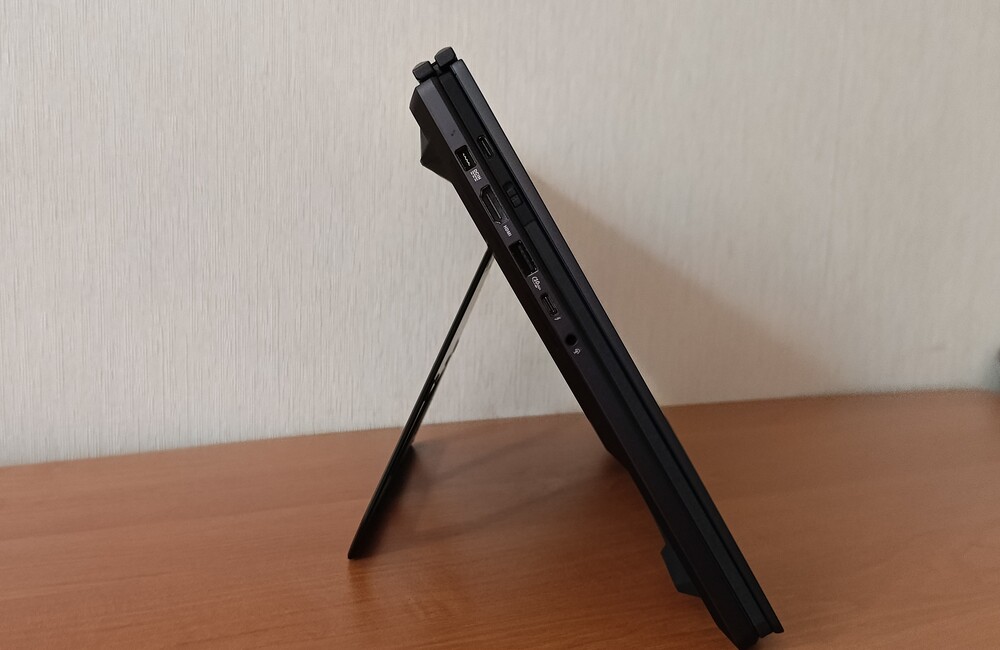
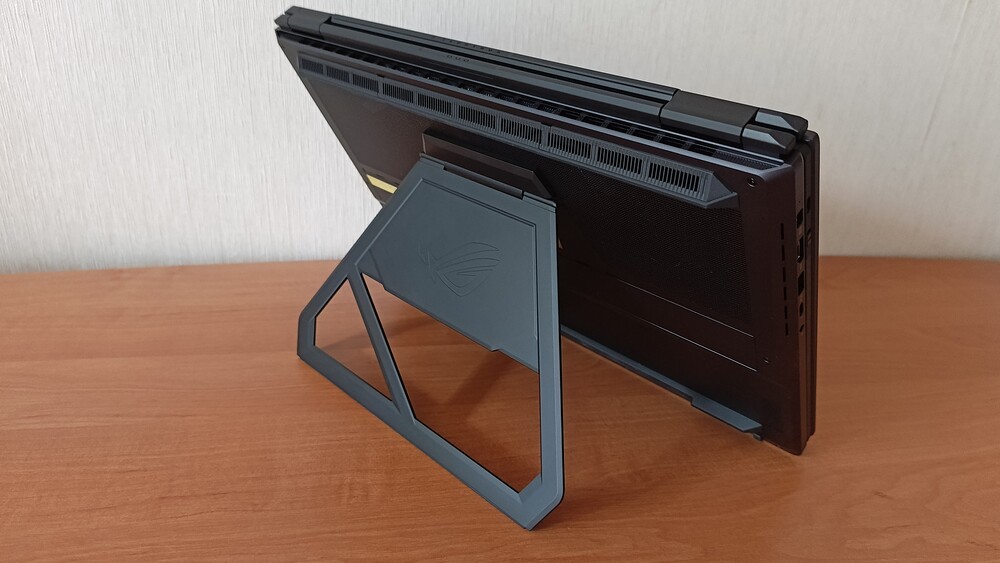
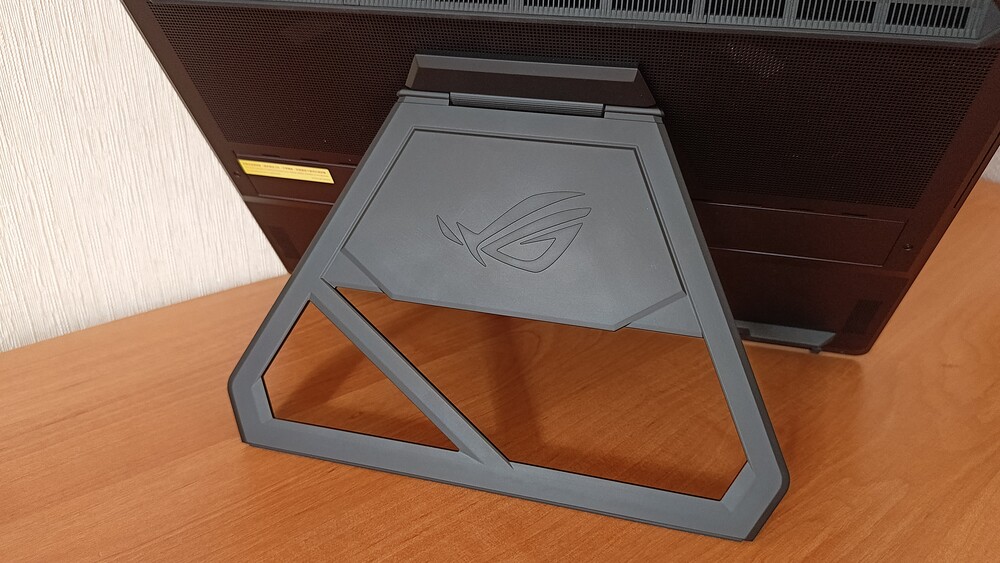
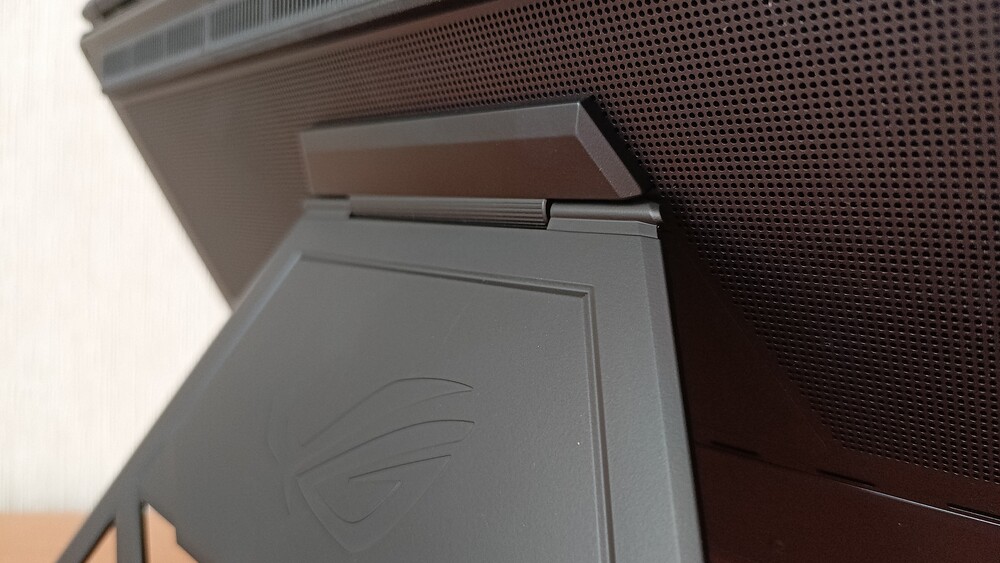
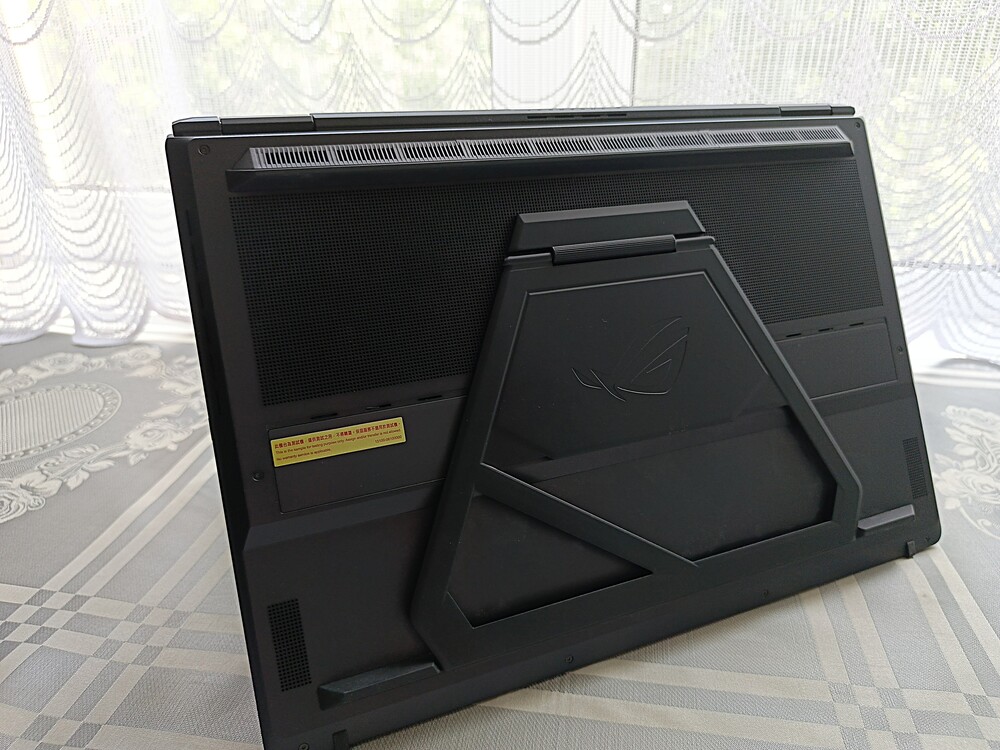
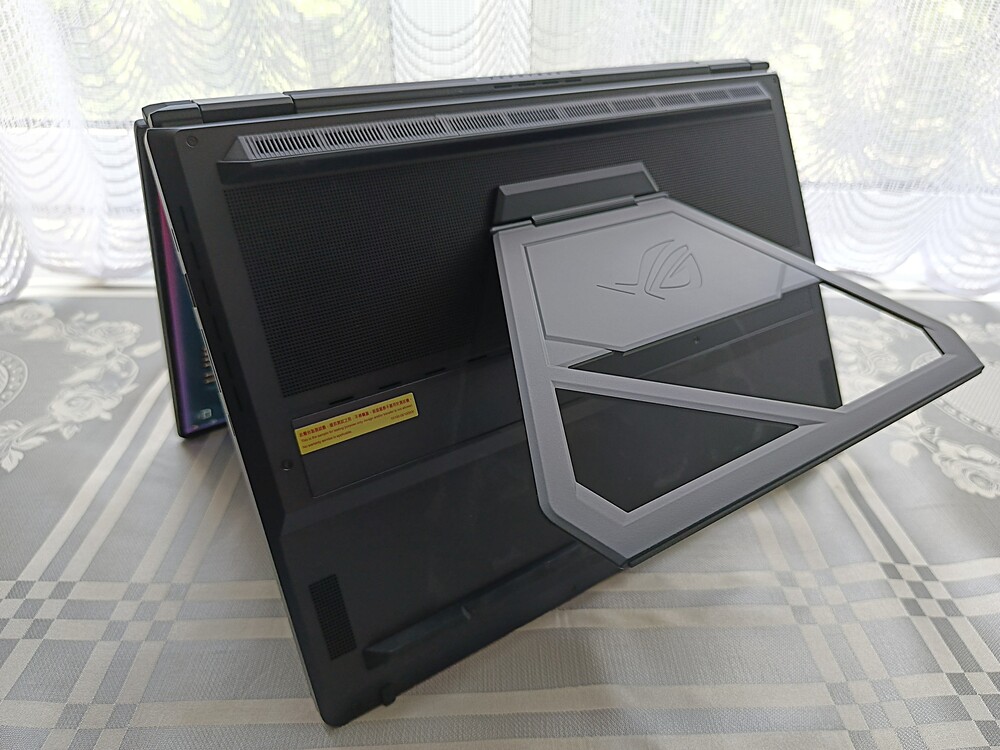
For a more comfortable viewing angle, ASUS has integrated a metal stand into the chassis that helps keep the laptop in a raised position. The mechanism feels solid and performs its function well, although an additional rubber insert could have improved grip on the desk surface.
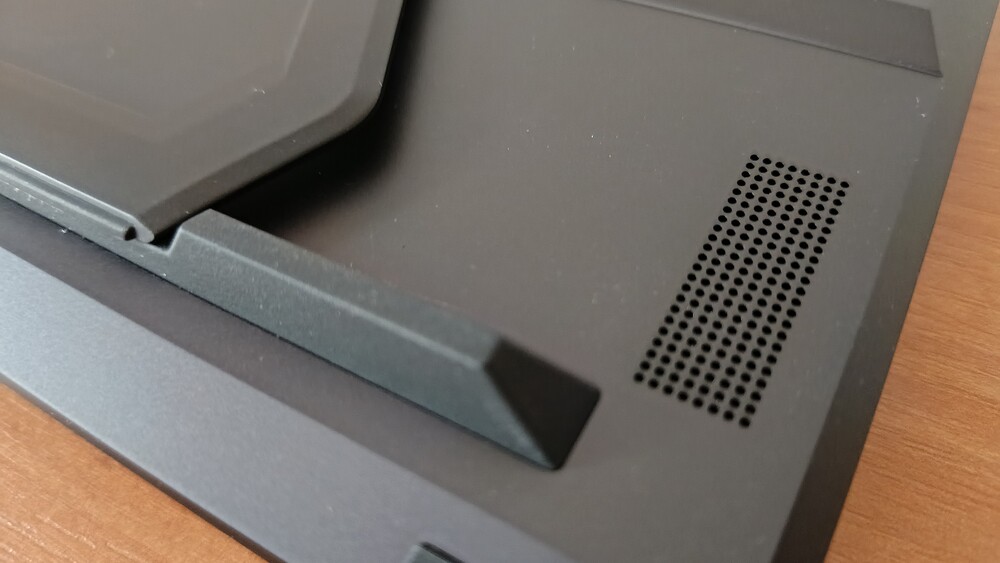
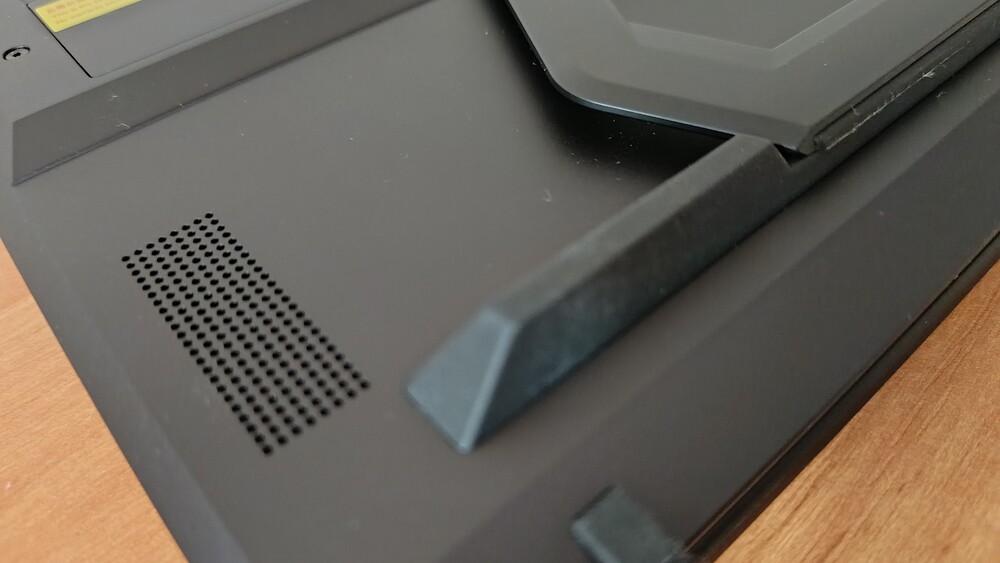
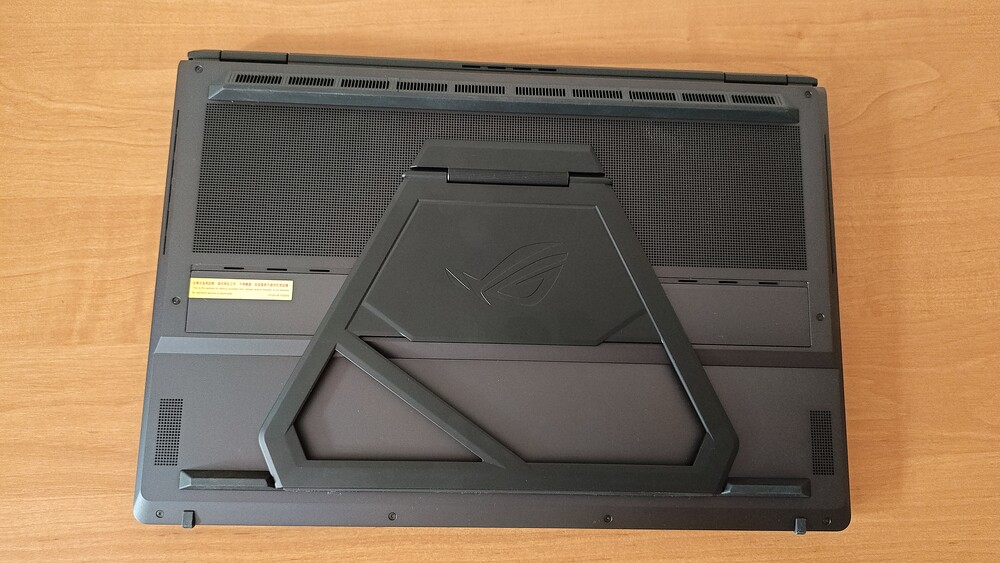
The underside of the chassis also features rubber feet, which provide good stability on a flat surface.
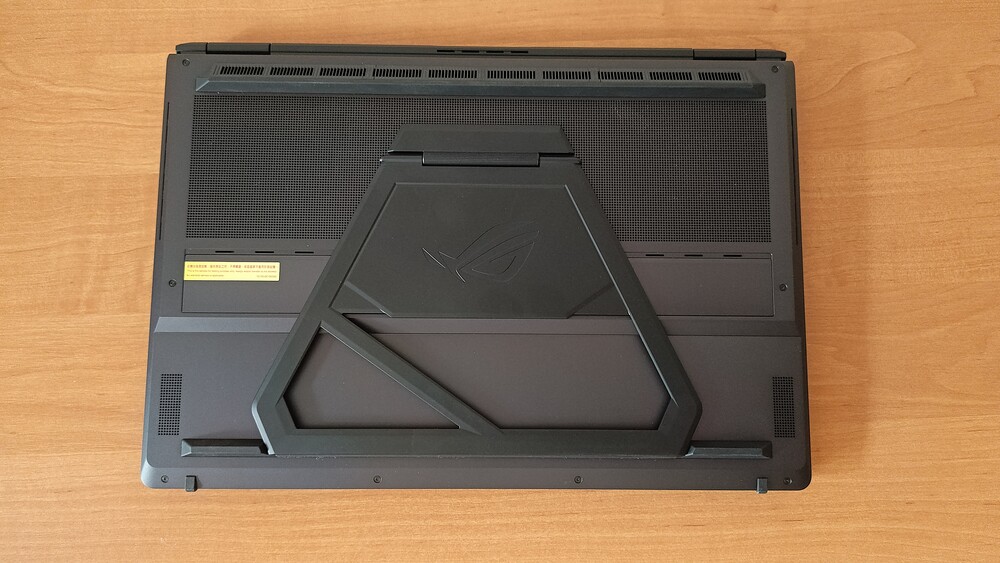
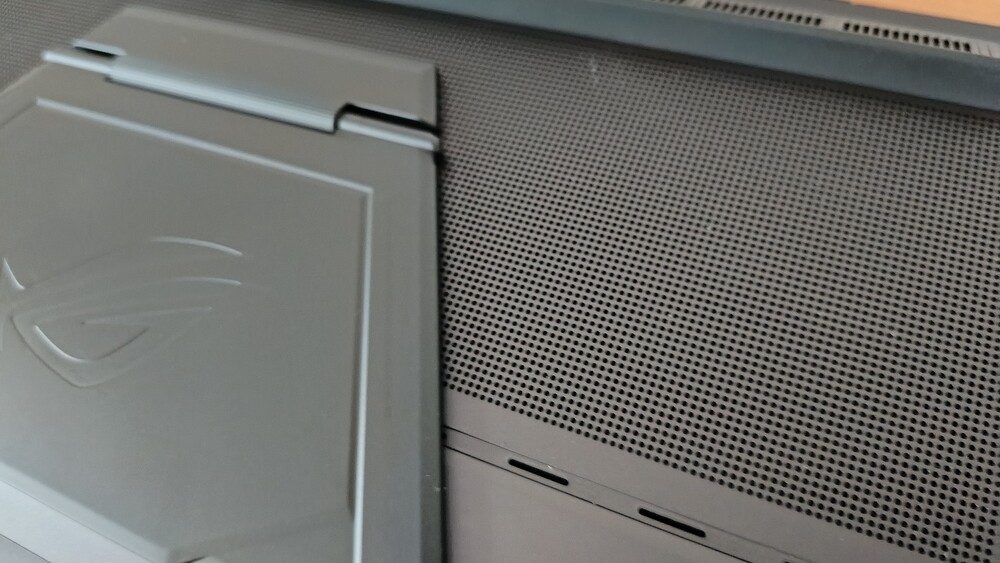
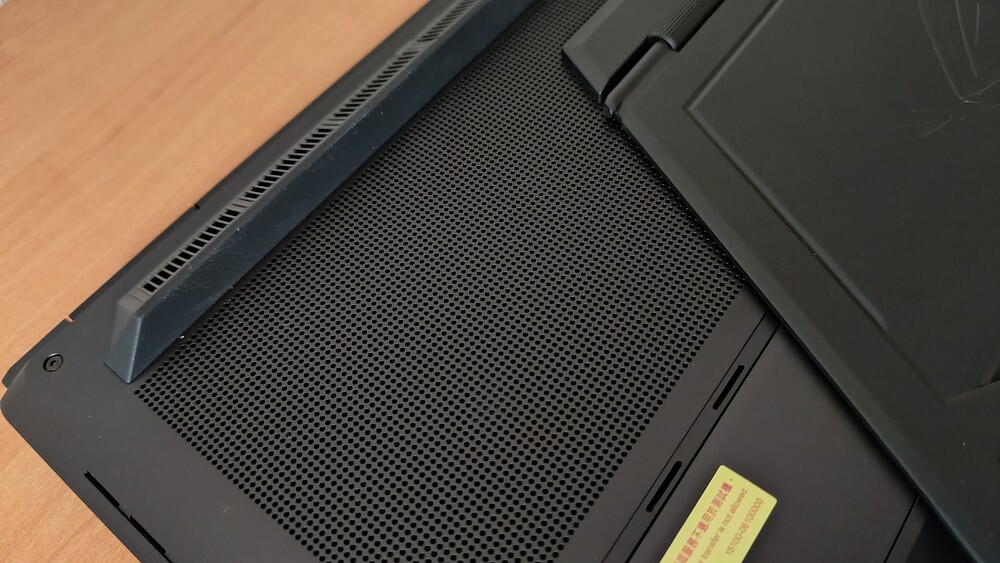
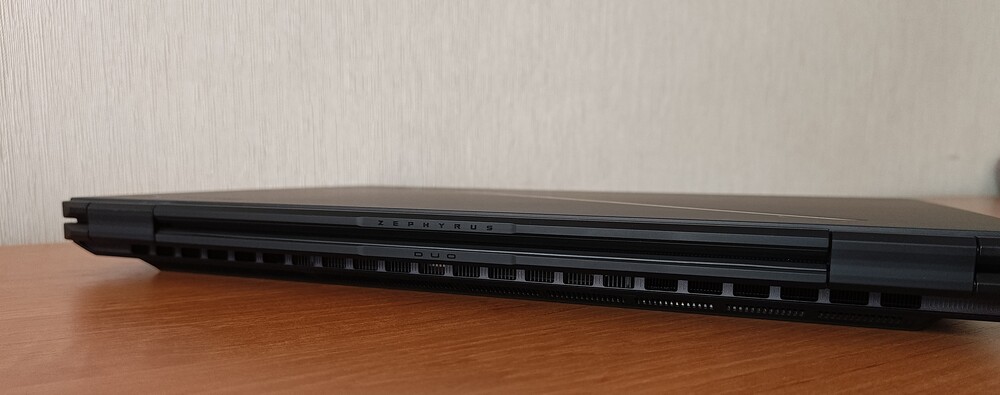
The cooling system occupies a significant portion of the internal space, which is clearly reflected in the large ventilation grilles. The audio system is also thoughtfully designed: the speakers are positioned closer to the front edge of the chassis, directing sound more directly toward the user.

In summary, the ASUS ROG Zephyrus Duo GX651 (2026) is not just a gaming laptop, but a demonstration of what a mobile PC for content creators, streamers, designers, and enthusiasts can look like. It is expensive, heavy, and highly niche, but at the same time it offers an experience that is rarely found in other laptops on the market today.
Ports and connectivity
The port selection on the ASUS ROG Zephyrus Duo GX651 (2026) is modern, well-considered, and sensibly distributed across both sides of the chassis. The laptop includes two Thunderbolt 4 ports, two USB-A 3.2 Gen 2 ports, an HDMI 2.1 output, a high-speed UHS-II SD card reader, and a combined 3.5 mm audio jack. For such an unconventional device, this is a practical and well-balanced configuration.

It is especially good to see a full-size SD card reader. Even in expensive laptops today, this feature is often omitted. For photographers, videographers, editors, and content creators, this is a genuinely important inclusion, as it allows working with media directly, without adapters or dongles.

Thunderbolt 4 also significantly expands the laptop’s capabilities. Through these ports, users can connect external 4K and 8K monitors, high-speed SSDs, docking stations, and even external GPU enclosures. For a mobile workstation, this is a critical feature.
However, there are still some compromises. The most noticeable is the absence of an Ethernet port. For certain gamers and professionals working with large data transfers or requiring maximum stability from a wired connection, this may be a drawback. While modern Wi-Fi 7 is fast and stable in most scenarios, it does not fully replace a wired network connection – especially in congested environments or in competitive gaming situations where latency is critical.
Read also: ASUS ROG Cetra Open Wireless Review: Open-Ear Design, Hybrid Multipoint, and Strong Battery Life
Two 16-inch OLED displays – the main highlight
The dual-display setup is effectively the core reason the ASUS ROG Zephyrus Duo GX651 (2026) exists, and at the same time its strongest feature. This is where the laptop stops being just a powerful gaming machine and becomes a genuinely unique device.

The unit in this review is equipped with two 16-inch OLED panels with a 3K resolution, a 120 Hz refresh rate, and G-Sync support. This is, without exaggeration, flagship-level image quality, suitable both for gaming and for professional work in graphics and video production.

The image quality is striking from the very first minutes: perfectly deep blacks, effectively infinite contrast, rich but not oversaturated colors, and very high detail. The OLED panels here perform exactly as expected from the premium segment.
A high-quality anti-reflective coating further improves usability, noticeably reducing reflections even under bright lighting. Peak brightness of up to 1000 nits makes it comfortable to work not only at home or in a studio, but also near a window or in daylight conditions. Most importantly, both displays are effectively equal. This is no longer a “main display plus auxiliary screen” setup, as seen in earlier Duo generations where the secondary panel always involved compromises. ASUS now uses two near-identical OLED screens, which fundamentally changes the user experience.
In practice, the laptop introduces a new workflow format. A video editor can keep the timeline on the lower display while preview and tools remain on the upper screen. A streamer can play on one display while simultaneously managing OBS, chat, or system monitoring on the other. For programmers or writers, the vertical “book” mode is particularly interesting, allowing code, documentation, or multiple windows to be arranged more naturally and logically than in traditional horizontal laptop layouts.

This is exactly where it becomes clear that the ASUS ROG Zephyrus Duo GX651 (2026) is no longer just a laptop, but an attempt to create a new type of mobile workstation. However, the revolutionary nature of the design also has its downside. Running games across both displays is currently almost impossible. The limitation is not hardware – there is enough performance – but rather the Windows ecosystem and game support itself. Most titles simply do not understand an unconventional 2880×3600 resolution with a 4:5 aspect ratio. This is a typical scenario for innovative devices: the hardware is already ready for a new way of working, while the software is not.
It is also worth noting that both displays are touch-enabled and support a stylus included in the box. For designers, artists, or users who rely on handwritten notes, this opens up an additional layer of functionality. In practice, the laptop partially transforms into a large digital drawing tablet with two active working surfaces.
Read also: ASUS TUF Gaming VG27AQML5A Monitor Review: 2K Fast IPS, 300 Hz, and New AI Modes
Keyboard and touchpad
The detachable keyboard is one of ASUS’s boldest and most interesting design choices in the ROG Zephyrus Duo GX651 (2026). It is precisely this element that allows the laptop to fully utilize the second display and transforms the device from a conventional notebook into something much closer to a next-generation mobile workstation.

The keyboard itself turned out to be surprisingly well executed. It features comfortable key travel, a clear actuation point, and a pleasant typing experience even during long writing sessions or gaming.
It also includes RGB backlighting and programmable macro keys, which will be especially appreciated by gamers, streamers, and video editors. The keyboard can operate either in wired mode via USB-C or wirelessly over Bluetooth. Charging is also convenient: simply dock it back onto the laptop body, and power is transferred automatically through magnetic contacts without the need for separate cables.
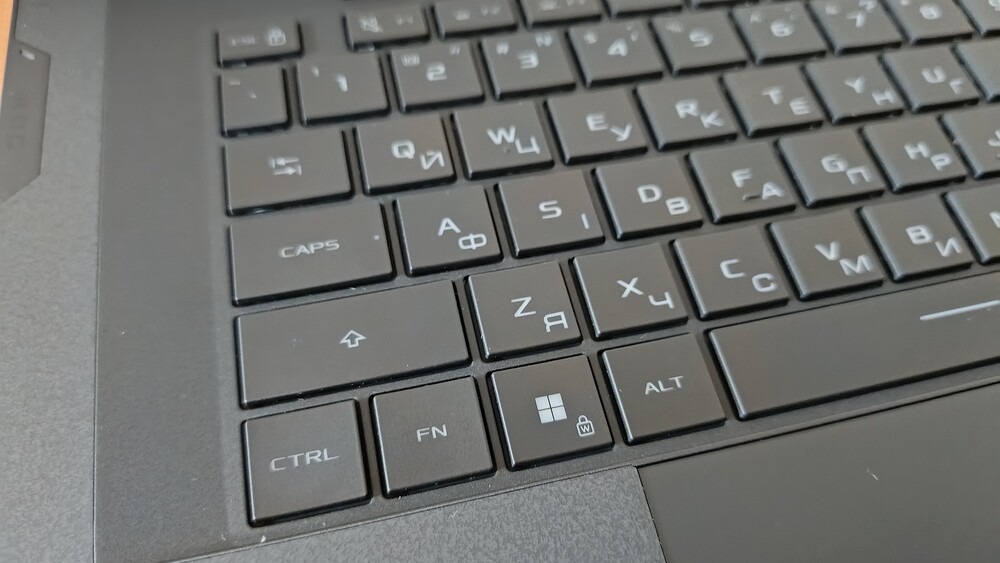
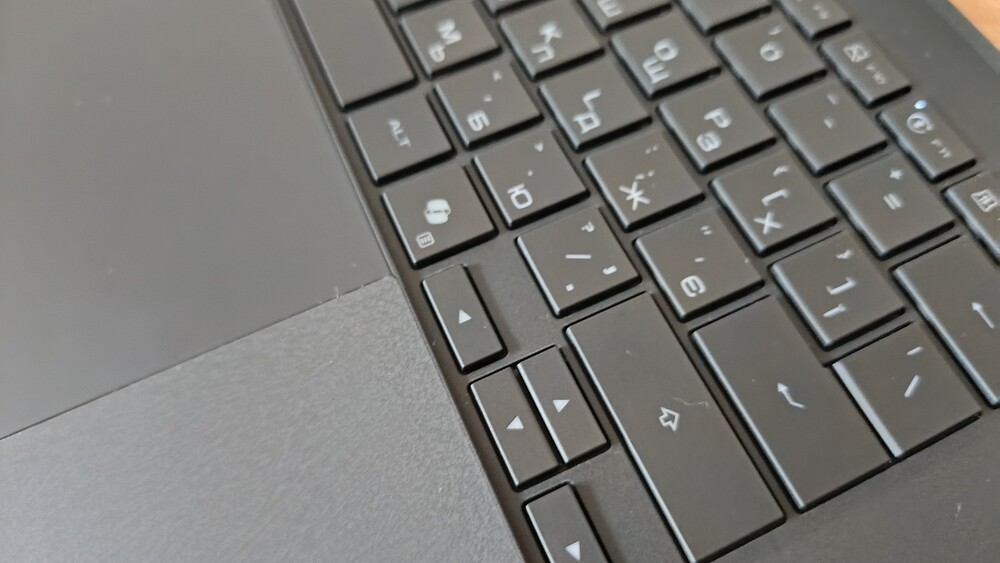


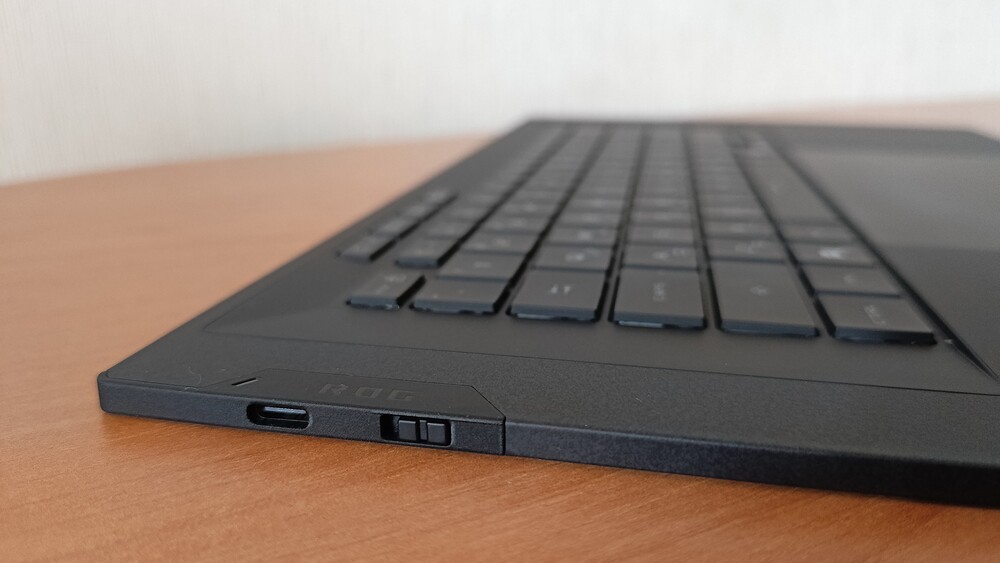
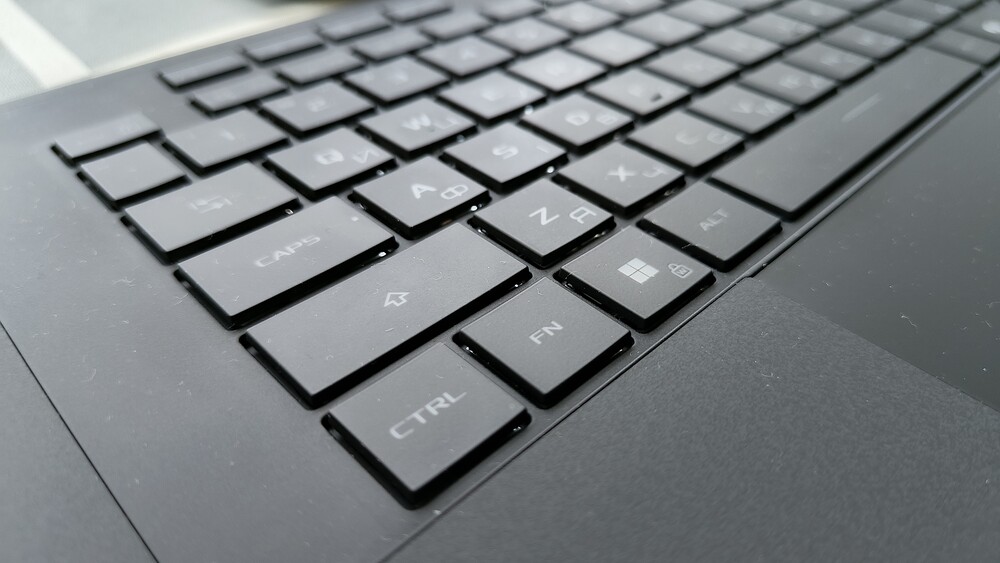
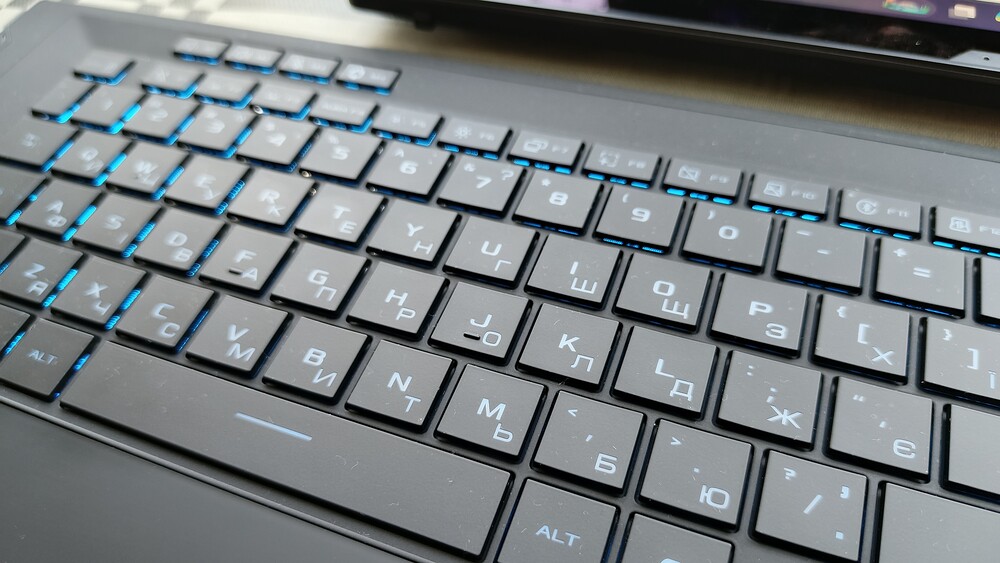
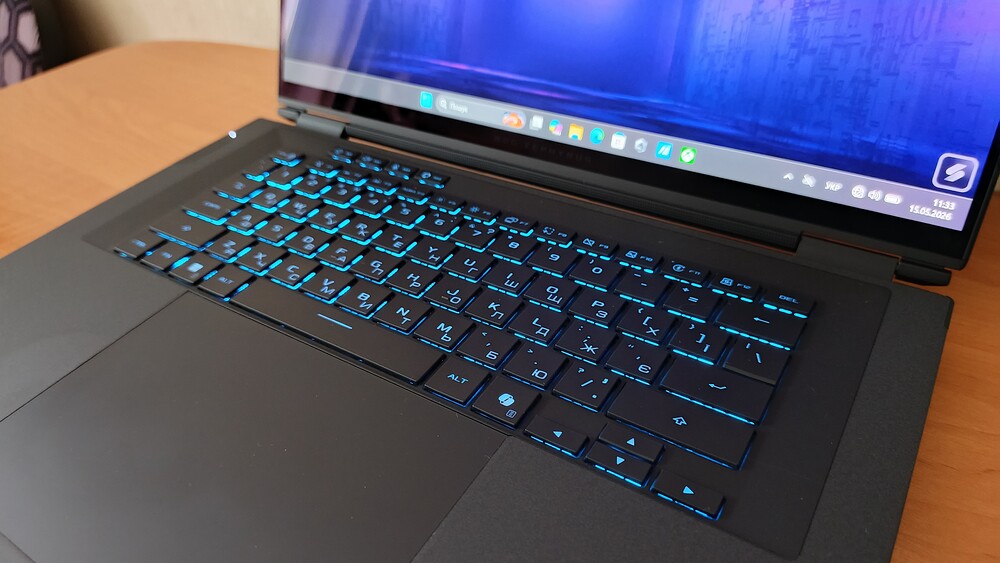
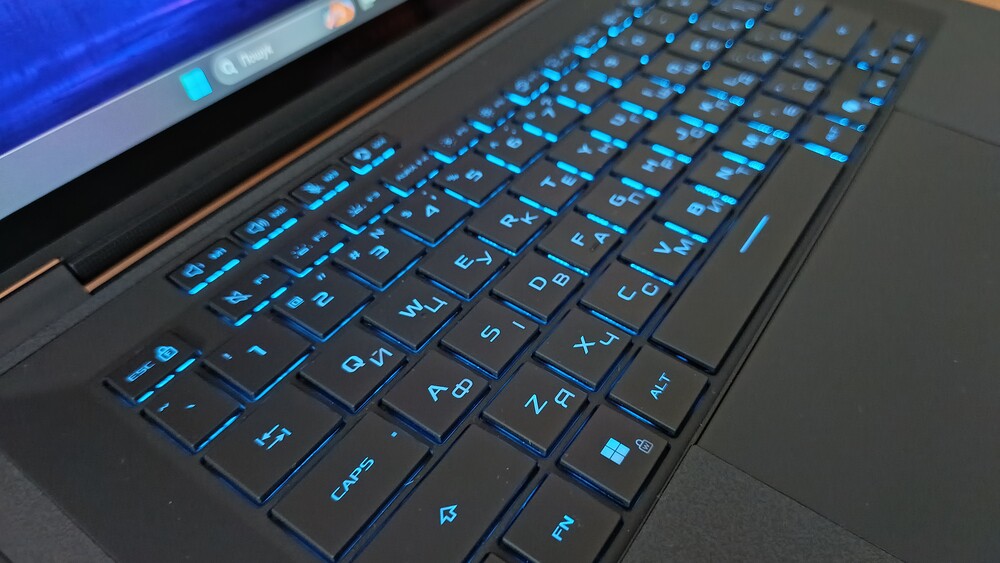
The main advantage of the entire setup is freedom of positioning. The keyboard can be moved aside, placed lower, or used entirely at a distance from the laptop. In this configuration, both displays remain fully unobstructed, and this is where the device’s concept truly comes into its own. It becomes significantly more convenient for video editing, working with large timelines, multitasking across multiple windows, or streaming.

The touchpad is also pleasantly surprising. It is large, smooth, and supports physical clicks, overall delivering the feel of a premium-quality component. Windows gestures work reliably, finger tracking is comfortable, and pointer accuracy is high.
Read also: ASUS ROG STRIX GS-BE18000 Review: Wi-Fi 7 for Gamers
Camera, microphone, and speakers
The Full HD camera with an IR sensor for Windows Hello is positioned slightly higher than on standard laptops due to the dual-screen architecture. Image quality is acceptable for video calls, but nothing beyond that.

The six-speaker setup with Dolby Atmos support and Smart Amplifier technology is genuinely impressive for a laptop. The sound is loud, well-balanced, and remains free of noticeable distortion even at higher volume levels.


For watching movies or background use, it performs excellently. For serious music listening, however, as always, wired headphones remain the better option.
The AI-based noise-cancelling microphone array also performs well. During video calls, voice capture is clear, and background noise is effectively suppressed.
Read also: ASUS ROG Falchion Ace 75 HE Keyboard Review: Expanded Layout, Hotswap, 8000 Hz, and Gear Link
Performance of the ROG Zephyrus Duo GX651
And this is where the ASUS ROG Zephyrus Duo GX651 (2026) becomes one of the most interesting laptops in its class. On paper, the specifications look almost fantastical: an Intel Core Ultra 9 386H based on the Panther Lake architecture, a GeForce RTX 5090, up to 64 GB of RAM, and a fast PCIe 5.0 SSD.

The Intel Core Ultra 9 386H processor turns out to be extremely well-balanced, and this was clearly one of ASUS’s main priorities. The company has successfully combined heat output, noise levels, battery efficiency, and the compact dual-display chassis into a coherent and stable system. In heavy multi-core workloads – such as long rendering sessions, large-scale code compilation, or complex computations – the laptop delivers impressive results. Thanks to a carefully tuned power profile, the system maintains sustained performance without overheating or noticeable throttling.
The situation with the GPU is no less impressive. The device is equipped with the flagship NVIDIA GeForce RTX 5090 Laptop GPU, operating in an optimized power envelope of around 150 W. This allows the cooling system to stay within comfortable thermal limits while maintaining stable performance without temperature spikes.

The cooling system performs well. The laptop remains relatively quiet even under sustained heavy workloads, and temperatures rarely raise concerns. ASUS has deliberately chosen a balanced, premium-oriented design approach rather than prioritizing maximum performance at the expense of acoustics, and this decision appears justified in practice.
For creative workloads, the system performs strongly. Video editing, Blender work, AI content generation, Photoshop, After Effects, and 3D visualization are scenarios where the dual-display setup, 24 GB of GDDR7 VRAM, and up to 64 GB of system memory become practically relevant. This is particularly noticeable in professional use cases where large VRAM capacity and multitasking across multiple applications are important.
For gaming, the laptop also delivers a solid experience: stable frame rates in modern AAA titles, the absence of noticeable micro-stuttering, and comfortable thermals during extended play sessions make the GX651 suitable for users who want to combine gaming with creative work on a single device.
The 2 TB PCIe 5.0 SSD is a clear strength. The system is very responsive, application and system load times are short, and handling large file transfers does not present any issues.
Read also: Through Nuclear Fire: Trinitite – A Material That Should Not Exist
Cooling and thermals
ASUS has taken a sound engineering approach here. The elevated position of the secondary display helps improve airflow intake. The use of liquid metal on the CPU, a vapor chamber cooling solution, and a graphite-based insulating layer between the mainboard and the panels indicates a well-considered thermal design rather than a minimal implementation.

Under load, the CPU stays around 60–75°C, while the GPU reaches up to approximately 69°C. For a system equipped with an NVIDIA GeForce RTX 5090, these are strong thermal results. The fans are virtually inaudible during typical everyday use. They become more audible under gaming workloads, but even then the noise level remains controlled and not particularly distracting.
Read also: Hantavirus: Virus from a barn that killed people in the middle of the ocean
Battery life
Battery life is one of the more notable strengths of the ASUS ROG Zephyrus Duo GX651 (2026). For a laptop equipped with two 16-inch OLED displays and an NVIDIA GeForce RTX 5090, the 90 Wh battery delivers results that exceed typical expectations for this class of hardware.
Under light workloads with only one active display, the system can last over 14 hours. This is a strong figure for a device of this performance level. With both displays active in a productivity-oriented scenario – such as web browsing, document work, and background tasks – runtime is reduced to roughly 6–7 hours on a single charge. Even video playback or streaming services like Netflix yield around 11 hours of battery life, which is notably high for a dual OLED configuration.

This is where ASUS’s engineering approach becomes most apparent. The observed battery life is achieved through intelligent power management, balancing quiet operation, low temperatures, and consistent endurance under different workloads. This design choice is particularly relevant for content creators, designers, video editors, and users who frequently work on the move. In practice, this balance proves to be a pragmatic trade-off between performance, acoustics, and mobility rather than a single-performance-focused optimization.

An additional advantage is support for USB-C charging up to 100 W. This is a practical feature for everyday use cases, particularly when carrying the larger 250 W power adapter is inconvenient or unnecessary.
Read also: Computers in Space: Limitations as an Advantage
How does working with two screens work in practice?
This brings us to the most interesting part of the review – real-world usage. This is where the ASUS ROG Zephyrus Duo GX651 (2026) either demonstrates its practical value or raises a reasonable question of necessity: whether a dual-screen setup is actually required for a given workflow.

The first day with two 16-inch OLED displays almost inevitably delivers a strong “wow” effect. The design looks futuristic, the system draws attention from everyone around, and the amount of usable workspace compared to a conventional laptop feels almost excessive. However, after a few days of use, the ROG Zephyrus Duo starts to feel more pragmatic, making it easier to assess who this concept is actually intended for.
The laptop was tested in different modes. In the traditional configuration, with the lower display covered by the keyboard deck, it behaves like a standard premium laptop without any unusual interaction requirements. This is an important aspect, as the ROG Zephyrus Duo does not force users to actively engage with the secondary screen at all times.
The most interesting experience emerges when both displays are in use. The stacked-screen layout proves to be significantly more practical than it initially appears in promotional images. The primary upper display can be used for the main workspace – such as video editing, browsing, coding, or gaming – while the lower screen handles secondary tools like timelines, Spotify, Discord, OBS, utility panels, or chat applications. After several hours of use, returning to a single-screen setup can feel noticeably limiting.

The “book” mode, with the displays arranged vertically, is likely the most niche use case, but it also best demonstrates the potential of this design. For programmers, journalists, analysts, or anyone working with large volumes of text and documentation, this layout can in some cases feel even more practical than traditional widescreen monitors.

However, a practical question arises quite quickly: where is all of this actually usable in practice? The laptop itself, at 2.82 kg, is still manageable to place on a desk or take on a trip. However, the detachable keyboard requires separate space in front of the device, and in some cases additional room for proper hand positioning. As a result, ASUS’s solution is best utilized in a proper desk setup, where sufficient workspace is available.

This makes it clear that ASUS did not aim to build a universal laptop for everyone, but rather a specialized tool designed for a specific workflow and user profile.
At the same time, it is worth noting that, after using the vertical dual-display setup with the keyboard placed in front, switching back to a conventional laptop can feel less comfortable. The sense of available workspace, multitasking capability, and overall control over the workflow is genuinely different in this configuration.

This is the core idea behind the ROG Zephyrus Duo 2026: it introduces a different way of interacting with a laptop. Depending on the user’s workflow, it either aligns very well with practical needs or remains an expensive technological experiment with a more limited real-world necessity.
Read also: John Ternus: The Engineer Apple Has Been Waiting For for Quarter Century
Conclusion
The ASUS ROG Zephyrus Duo GX651 (2026) is one of the most ambitious laptops I have handled. It is impressive, unconventional, and prompts a reconsideration of what a “portable computer” actually is. It also demonstrates that two full-size 16-inch OLED displays are not merely a marketing concept, but a genuine functional advantage for specific workloads.

Who I would recommend the ASUS ROG Zephyrus Duo GX651 for: This laptop is best suited for video editors, streamers, 3D artists, designers, and developers who require a large working area without relying on external monitors. It is also relevant for users who frequently find themselves thinking, “I wish I had a second screen right now” – the ASUS ROG Zephyrus Duo GX651 directly addresses that need.
Who should consider alternatives: Users who prioritize maximum portability and primarily work on the go may find a traditional laptop form factor more practical for their specific use cases.
This is not a laptop for everyone. However, if you are certain that a dual large OLED display setup will meaningfully improve your workflow, there is currently nothing quite like it on the market.

ASUS ROG Zephyrus Duo GX651 (2026) is a niche, experimental product. It explores a different design direction compared to conventional high-performance laptops, which largely follow a similar form factor with incremental hardware improvements. In contrast, ASUS takes a more unconventional approach here, focusing on a dual-display configuration that changes how the device can be used in practice.
After using this laptop, standard laptop designs can feel somewhat less engaging in comparison, primarily due to the reduced available workspace and lower flexibility in multitasking scenarios.
Read also:
- ASUS ExpertBook Ultra Laptop Review: Distinctive Blend of Hardware and Design
- ASUS ProArt P16 H7606WX Review: Ultrabook with RTX 5090 and 24 GB of VRAM
- ASUS ROG Strix G16 (2025) G615 Review: Almost a Flagship on Blackwell
Where to buy the ROG Zephyrus Duo GX651


 is undoubtedly one of the most unique laptops currently available. Today, we’re taking a closer look at this beast.)