





© ROOT-NATION.com - Use of content is permitted with a backlink.
The human eye is a biological camera that allows us to perceive the world as a continuous, detailed stream of information. We often treat our vision as a reference point, yet – like any optical system – it operates within a clearly defined physical limit. This limit, known as resolution, is determined by two primary factors: the wave nature of light (diffraction) and the biological structure of the retina, specifically the density of photoreceptors. Our ability to discern fine details is a direct result of this scientific balance between the physics of light and human anatomy.
A recent study published in Nature Communications has, for the first time, measured the actual resolution of the human visual system using a new experimental setup. “Retinal resolution” represents the upper limit beyond which our visual system can no longer distinguish differences. As modern displays approach this threshold, researchers sought to determine the exact point at which adding more pixels no longer improves perceived image quality. That’s the question we’ll look at today – stay with us.
Read also:When Math Meets Art: How JPEG Magic Works
TABLE OF CONTENTS:
Where the Limits of Human Vision Begin
Earlier scientific work on retinal resolution has largely taken a fragmented approach. These studies focused on individual components, such as the effect of optical aberrations in the eye, the ability to track moving objects, the recognition of specific shapes, or the measurement of visual acuity in isolation.
In contrast, the current study employs a holistic, integrated method. Beyond identifying a clear resolution limit for high-quality displays – which is technically significant – it also examines perception in a broader context. The researchers analyze how resolution varies across different regions of the retina and assess how color-dependent changes affect visual acuity, even under identical lighting conditions. Together, these findings aim to provide a more complete understanding of the upper boundary of human visual perception.

The resolution of the human eye is determined by a complex and often unpredictable interaction of neural and optical factors. The limits of what we can perceive change dynamically depending on the type of stimulus, its color, brightness, motion, and the exact location where the image is projected onto the retina.
On the optical side, several physical constraints are at play. Optical aberrations – imperfections on the corneal surface – scatter light as it passes through various layers of the eye, leading to less-than-ideal focusing on the retina. Diffraction of light passing through the pupil sets a fundamental limit on the highest spatial frequency we can resolve. Accommodation, the process by which the lens adjusts its curvature to bring objects into focus, also affects resolution; inaccuracies in this mechanism directly shift the upper limit of visual precision at different viewing distances.
On the biological level, the uneven distribution of photoreceptors and ganglion cells is crucial. The highest resolution is achieved in the fovea, a small region densely packed with cones responsible for color perception and fine detail. This concentration is what enables the sharpest vision. As one moves toward the periphery of the retina, cone density decreases, resulting in a predictable reduction in visual resolution.
Read also:19 Minutes to Apocalypse: Review of ‘A House of Dynamite’ (No Spoilers!)
The experiment that revealed the truth
To determine the actual resolution limit of the retina, an experiment must rely on a methodologically precise setup. It has to provide a continuous and finely controlled adjustment of the stimulus being displayed. Only under these conditions is it possible to pinpoint, with mathematical accuracy, the threshold at which the eye can still perceive an image clearly, without any trace of blur or softness.
This requirement introduces a technical challenge: the resolution of an electronic display is discrete. It can be reduced only in whole-number steps relative to the native pixel count. As a result, intermediate resolutions require digital resampling, a process that inevitably distorts the original spatial frequency of the stimulus and introduces measurement errors.
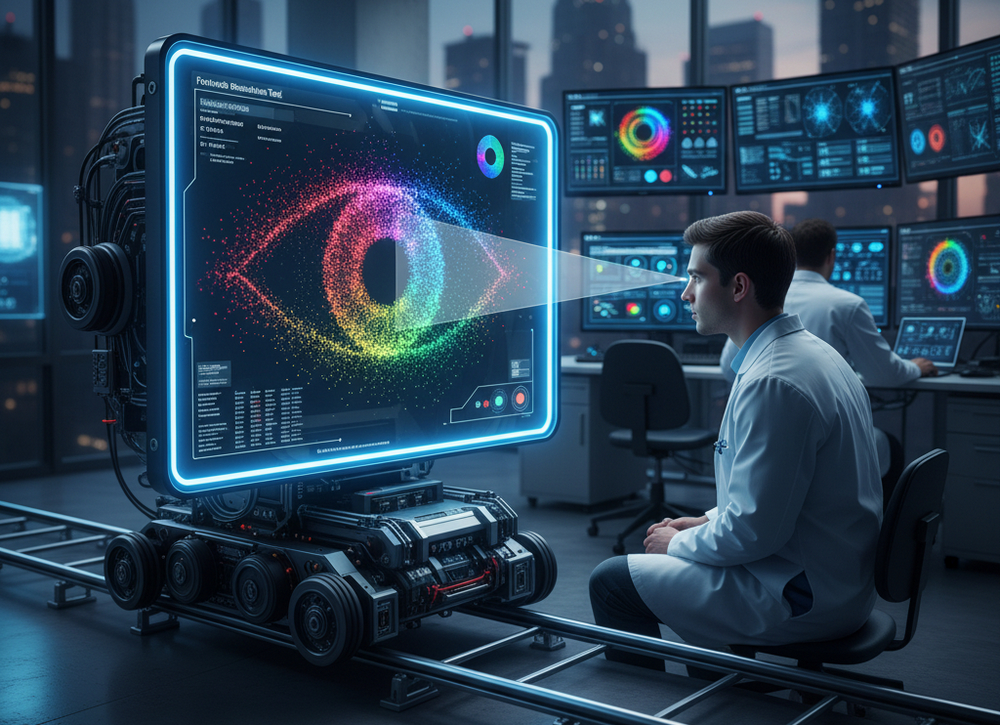
To avoid this technological limitation, the researchers employed an elegant solution: a motorized sliding display. By moving the image toward or away from the viewer with high precision, they were able to adjust the effective resolution continuously, without introducing digital distortions. Measurements were performed binocularly, which provided a more realistic approximation of natural vision and allowed the team to capture subtle effects of binocular summation. In essence, this refined method can be seen as a modern counterpart to Wertheim’s 1894 study, which used simple wire grids to examine how resolution decreases at various parafoveal positions.
With this improved experimental setup and reliable psychophysical techniques, the researchers were able to establish precise behavioral thresholds of visual resolution. They measured foveal resolution for both achromatic (black-and-white) and chromatic (red-green and yellow-violet) stimuli, expressing the results in pixels per degree of eccentricity (ppd). The long-standing benchmark of 60 ppd, derived from 20/20 visual acuity, turned out to be an underestimate.
The experiment showed that average foveal resolution for achromatic stimuli at zero eccentricity is 94 ppd, with individual values reaching up to 120 ppd. For color vision, the foveal limit was 89 ppd for red-green patterns, compared with 53 ppd for yellow-violet patterns, indicating higher sensitivity in the red-green color channel. These findings are significant for modern display technology: as screen resolutions – such as 65 ppd on the 7th-generation Apple iPad Pro – approach these newly established thresholds, further increases are unlikely to yield noticeable improvements for most users. Additionally, the data offer guidance for optimizing video compression by exploiting the eye’s asymmetric color sensitivity to reduce data requirements without compromising perceived quality.
Read also: Atomic Horizon: How Humanity Pushes Chips to Edge of Possibility
What this limit means for modern technology
The data obtained in the study not only confirm earlier findings but also expand them by covering the entire visual system through measurements of binocular acuity, which provides a more natural metric than monocular tests. The observed decline in resolution toward the periphery for chromatic stimuli further supports – and broadens – the applicability of advanced techniques such as foveated rendering and foveated compression. These approaches conserve computational resources and bandwidth by reducing chromatic, but not achromatic, resolution and removing details that remain imperceptible to the human eye.
Researchers also developed a probabilistic model of resolution limits for the general population, showing substantial individual variability, particularly in peripheral vision. This model allows designers to move away from targeting an “average” observer and instead optimize displays for a chosen proportion of users – for example, achieving “retinal resolution” for 95% of the population.
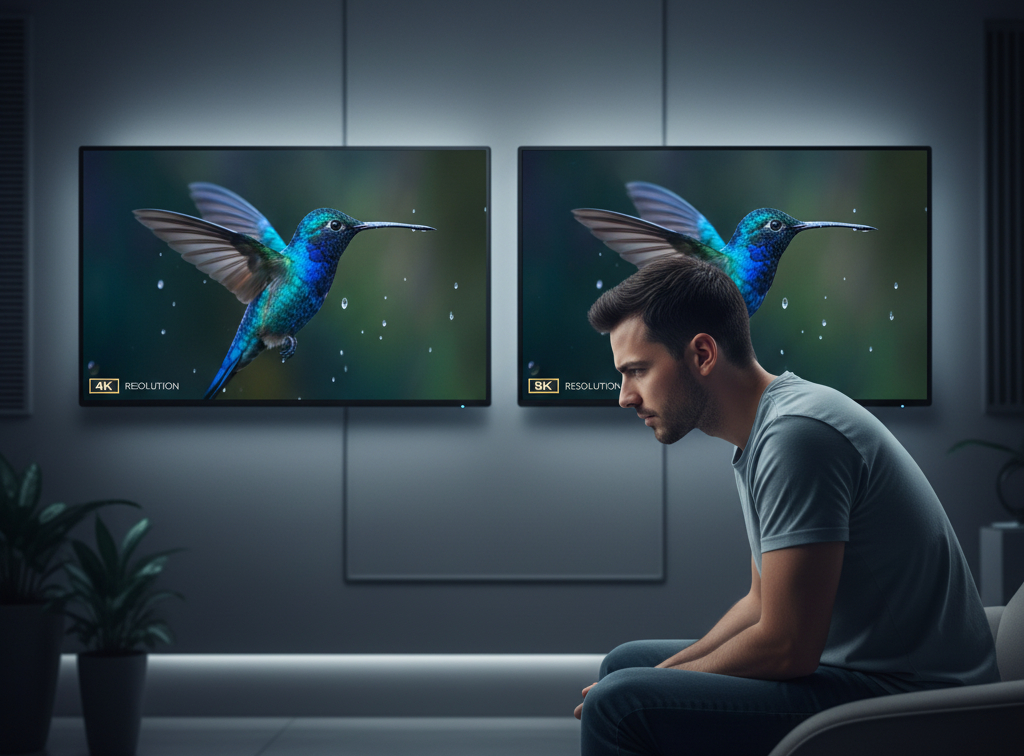
The results of this practical study focus on how the human visual system responds at real-world viewing distances. They provide a potential basis for updating outdated industry guidelines. For instance, the study found that extremely high-resolution television content (such as 8K) offers no visible advantage over 4K images when viewed from distances greater than 1.3 times the screen height. Beyond this distance, the eye is simply unable to resolve individual pixels, clearly defining the effective resolution limit of human vision.
Read also:Breakthrough Development: Scientists Create Artificial Muscles Activated by Ultrasound
What this study really revealed about human vision
In this way, the comprehensive investigation of the actual resolution limits of the human eye transformed historical assumptions into precise scientific data. It showed that retinal resolution is not a fixed number but a dynamic threshold influenced by color, retinal location, and individual variability. The researchers determined that the fovea can resolve up to 120 ppd for achromatic stimuli, and that the red-green color channel is significantly more sensitive than previously thought.
These results demonstrate that there is a limit beyond which individual pixels become imperceptible. This insight enables more efficient use of computational resources through techniques like foveated rendering and discourages the pursuit of excessive detail that the eye cannot resolve at typical viewing distances. The actual resolution limit of the human eye is not a limitation of biology but, rather, an intellectual challenge for technology: instead of providing more than we can perceive, focus on making what we do see as precise and accurate as possible.
Read also:
- How to Spot Fake Photos: New Challenges of the Digital Age
- Why You Shouldn’t Ask a Chatbot “Where to Hide a Body?”: Top Questions You Should Avoid Asking AI
- Closer Than Ever: What Is the Dead Internet Theory?

