





© ROOT-NATION.com - Use of content is permitted with a backlink.
My verdict after testing multiple AI browsers? There’s still nothing better than a good old “dumb” browser.
To clarify – this isn’t about technological skepticism. Quite the opposite. I’m one of those users textbooks call early adopters. My interest in innovation is far from theoretical: I’ve been using VR headsets since 2014, installed smart speakers in every room of my apartment back in 2016, chat with various AI models regularly (even in the shower), and bought my first pair of smart glasses long before it became mainstream – in 2019.

Technological innovations rarely make me skeptical – quite the opposite, I usually test them eagerly, exploring new use cases and assessing market potential. Yet, despite all that, the category of AI-powered browsers makes me cautious. Unlike in other areas, here innovation doesn’t necessarily translate into a better user experience. Perhaps the issue isn’t the technology itself, but rather that AI integration in browsers still feels more experimental than practical.
Read also: Comet AI Browser by Perplexity review: Is It Time to Switch?
TABLE OF CONTENTS:
What exactly are browsers with artificial intelligence?
Dia, Perplexity Comet, and ChatGPT Atlas are three examples of browsers that didn’t even exist as concepts just a few months ago. Today, they’re positioned as next-generation products – built from the ground up with deep AI integration in mind. But it’s not just startups experimenting anymore – even tech giants are now actively rethinking the very idea of web browsing itself.

Just look at the recent developments over the past few months:
- Google has integrated its Gemini assistant into Chrome and is testing a separate AI agent under the codename Project Mariner, currently limited to U.S. users.
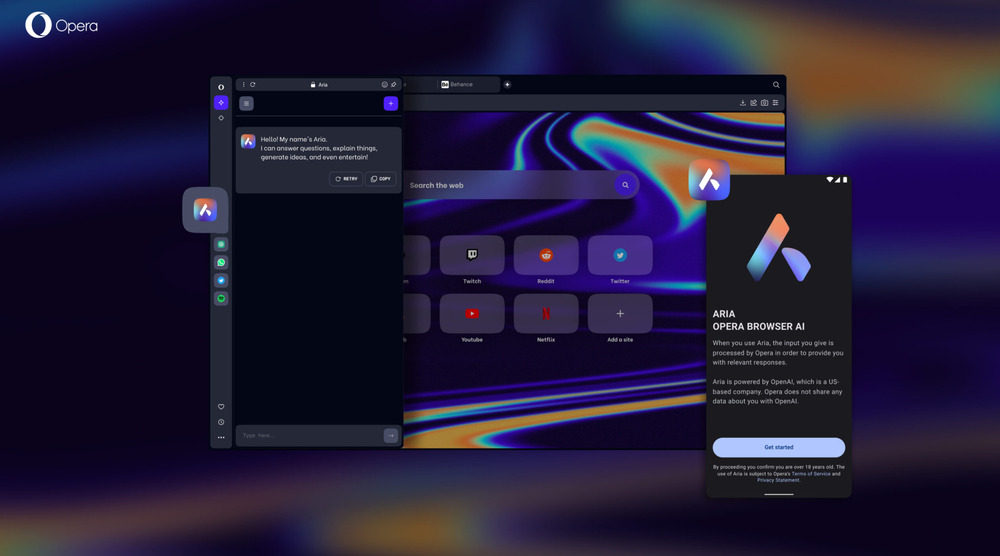
- Opera introduced Opera Neon in September – a new browser designed from the ground up as a platform for AI interaction.
- Microsoft, meanwhile, added the Copilot mode to Edge back in August. For now, it handles supporting tasks, but it’s gradually evolving toward a full-fledged personal agent capable of acting on the user’s behalf.
All these initiatives share a common goal – to make artificial intelligence a constant intermediary between humans and the web. The idea isn’t just to help users find information faster, but to enable AI to understand browsing context, anticipate needs, and even perform actions on the user’s behalf.

For instance, while you’re reading a cooking blog, the browser could automatically generate a shopping list based on the recipe you’re viewing. Or, if you’re planning a vacation, it might search for the cheapest flights on your preferred dates, navigate to the airline’s website, use the built-in search engine, and even fill out booking forms – all without your direct input.
Conceptually, this feels like the next logical step in the evolution of the internet experience – shifting from active engagement to task delegation via digital agents. Yet, in practice, there are at least three reasons why I’m not ready to fully embrace this movement.
Read also: The Third World War of Browsers: Has It Already Begun?
Artificial intelligence agents in browsers are terribly slow
The first AI-powered browser I tested was Perplexity Comet. At first glance, everything looked promising: the built-in AI agent could actually navigate websites, open pages, and even perform simple actions. However, in practice, its operation felt like watching the web in slow motion – tasks that would take me 30 seconds to complete required two to five minutes for the AI.

A similar story unfolded with Opera Neon. Just before its launch, the developers candidly admitted that, for now, humans are still much faster. Their stated goal, however, is to make the AI browser ten times quicker within a year. Ambitious – but for the moment, still far too slow to make sense in real-world use.

At this point, I simply don’t see the logic in waiting a full minute for something I can do in a few seconds. Sure, some might argue, “But you could be having dinner while the browser books your hotel room!” It sounds convenient – yet in reality, it’s an illusion of automation. And this brings us to another major issue with AI browsers: they may save your clicks, but they don’t actually save your time.
Read also: AI in Medicine: Is the Future Already Here?
AI agents are not yet reliable enough to be left alone
When I tested Comet and Opera Neon shortly after their release, I wanted to evaluate not just speed but also the functional reliability of their built-in AI agents. I gave the browsers three simple but telling tasks:
“Find the cheapest smartphone with 512 GB of storage and add it to the cart” – on Rozetka.
“Find the cheapest vacation for two in the Carpathians and book it for the holidays” – on Booking.com.
- “Find articles written by Yuriy Svitlyk on October 20” – on root-nation.com.
The results were revealing. Perplexity Comet successfully completed two out of three tasks, showing some ability to understand context and act autonomously in a web environment.
Opera Neon, on the other hand, failed to complete any of the tasks correctly. The developers responded quickly to my feedback, requested detailed input, and within a few days reported that they had made code adjustments specifically for these use cases. This demonstrates an active experimental phase and a rapid feedback loop, but it also highlights the system’s instability at a fundamental level.
The issue isn’t just speed – it’s also a matter of trust. When a tool has direct access to your browser, forms, payment information, and the ability to click buttons on your behalf, any mistake shifts from being a mere technical flaw to a real-world risk.
At this point, the intelligence of these agents resembles a child who has learned to use a mouse but doesn’t yet understand the consequences of their actions. Until their autonomy is matched by sufficient accuracy, I’m not willing to trust a browser with tasks involving payments or bookings. After all, nobody wants to end up with 256 pizzas delivered because their “smart” browser decided it was the best deal of the day.
Read also: Cryptography: What It Is and How It Works
And finally, safety…
I won’t dwell on the security risks of AI browsers at length – it’s enough to quote the developers themselves.
In a press release announcing the launch of ChatGPT Atlas, the OpenAI team explicitly acknowledged significant threats:
“The capabilities of the ChatGPT agent still carry risks. Beyond potential errors when performing actions on your behalf, agents are vulnerable to hidden malicious instructions that could be embedded, for example, in websites or emails, altering the agent’s expected behavior. This could lead to data theft from sites where you are already logged in or to actions you did not intend to perform.”

The developers note that they have already conducted “thousands of hours of targeted security testing,” yet they acknowledge that even these efforts cannot fully prevent potential attacks, especially as AI agents become increasingly widespread.
In practice, this is an official admission that the current level of security in AI browsers remains experimental. On one hand, companies aim to create a convenient, autonomous tool capable of interacting with the web on its own. On the other hand, even the developers of these systems cannot guarantee that an agent won’t become a vector for malicious manipulation or accidental data leaks.
During their presentation, OpenAI advised users to “weigh the trade-offs and carefully decide what information they are willing to trust to the agent.” In other words, the risk is ultimately placed on the user.
From this, I’ve drawn a conclusion that seems the most rational for now: I minimize risks, just as the developers recommend, and for the time being, I’m returning to my tried-and-true “dumb” browser – the only one I can still trust without relying on elaborate security instructions.
Read also:
- How Chinese Companies Circumvent the US Ban on AI Chips
- How to Spot Fake Photos: New Challenges of the Digital Age
- ChatGPT-5 from OpenAI: What the New AI Model Can Do
- Sex Robot Industry: New Rules in the Age of Technology

