





© ROOT-NATION.com - Use of content is permitted with a backlink.
Is the reality we experience really limited to just three spatial coordinates? Does a fourth spatial dimension exist? Today, we’re exploring exactly that.
TABLE OF CONTENTS:
Origin of the question
The question of whether additional dimensions exist has long moved beyond purely philosophical debate and entered the realm of concrete scientific inquiry. Albert Einstein showed that space and time form a single four-dimensional structure – the spacetime continuum. Modern theoretical models, such as string theory, along with research by physicists like Brian Greene from Columbia University, suggest the existence of additional dimensions that are fundamentally imperceptible to our senses. Greene, in particular, provides a clear explanation of how to conceptualize the fourth dimension.
Read also: Mysterious Object 3I/ATLAS: Comet or Extraterrestrial?
Explanation by Brian Greene
The mathematical models describing these hypothetical dimensions are internally consistent and help explain a range of fundamental phenomena. At the same time, experimental evidence is still lacking, and this absence of verified data remains the main limitation for the development of theories involving higher-dimensional space.
In his explanations, Greene emphasizes that our understanding of space is based entirely on direct experience. We can move left and right, forward and backward, up and down, but this three-dimensional view may be just a projection of a more complex structure.

“That’s the point,” Greene says. “These are new places our experience doesn’t allow us to reach directly, but according to these theoretical ideas, they could exist there.”
According to current hypotheses, additional dimensions might be extremely small, folded into complex geometric shapes, or distorted in ways that make them undetectable without specialized theoretical and experimental tools.
Read also: Can a Modern Human Live to 150 Years?
What does something we cannot see look like?
To illustrate the complex concept of higher dimensions, Brian Greene uses a simple analogy with a garden hose. From a distance, it appears as a one-dimensional line. Only upon closer inspection does its round cross-section become visible – always present, yet hidden from the observer without the right perspective. This serves as a clear example of how certain properties of space can be real but inaccessible to direct experience.
String theory offers a similar interpretation of the fundamental nature of the universe. It suggests that space may contain additional dimensions, compacted at extremely small scales – so tiny that no current instrument can detect them. These dimensions don’t disappear and aren’t merely abstract; they could be an integral part of physical reality, simply hidden from our direct perception.

“This idea could apply to space itself,” Greene says. “Perhaps the left-right, forward-backward, and up-down dimensions are just the large, easily observable ones. But just as a hose has a compacted dimension, space itself might have folded dimensions around us – folded to such an incredibly small scale that we can’t see them with our eyes,” he adds. “Not even the most powerful modern microscopes could reveal them.”
In this way, the hose analogy illustrates that the lack of visual access to a dimension does not negate its existence.
If additional spatial dimensions are indeed compacted at subatomic scales, detecting them would require new physical methods far beyond current capabilities. This concept opens the door to unifying the fundamental forces of nature into a single theory, one of the central goals of modern physics.
The lack of experimental evidence so far prevents any definitive conclusions, but it is precisely in this uncertainty that the potential for future scientific breakthroughs lies.
Read also: 15 Creepiest Space Objects and Concepts That Defy Explanation
Brian Greene popularises science for the general public
Brian Greene is a leading figure in contemporary science communication, combining an academic career as a theoretical physicist with the ability to explain complex concepts to a broad audience.
He studied at Harvard and Oxford before becoming a professor at Columbia University. His research focuses on superstring theory, particularly the study of hidden dimensions and the topology of compact spaces, which are considered essential for reconciling general relativity with quantum mechanics.
Although Greene was not one of the creators of string theory, he has played a key role in bringing it beyond the confines of academic debate. His work focuses on the mathematical properties of higher-dimensional spaces – particularly Calabi–Yau spaces – which are fundamental in modeling extra dimensions in string theory.
Greene’s real impact lies less in scientific publications and more in shaping public understanding of modern physics. His books – The Elegant Universe, The Fabric of the Cosmos, The Hidden Reality, and Until the End of Time – combine scientific rigor with illustrative metaphors. In them, he consistently presents the universe as a multidimensional structure where time is not an absolute flow but a coordinate.
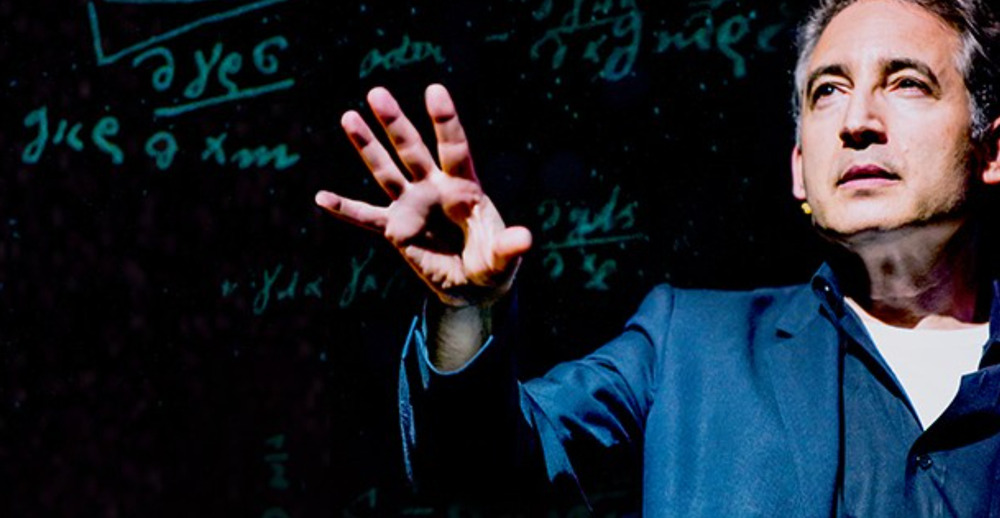
As a co-founder of the World Science Festival, Greene established a platform that brings together scientists, artists, and the general public. The project serves as a form of “science diplomacy,” integrating fundamental research into cultural discourse.
Brian Greene exemplifies a scientist who has successfully transformed complex theoretical models into an intellectual narrative accessible to a broad audience. His contributions matter not only to physics but also to science as a social institution. He helps legitimize complex hypotheses – such as multiverses – in public consciousness. On one hand, this expands society’s imaginative horizons; on the other, it sparks debate among scientists about the line between hypothesis and speculation.
Read also: Rare Earth Metal Situation: Whoever Controls the Resources, Rules the World
Does the fourth dimension affect our lives?
At first glance, it may seem that humans have no direct experience of a fourth dimension: we cannot see it, feel it, or measure it directly. However, the lack of empirical contact is not sufficient evidence against its existence. The history of science has repeatedly shown that many fundamental phenomena – from atomic structure to gravitational waves – remained hidden for long periods before being discovered through new observational methods.
In modern science, the fourth dimension is typically understood as time (in Minkowski spacetime). This means we already live in a “four-dimensional world”: three spatial coordinates plus one temporal coordinate. Our lives are fully defined by this framework – we move not only through space but also through time, from past to future.
From the perspective of contemporary physics, additional dimensions are not merely abstract hypotheses but could be key to solving several fundamental problems. They might help explain the nature of gravity, which is much weaker than other fundamental forces. There is also a hypothesis that dark matter and dark energy – together accounting for over 95% of the universe’s mass-energy – could be manifestations of a higher-dimensional structure of reality.
The significance of these assumptions lies in their potential to answer one of cosmology’s central questions: why our universe has the specific properties we observe. Even though current technology does not yet allow us to directly “peek” into a fourth or any other hidden dimension, the scientific search continues.
It’s important to remember that the lack of direct experience does not rule out the existence of higher-dimensional structures. The concept of additional dimensions could help explain fundamental phenomena that remain mysterious to modern science.

Advances in experimental research – particularly in high-energy physics and cosmological observations – could prove crucial in testing these hypotheses. Studying higher dimensions not only expands the boundaries of physics and cosmology but could also influence future technological progress, potentially revealing new ways to work with energy and matter.
It’s also worth noting that the fourth dimension is often perceived as a symbol of something beyond ordinary perception. Psychologically, it can represent the depths of the subconscious; in art, it serves as a way to depict another level of reality. In religion and mysticism, it is frequently used to describe the “beyond” or otherworldly space.
The fourth dimension already affects our lives, since it is time. We simply perceive it differently from spatial coordinates. As for any “other” additional dimensions, their influence remains hypothetical and awaits experimental confirmation.
Read also: Cryptography: What It Is and How It Works
One step away from a cognitive revolution?
Ultimately, it comes down to a fundamental question: is what we see and experience the full extent of reality? The history of science suggests otherwise – human perception has repeatedly proven limited, while the boundaries of what is possible have expanded through technological advances and new mathematical models. What once seemed unimaginable can become experimentally verified.
We don’t perceive the fourth dimension directly today, but that doesn’t rule out the possibility that future tools could allow us to interact with it, at least partially. Indirectly, through observable effects or deviations, we may already be encountering traces of it without even realizing.
So, if an additional dimension does exist, it’s entirely possible that we interact with it every day without having the language or tools to describe it. The real question is whether science will be able to uncover this hidden reality within our lifetime, and how our understanding of the world might change once we do.
Read also:
- How Chinese Companies Circumvent the US Ban on AI Chips
- How to Spot Fake Photos: New Challenges of the Digital Age
- AI in Medicine: Is the Future Already Here?
- AI Hallucinations: What They Are and Why They Matter

