




© ROOT-NATION.com - Use of content is permitted with a backlink.
Just as we were getting used to Wi-Fi 7, developers are already preparing the next generation of wireless networks – Wi-Fi 8. Here’s a closer look at what this new standard entails.
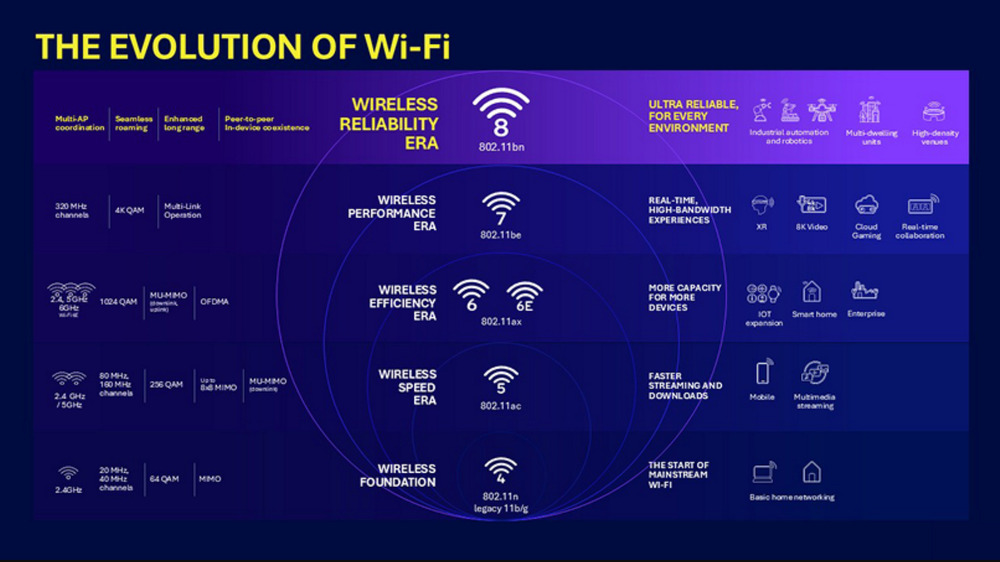
Wi-Fi 8, also known as IEEE 802.11bn, might come as a surprise for those expecting another record-breaking speed leap. Instead of chasing the next 50 or even 100 Gbps, developers are focusing on something arguably more important. Over the past decade, Wi-Fi evolution has often resembled an endless arms race – from the modest 150 Mbps of Wi-Fi 4 to the theoretical 46 Gbps of Wi-Fi 7. The issue, however, is that even the fastest router is of little use if the signal drops during a call or lags in the middle of a game.
Wi-Fi 8 will maintain the same peak throughput as its predecessor (around 23 Gbps in real-world conditions), but the main focus is on stability, reliability, and fair distribution of bandwidth among connected devices. In other words, the goal isn’t just to deliver ultra-high speeds, but to ensure that every device on the network gets its share without interruptions or lag. Ultimately, Wi-Fi 8 isn’t about breaking speed records; it’s about making the internet faster, more stable, and more predictable – as it arguably should have been all along.
Read also: Dual-Band Wi-Fi in Video Surveillance: How It Works and Use Cases
TABLE OF CONTENTS:
Development timeline – when will we see Wi-Fi 8?
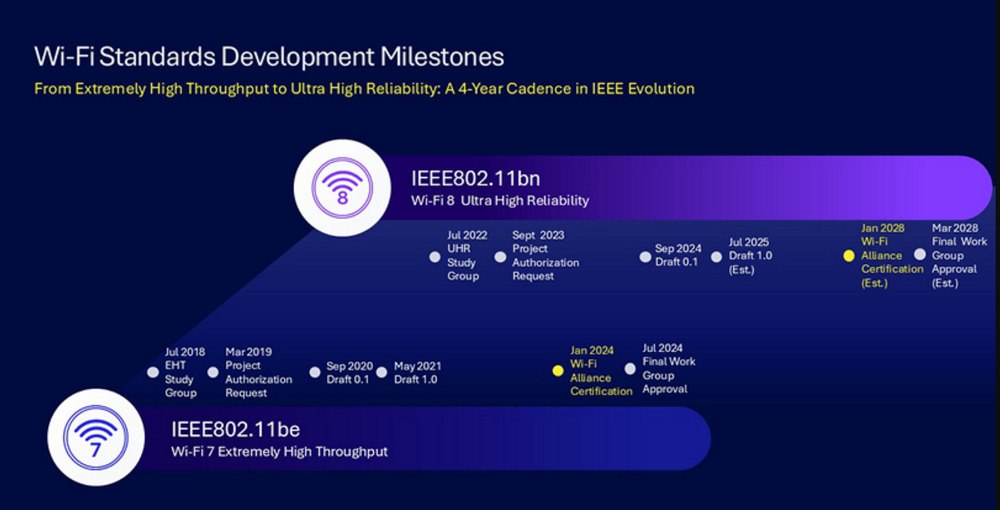
The IEEE 802.11bn working group began intensive development of the new standard in November 2023, and by July 2025, the first draft, D1.0, received official approval. This is a key milestone, as it allows chip and equipment manufacturers to start experimenting with prototypes based on the standard’s core architecture. The timeline is ambitious but realistic: the final specification is expected by March 2028, with the first Wi-Fi 8–compatible devices likely to reach the market in late 2027 or early 2028.
This is a typical scenario for the industry: for example, Wi-Fi 7 appeared in commercial products in 2023, even though the standard wasn’t officially approved until 2024. The reason is straightforward – the market can’t wait, as developing new chipsets takes 18 to 24 months. As a result, hardware and smartphone manufacturers usually “jump on the train” before it officially departs.
Certification from the Wi-Fi Alliance, a key step for widespread adoption, is scheduled for January 2028. This certification will mark the starting point for the broader market, as operators and major manufacturers typically won’t implement a new standard across millions of devices without it. This means large-scale rollout of Wi-Fi 8 is expected around 2029. Looking at previous generations, the gap between the release of the first “premium” devices and mass adoption has generally been about two years.
In other words, by the end of the decade, Wi-Fi 8 could become the new default standard – initially in flagship smartphones and corporate networks, and later in the broader consumer market.
Read also: ChatGPT-5 from OpenAI: What the New AI Model Can Do
A revolution in access point coordination
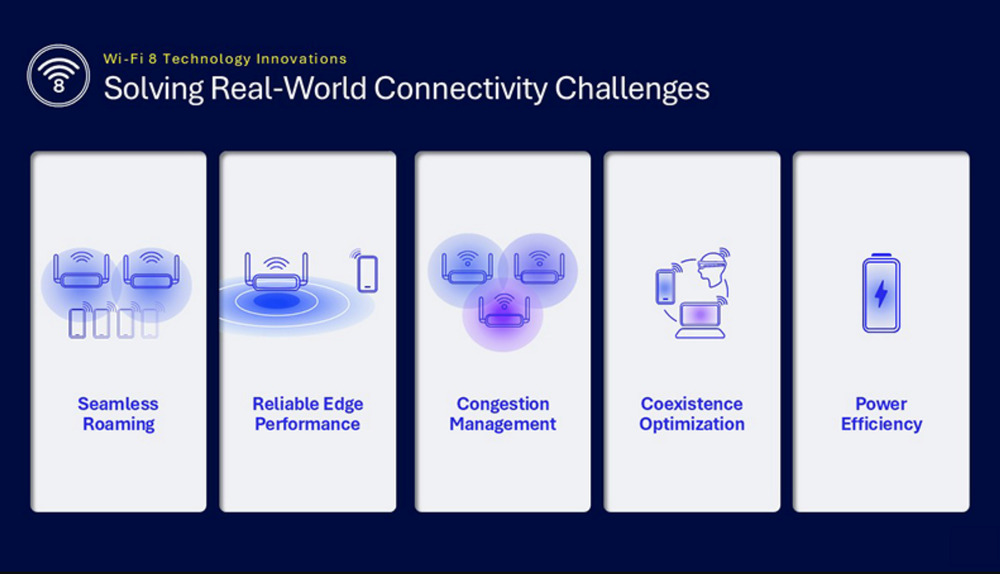
The most significant innovation in Wi-Fi 8 is Multi-AP Coordination (MAPC), a technology that could fundamentally change how wireless networks operate. While current mesh systems only simulate coordinated operation, remaining essentially as a set of relatively independent nodes, the new standard aims to turn them into a single “orchestra.” Instead of interfering with each other, routers will be able to synchronize their actions and make more efficient use of the spectrum.
Wi-Fi 8 includes two core mechanisms for this kind of coordination. The first is Coordinated Spatial Reuse (Co-SR), where access points automatically adjust their transmission power and select optimal channels to avoid interfering with neighboring nodes. According to MediaTek, laboratory tests show this can improve throughput by 15–25%. The second method is Coordinated Beamforming (Co-BF). This goes beyond simply avoiding interference, enabling multiple access points to actively direct their signals to reinforce each other. In dense network environments, this approach can boost performance by up to 50%, representing a significant step up in efficiency.
In essence, MAPC can be seen as an attempt to make Wi-Fi operate more like cellular networks, where base stations have long coordinated closely. If implemented as intended, Wi-Fi 8 could significantly reduce dead zones, improve stability in multi-story buildings, and deliver more predictable performance even in crowded environments. This is particularly important for emerging use cases, from AR/VR and cloud gaming to smart factories with thousands of IoT devices.
In other words, the main innovation of Wi-Fi 8 lies not in raw speed, but in the network’s collective intelligence.
Read also: Windows 11 Open Source: Myth or Reality?
Always connected
No more frustrating connection drops when moving from room to room. Wi-Fi 8 introduces the concept of Single Mobility Domains, a system that allows devices to switch between access points as if they were a single seamless network. The principle is straightforward: before the signal from the first router weakens, the device has already established a session with the next one. The result is minimal packet loss and reduced latency fluctuations.
Current mesh setups still struggle with this issue: smartphones often cling to a distant access point even when a stronger signal is nearby. This can cause delays in video calls, buffering in streaming, or noticeable lag in cloud gaming. Wi-Fi 8 addresses this problem at the standard level, rather than leaving it up to individual manufacturers to solve.
The significance of Single Mobility Domains goes beyond home convenience. In industrial settings, any interruption in connectivity can be costly – stopping a production line, causing a robotic arm to fail, or triggering critical errors in an automation system. Here, seamless mobility isn’t just a feature; it’s a fundamental requirement. A similar situation arises in healthcare, where medical devices and patient monitoring systems rely on a reliable, uninterrupted connection.
Essentially, Wi-Fi 8 moves toward a “quasi-cellular” architecture, where transitions between access points occur as predictably as in 4G or 5G mobile networks. This not only addresses common home issues like dead zones but also enables new use cases – from VR training systems in industrial environments to mobile robots in logistics.
Read also: How Chinese Companies Circumvent the US Ban on AI Chips
Improved edge coverage
Wi-Fi 8 aims to improve connectivity exactly where it’s currently weakest – at the edges of coverage. Areas like gardens, garages, distant office corners, or basements should no longer be “dead zones.” The standard introduces Extended Long Range (ELR) along with several physical-layer enhancements, which could increase signal reliability in challenging conditions by up to 25%. This involves not just boosting power, but also optimizing modulation, coding, and adaptive error-correction algorithms.
The practical impact is clear for any user. In areas where repeaters or additional access points are currently needed, Wi-Fi 8 can handle coverage on its own. This means less equipment, lower costs, and fewer “gaps” in the network where signal quality often dropped when switching between devices. As a result, video calls become more stable, streaming runs smoother, and VoIP calls remain clear even from the farthest corners of a building.
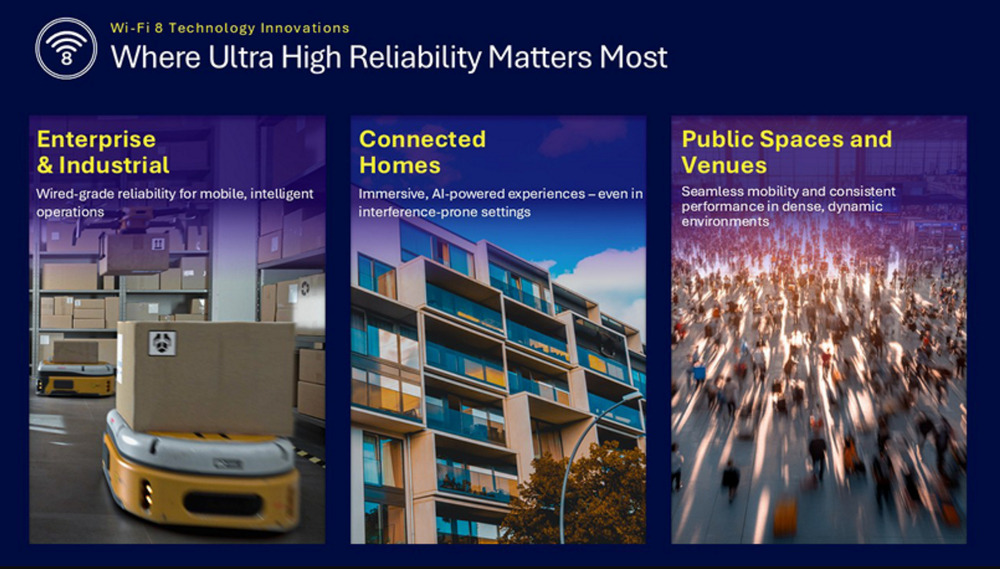
For businesses and industrial environments, this feature could be even more valuable. Warehouses, manufacturing floors, and logistics centers often suffer from weak signals due to thick walls and metal structures. Extended Long Range (ELR) can significantly reduce the number of access points needed to cover large areas, lowering infrastructure costs and simplifying network management.
In other words, Wi-Fi 8 takes another step toward making connectivity seamless, so users no longer have to worry about “where it works” – the internet should be available wherever it’s needed.
Integration with millimeter wave networks
Wi-Fi 8 could become the first standard to fully integrate mmWave bands with the traditional 2.4, 5, and 6 GHz ranges. While millimeter waves are still mostly experimental within 5G, Wi-Fi 8 may bring them to a broader audience. In theory, mmWave can deliver speeds up to 100 Gbps with latency under one millisecond, but it only works over very short distances and requires a clear line of sight between devices.
Integrating the mmWave band will be highly challenging. Millimeter waves are easily absorbed by walls, windows, and even the human body, and they require phased-array antennas and precise synchronization. Compatibility with existing Wi-Fi protocols, which were not designed for these frequencies, is another concern. For this reason, the IEEE is considering introducing a separate certification label – Wi-Fi 8E – to indicate mmWave support.
However, the potential benefits may outweigh the challenges. First, mmWave enables ultra-low latency, which is crucial for AR/VR applications, cloud gaming, and remote medical operations. Second, with extremely wide channels – over 2 GHz – the technology can support hundreds of connected devices within a single office or stadium without interference. Finally, mmWave could open the door to entirely new use cases, from wireless docking stations replacing Thunderbolt cables to uncompressed 8K video streaming.
Read also: Cryptography: What It Is and How It Works
Energy conservation in the Internet of Things
Wi-Fi 8 introduces fundamentally new power-saving mechanisms that affect not only client devices but also the access points themselves. AP Power Save allows routers to dynamically shut down unused resources, ranging from individual antennas to entire frequency bands. Preliminary estimates suggest this could reduce access point energy consumption by at least 28%. For enterprise network operators or data center managers, where thousands of devices are involved, the savings could be both significant and strategically important.
Another notable improvement targets the IoT ecosystem. Wi-Fi 8 introduces Coordinated Target Wake Time (Coordinated TWT), a mechanism that allows dozens or even hundreds of sensors to schedule precise moments to communicate with the router. Instead of constantly “listening” for signals, devices activate only when they need to send or receive data. This approach significantly reduces energy consumption and enables sensors that could operate for years on a single battery without maintenance.
An important aspect is that Wi-Fi 8 makes these mechanisms scalable. While previous TWT implementations mainly served individual devices, the new standard allows entire groups of sensors to coordinate. In a smart city, this could mean synchronized operation of thousands of air-quality sensors or surveillance cameras. In industrial settings, it enables stable network performance across hundreds of robotic modules.
In this way, Wi-Fi 8 aims to tackle two major challenges at once: reducing the energy consumption of network infrastructure and extending the battery life of IoT devices. If these mechanisms perform as the standard promises, Wi-Fi could, for the first time, serve as a universal wireless platform – not only for smartphones and laptops but also for billions of low-power sensors embedded in everyday environments.
Read also: Sex Robot Industry: New Rules in the Age of Technology
Industrial applications – Wi-Fi access in factories
Wi-Fi 8 is the first standard designed from the outset not just for home use, but also for industrial applications. While previous Wi-Fi generations were largely positioned as consumer technology, the focus now is on reliability, predictable latency, and scalability – factors essential for modern automation. This opens the door for Wi-Fi deployment in areas where wired networks or private LTE/5G previously dominated.
A key innovation is the emphasis on ultra-reliable connections and guaranteed Quality of Service (QoS). In industrial automation, mobile robotics, and quality control systems, network failures are unacceptable; even a few milliseconds of lost data can lead to accidents or production stoppages. Wi-Fi 8 introduces mechanisms to maintain stable connections at a level approaching that of wired technologies.
An example of this is autonomous warehouse robots (AGVs/AMRs) moving along production lines. With Wi-Fi 8, these robots can seamlessly switch between access points while transmitting critical real-time data, such as location, battery status, or detected obstacles. Similar capabilities extend to smart tools, which can automatically report information to Manufacturing Execution Systems (MES), enabling predictive maintenance before issues occur.
Another application is real-time quality control. High-resolution cameras connected via Wi-Fi 8 can stream video with minimal delay, allowing machine vision algorithms to analyze products on the assembly line. Combined with low latency, this enables fully automated factories where humans primarily act as supervisors.
In this context, Wi-Fi 8 is positioned not merely as an incremental “home Wi-Fi upgrade,” but as a versatile wireless infrastructure. If it performs as expected, it could mark the first step toward Wi-Fi and mobile networks complementing each other in industrial environments rather than competing.
Read also: How Chinese Companies Circumvent the US Ban on AI Chips
No access to the main channel: use of each MHz
One of the more “intelligent” innovations in Wi-Fi 8 is Non-Primary Channel Access (NPCA), which allows devices to use the spectrum without relying solely on the primary channel. If the main channel becomes congested due to neighboring networks, Wi-Fi 8 devices can dynamically switch to a secondary channel and continue transmitting data without dropping the connection. While this may seem like a minor optimization, in modern urban environments – where dozens of networks compete for the same spectrum simultaneously – this feature could prove crucial.
In high-interference scenarios, NPCA can nearly double the actual throughput by making more efficient use of available resources. For users, this translates to smoother video streaming, reduced latency in video calls, and more predictable performance in networks with a high density of connected devices.
However, the technology comes with trade-offs. Switching to a secondary channel effectively increases competition for that spectrum, which can negatively affect other networks operating in the same range. In other words, NPCA optimizes performance locally, but on a broader scale it can contribute to congestion in crowded bands. This creates a dilemma: a gain for one network might partially translate into a loss for a neighboring one.
On the other hand, these mechanisms illustrate a strategic shift in Wi-Fi 8’s philosophy: moving away from a blind pursuit of speed toward adaptive resource management. NPCA doesn’t widen the channel, but it allows networks to navigate bottlenecks more intelligently, ultimately giving users a perception of “faster” internet in situations where previous standards struggled.
What about backward compatibility?
Wi-Fi 8 will be fully backward compatible with all previous standards. A Wi-Fi 8 router will easily support devices using Wi-Fi 6, 6E, or 7, although those devices won’t benefit from the new features. This backward compatibility is crucial for adoption, as users won’t need to replace their existing equipment.
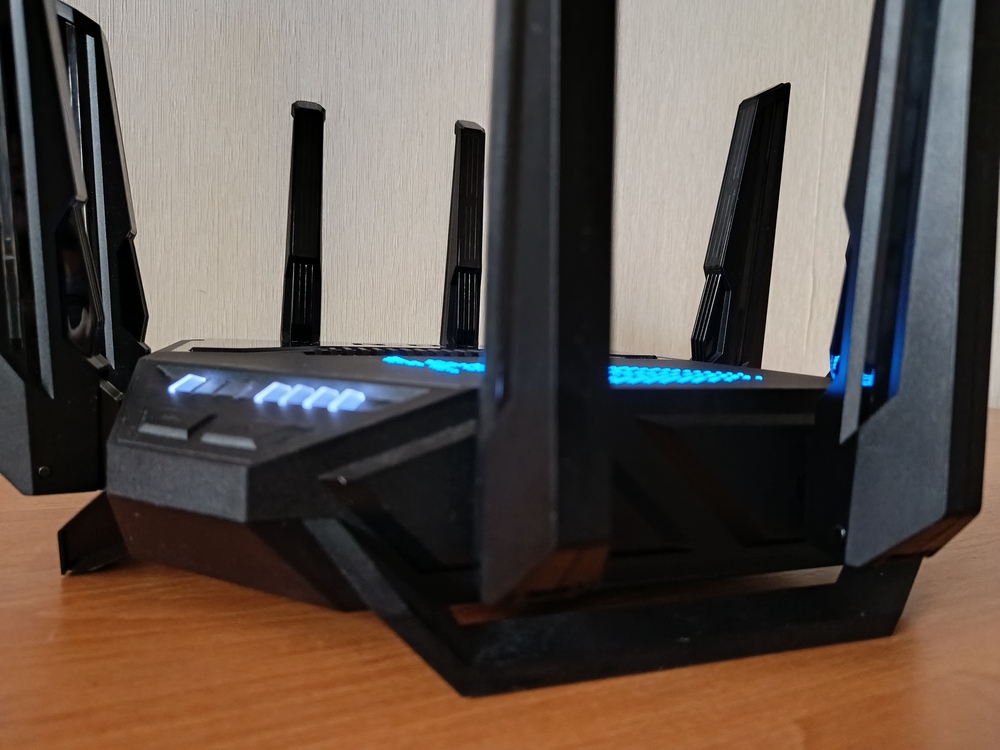
However, it’s important to note that the full benefits of Wi-Fi 8 will only be realized in homogeneous networks where all devices support the new standard. Multi-AP coordination and seamless roaming require the cooperation of the entire ecosystem – from the router through repeaters to end devices.
Read also: How to Spot Fake Photos: New Challenges of the Digital Age
Is it worth waiting for Wi-Fi 8?
If you’re planning to buy a new router in the coming months, Wi-Fi 7 remains the most practical choice. The standard is mature, compatible hardware is widely available, and the improvement in speed and stability over Wi-Fi 6 is immediately noticeable. For most users, this performance will be more than sufficient for the next few years.
Wi-Fi 8, however, represents a different approach. Its main advantages become apparent in specific – but increasingly common – scenarios: dense mesh networks in multi-story buildings, homes with dozens of IoT devices, warehouses with autonomous robots, or industrial environments where wireless connectivity needs to be as reliable as wired networks.
For a typical home user, the difference between Wi-Fi 7 and Wi-Fi 8 may feel less noticeable than the jump from Wi-Fi 6 to Wi-Fi 7. That said, this doesn’t make the new standard secondary. On the contrary, it lays the architectural groundwork for the next decade, where stability, predictability, and the ability to run hundreds of devices simultaneously without network chaos will matter more than raw speed.
Wi-Fi 8 is an evolution, not a revolution. But it’s precisely the kind of evolution needed in a world increasingly filled with smart sensors, AI-driven services, and applications demanding minimal latency. In this sense, Wi-Fi 8 is closer to the infrastructure of the future than any of its predecessors, preparing the network environment for a time when wireless connectivity becomes an invisible yet critically important part of daily life.
Read also:
- The Third World War of Browsers: Has It Already Begun?
- OpenAI’s New Superpower: What Is a ChatGPT Agent?
- AI in Medicine: Is the Future Already Here?

